Ted Bishop's Unfriended opens like a media crisis thriller, but ultimately is worth reading because of the gentle way the former PGA of America president shows how golf's five families work and takes you behind the scenes of Tom Watson's Ryder Cup captaincy. While serving as a golf tell-all that only genuinely exposes a few PGA of America officers as short-sighted given the absurdity of his offense, the book never makes you want to run for the shower. In fact, it's often hard to put down thanks to Bishop's brisk, breezy style that only occasionally slows down.
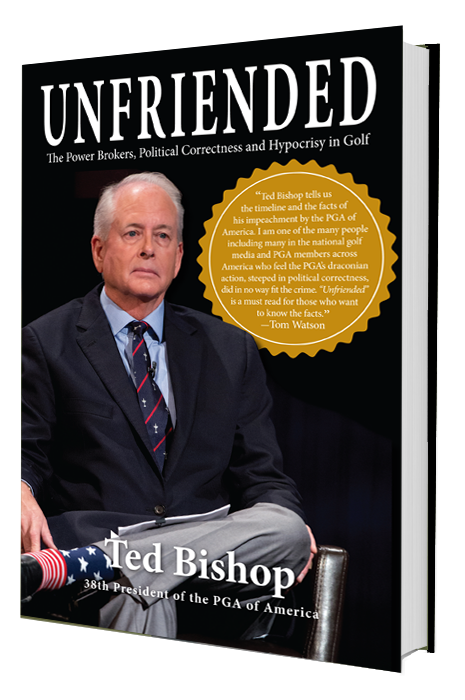 The book documents Bishop's extraordinarily productive two years as PGA President, which saw the organization's profile raised and the membership defended by Bishop. Things have flat-lined since with the PGA and it's little wonder that the downward trend coincides with Bishop's removal with 28-days to go.
Ted answers a few questions via email below. You can buy Unfriended here at Amazon that includes a Kindle edition, or should you support non-Amazon retailers and want a signed copy from Ted, visit this page.
Also, Ted recently joined us on ShackHouse pre-Ryder Cup. Here is The Ringer's page for the show.
GS: What was your goal in writing this book?
TB: My departure as the President of the PGA of America is unprecedented and historic. Political correctness has taken on a life of its own with the 2016 Presidential election and it makes my impeachment look even more bizarre. Unfriended was simply an opportunity for me to tell my side of the story with no filters from anyone, including the media. It was also a chance for me to share some of the great stories and memories that I have been privileged to be part of in golf.
GS: Did the PGA Of America attempt to stop the book from being published?
TB: The PGA made it difficult to write and publish my book. Ultimately, I had to seek the services of Levine, Koch, Sullivan & Schulz, one of the top First Amendment firms in the U.S. My lawyers determined that I had not violated any of my confidentiality or fiduciary duties to the PGA. That allowed me to press on with the book. I was fortunate that Classics of Golf publishing stuck with me through the PGA threats. In the end, I allowed the PGA to preview the book before it was published. In my opinion, that validates the integrity of the content in Unfriended.
GS: What’s the feedback been like since you published?
TB: People tell me the book is extremely interesting, entertaining and easy to read. They enjoy being "inside the ropes" on things such as the Ryder Cup plus getting to know the biggest names in golf like Tom Watson, Arnold Palmer, Tim Finchem, Donald Trump, Phil Mickelson and Tiger Woods. Golfweek said that the book "raises the curtain on the insular world of those who rule the game and offers rare insights."
But, I would also say that the politics in golf have worked against Unfriended to some degree. There is no question that certain media outlets won't touch the book because they don't want to get sideways with the PGA of America. That's too bad because the book does not reflect poorly on the PGA. People need to give Unfriended a chance. I suppose the title might have given some readers the wrong impression about the book's message, but Unfriended is a pretty fitting way to describe what happened to me.
GS: The book opens as a firsthand account of how not to handle a modern media crisis, which you openly share. Was this a bit of therapeutic writing or your effort to help someone down the road in a similar situation?
TB: It was definitely therapeutic to a degree, but the first couple of chapters were also very painful for me because I had to relive the events when I wrote about my departure. You are absolutely correct about helping other people out. Unfriended is far more than a golf book. It's a case study on corporate media relations, political correctness and social media usage. I would like to use the book as a spring board to speak at the corporate level about the responsibilities of leadership in the 21st Century. There are many valuable lessons that I can share and they are very interesting given the people that I associated with in golf.
GS: The account of the 2014 Ryder Cup is particularly interesting and puts the U.S. performance in good perspective. You also detail the beginnings of the Task Force concept, but now in hindsight you think it was unnecessary?
TB: The Ryder Cup Task Force was absolutely necessary. We had to change our approach and it obviously paid off with a U.S. victory this year. PGA Tour players are A-3 members of the PGA of America and they deserved a greater voice when it came to the Ryder Cup. That being said, I will always defend the PGA of America on its choice of past Ryder Cup Captains. However, Larry Nelson and Hale Irwin are certainly glaring omissions from several decades ago.
GS: Have you gotten a thank you from the Task Force you helped start, post-2016 Ryder Cup?
TB: Phil Mickelson left me a voice mail after Hazeltine and said, "I like the fact that you went out on a limb and brought the Task Force together even though you are not getting a lot of credit for that. It's a whole different feel than I have ever experienced before in my 20 years prior. l will never forget that first call I had from you about it. It's just one Ryder Cup, but we have something to build on now thanks to you." I appreciated that from Phil.
GS: You dealt with Donald Trump quite a bit during your tenure as President and speak highly of the interactions you had with him. What should the USGA and PGA of America do, if anything, with regard to events hosted at his courses? I was disappointed when the PGA chose not to play the Grand Slam at Trump LA.
TB: At the time, I thought that was a mistake.
It has been surprising to me that more of the media are not asking the PGA questions about the 2017 Senior PGA at Trump D.C. and the PGA Championship at Trump Bedminster in 2022 given his past comments that are certainly degrading to women. As the guy who was exiled from the PGA for calling Poulter a 'lil girl, I have been surprised that the PGA has softened its stance on political correctness with Mr. Trump.
But, like Mr. Trump, we have all done things or said things that we certainly would not want the public to know about. Trump has great courses and is a great host- so I say play on!


 From the story: