

Roundup: Tiger Returns In Thrilling Style, Fades To 73

This comeback was definitely different in tone. Just look at Doug Ferguson's list of previous Tiger Woods comebacks and you recall how many were forced, premature or just downright edgy.
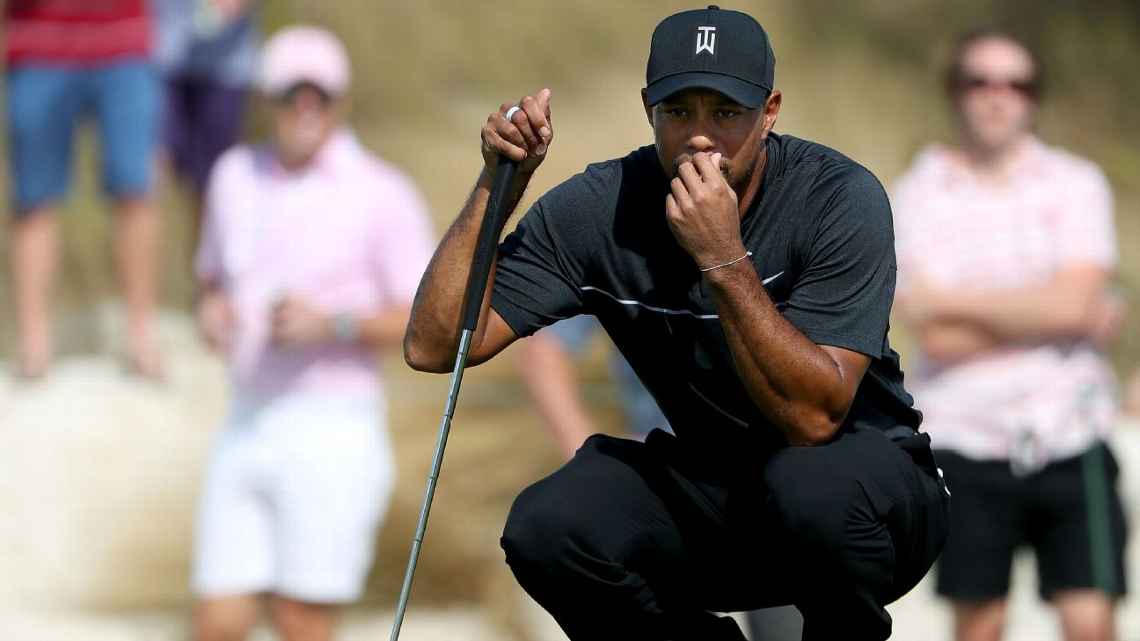
This time around anyone with an ounce of soul did not want to see another boondoggle. Mercifully for golf and Tiger, the 14-time major winner put on a strong early show before succumbing to the fatigue of a hot day, enormous pressure and a lack of tournament seasoning after a long layoff.

Of course, in classic Tiger fashion, he refused to admit to fatigue. That might just be the best evidence he's his ownself again.

Jason Sobel noted this classic stubbornness in his account for ESPN.com:

This was a textbook round for someone who hadn't played in a while: Make a few nervy pars just to ease away the tension; ride the wave of adrenaline up the leaderboard; get overtaken by fatigue down the stretch.

If we needed further proof, though, of Woods' return to familiarity, it came after the round, when he wouldn't acquiesce to that last observation.

He was asked a reasonable question about whether he'd run out of gas before making those two doubles.

"I wouldn't say that," he offered. "I just made some mistakes."

Michael Collins, talking to Sportscenter, also pointed out that post-round, Tiger did not come across as someone physically compromised.

Will Gray at GolfChannel.com makes the shrewd point that the strong start to the round makes this a much better feeling 73 than one in which Woods was just so-so all day.

Had Woods more evenly dispersed his scorecard, had one of his closing doubles instead come amid the three-birdie run that highlighted his opening nine, perhaps the tinge of disappointment might have evaporated. But he didn’t, and they didn’t, and a 73 is more difficult to stomach after Woods appeared on his way to something in the mid-60s.

In case you have a real job and missed it, here is Golf Channel's highlight package.

Alan Shipnuck, writing for Golf.com, offers his overall assessment as a long time Tiger observer, some more elaborate comments from former swing coach Hank Haney and this on the first tee mood scene:

He was dressed in a badass all-black ensemble, befitting the high noon tee time. The World Challenge is a mostly meaningless hit-and-giggle event, but the tee was crowded with reporters, cameramen and assorted rubberneckers. The most dominant golfer of all time does not have the luxury of easing back into competition. The mood was tense, even fraught. As Woods settled over the ball, waggling his discordant new TaylorMade driver, it was so funereal quiet you could hear decorative flags flapping in the distance.

Former swing coach Haney also offered this Tweet:

Steve DiMeglio of USA Today saw enough to declare more wins in Tiger's future.

As long as his body — and especially his back — holds up, Woods will lift championship hardware again. Doesn’t matter if he’ll turn 41 on Dec. 31. The game’s needle will trigger appreciative cheers in trophy ceremonies on the 18th green in the future.

Another longtime Tiger watcher who has seen his share of antics, also had a positive assessment.

Jeff Babineau at Golfweek includes a lot of Tiger playing partner Patrick "Pat" Reed, as well as this:

Cool to see, yes. Tiger Woods, back in action, the round moving like a movie reel, giving us glimpses of the familiar. He pounded a drive 20 yards past Reed, a long knocker, at the third, and roped a 5-iron from 235 yards on the same hole that soared through the air on a string. He enjoyed that one. The ball would run out over the green, but it gave Woods some confidence. When he poured in a 16-foot left-to-righter at the short 14th to save par after being in a sandy area AND a bunker, there was a fist pump. The adrenaline was pumping.

And for Tigerphiles, in case you missed it, Mike Johnson filed an interesting GolfDigest.com look at what it's like to work with Tiger when he's club testing.

Tiger tees off at 11:12 am ET Friday, with Morning Drive and Golf Central bringing early play highlights before the 1 pm telecast.

Roundup: Tiger To Begin "Phase Two" Of His Career

Euphoria, multiple eagles and high-level anticipation! it's all in the Bahamas air as Tiger is finally back! Shoot, the first birdie back may lower his Masters win odds to 5-1. Even the jargon (ballistics!) has been sharp and the almost-funny one liners are back.

All is right with the world!

Oh sure there is a long way to go. The body looks understandably tight (see Tripp Isenhour's breakdown at the 6 minute mark of today's Golf Central). But the swing rhythm and reports like this one from Jeff Babineau sound promising:

Maybe more impressive were some of the low, laser-like long irons he hit into the teeth of the wind on a few of Albany’s difficult par 3s, such as the eighth, playing about 230 yards, where he knocked a tee shot 12 feet past the flag and missed the putt.

As Tiger prepares to launch what is apparently been dubbed "Phase Two", Will Gray notes at GolfChannel.com that there will be entertaining mood swings that may prove more entertaining than the golf.

Sure, some feedback will be gleaned. His swing will inevitably be dissected from all angles, and the short game that bogged him down so often last year will be on full display, for better or worse.

And given such a small sample size, dangerous levels of extrapolation are sure to follow. Every made birdie will mean a 15th major is a fait accompli; every flubbed chip will lead others to question if his career has officially run its course.

Tiger is feeling the good vibes of his time at Hazeltine, as the U.S.A. Ryder Cup team wore onesies and red t-shirts emblazoned with "Make Tiger Great Again" to honor their assistant captain, writes Jason Sobel at ESPN.com. More fascinating may be how much the players want to see him play well again:

"We want our champion back," Bubba Watson said. "We want our Tiger Woods back. We want him playing again."

"He's still just turning every head when he walks into the dining area," added Spieth. "Or if he's on the driving range, I mean, everybody's looking up to see him hit some shots. I was doing it this morning, interested obviously."

Given how long he's been away and how many surgeries Tiger has been through, expectations probably need to be tempered though, as Paige Mackenzie and I discussed today on Morning Drive with Whit Watson.

Tiger will pass 150 or so players just by finishing the Hero World Challenge, even if he finishes last, Bob Harig notes at ESPN.com. Shouldn't there be some sort of ranking points penalty for tournaments of a certain (miniscule) size?

The subdued energy level from his post-pro-am round interview could be read one of two ways: this is just another Hero World Challenge and I've been doing this too long, or, I'm trying to make it sound like this is another Hero World Challenge and that I've been doing this too long.

Tiger tees off at noon ET Thursday. Golf Channel will present Morning Drive starting at 10:30 am. The show will include live shots of Tiger warming up, along with more of our Design Week coverage. At 11:55 Golf Central will take over and provide bonus coverage before the regularly scheduled 12:30 ET start.

LPGA At 22 Domestic Events, U.S. Women's Open A $5M Purse

The momentum of the LPGA Tour's business side continues under Commissioner Mike Whan's tenure, with purse increases at the majors and 22 events in the United States (but three domestic events disappear, including the Swinging Skirts at Lake Merced). 

Randall Mell notes the new events for GolfChannel.com as well as the purse increases.

The new schedule features four new events, the Aberdeen Asset Management Scottish Ladies Open, the McKayson New Zealand Women’s Open, the Indy Women in Tech event at Brickyard Crossing in Indianapolis and the Thornberry Creek Classic in Green Bay, Wis.

This Golfweek report notes the return of match play in a revamped Lorena Ochoa Invitational and the USGA's $1 million purse increase at the U.S. Women's Open.

On the match play event and the dying events.

The biggest surprise of Wednesday’s announcement is that match play will return to the LPGA schedule for the first time since 2012. The Lorena Ochoa Invitational, a tournament that struggled to get a strong field in recent years, will transition into the Lorena Ochoa Match Play and will feature a field of 64. The event will also move from the fall to the spring and will be held at Club de Golf México in Mexico City, the tournament site since 2014.

Three domestic events, the Yokohama Tire LPGA Classic (Prattville, Ala.), Swinging Skirts LPGA Classic (Daly City, Calif.), and Coates Golf Championship (Ocala, Fla.) will not return. 2017 will mark the first time the LPGA hasn’t competed on a Robert Trent Jones Golf Trail property in 19 years.

World Cup And Kingston Heath As Entertainment

A little lost in all of the Tiger talk this week: the resounding success of the World Cup of Golf. As we discussed on Morning Drive, the format seemed to work well. But it was Kingston Heath that stole the show.

Mike Clayton filed some thoughts on what made the week such a sucess in spite of silly driving distances and also offered this observation about the course's best moments.

More interesting and entertaining to watch was how the field played the short par 4 4th hole (the club’s normal 3rd) There was a wide variety of clubs played from the tee in Saturday’s foursomes play with Rickie Fowler leaving Jimmy Walker a full nine iron to the flag while Soren Kjelsden, the shortest of the top players last week, left his partner Thorbjorn Olesen with barely anything more than a chip from the perfect angle.

A few matches ahead the New Zealanders Ryan Fox and Danny Lee made a comedic mess of a seemingly simple hole by playing it completely the wrong way despite hitting two perfectly good looking shots.

Tiger Explains His Commitment To Safeway And Then A WD

I listened to Tiger's press conference on satellite radio and have read many of the takes from his big return to the media center stage. He sounds like the old, confident Tiger comfortable in his skin and in his ability. But also also threw out the usual bingo board jargon and a few weird answers that make you wonder.

For me, it was hard to reconcile his answer about WD'ing from the Safeway Open with any image of a more mature, responsible Tiger Woods.

Jay Coffin at GolfChannel.com with the answer.

“One, the Ryder Cup helped a lot in the sense that I got a chance to be out there with the guys and see it and feel it and experience it,” he said. “Two, it hurt me by not being able to practice for a week.”

Which then led to a Friday commitment before?!

Here's where flags really rise...

Woods said that he could’ve played Safeway with limited go-to shots in his arsenal but it wasn’t worth the risk to do that on a golf course he hasn’t played since his college days, 20 years ago.

It's Silverado, not St. Andrews!

“As hard as it was on me to take it off and pull out of the event, it was a smart thing to do even though as a competitive athlete it killed me,” Woods said. “But if I’ve waited at the time, what, 13 months, what’s another couple more months? So let’s be a little patient, a little easier on myself, a little smarter and let’s come back when things are a little more together.”

So he wasn't ready. We all would have understood.

Why not just admit that it was a blunder, apologize for entering on a Friday before withdrawing on Monday after a bad weekend, and beg for the forgiveness of those who planned on attending to see you?

Weiskopf's Torrey Pines North Re-Opens

Tom Weiskopf was on hand to christen his remodel of Torrey Pines North and while it sounds positive in its sensitivity toward the everyday golfer's needs, nearly every photo shows very distinct step-tiers in the greens. Which, I realized after seeing them in images, has become such an increasingly rare look.

Anyway, John Strege offered this for GolfDigest.com:

Toward that end, Weiskopf has reduced the number of bunkers from 60 to 42 and made them generally easier from which to play. Average green sizes have increased from about 4,500 square feet to 6,000 square feet. He’s added his signature touch, a drivable par 4, the new seventh hole. The fairways are marginally wider and he’s softened playability in areas fronting the greens.

“My philosophy is to put the penalties on the side of holes,” he said. Penalties are not directly in front, so people can play by missing the ball in front of these greens and still have a good pitch or a chip and even a long putt.”

Kirk Kenney noted Weiskopf's devotion to the project in a San Diego Union-Tribune story that also seems to be accompanied by John Gibbins' photo gallery (I couldn't get more than one image, maybe you'll have better luck).

Weiskopf, 74, and his wife Laurie moved to Del Mar during the 5 1/2 months of the redesign so that he could stay on top of the project.

He observed golfers on the course during the month before construction began to gain insight that improved initial ideas. He listened to concerns of golf members at meetings. And he shared with them his ideas.

One of the major changes was swapping the front nine, featuring the course’s most scenic ocean-side holes, with the back nine. The idea received unanimous support by the time Weiskopf had explained his reasoning.

“I just think this is your brand,” he said. “The ocean, that beach, these ravines, the distant view that we catch down to La Jolla. San Diego, the pier and the surf breaking."

Architect Kidd Claims Media Seduced Him Into Excessive Design

The media has been blamed for many things, but I'm fairly certain architect David Kidd took things to another level in suggesting his much-derided, since-renovated Castle Course at St. Andrews was the fault of others. 

Kidd was challenged by "the media", starting with former Golfweek publisher Alex Miceli:

This would suggest he designed to play to a ranking. While many architects have surely been influenced in some way by ranking criteria, blaming it for an unsuccessful design seems out of line.

And this reply to Golf World's John Huggan:

It is an unfortunate state of affairs when resistance to scoring is a ranking criteria. And the golf ball quickly outdated some pretty stellar courses. But blaming such outside forces appears short-sighted and, at best, should at least spark discussion toward remedying both blights on the game.

"What is it that the rule makers of the U.S. Golf Association have against golfers, like me, of a certain age?"

Alfred L. Malabre Jr. is a retired WSJ editor playing golf in Charleston and not really caring much for the USGA's anchoring ban or its rules against posting solo rounds for handicap purposes.

Given that the Journal is the paper of record for Executive Committee members, this one no doubt caused internal calls for a rebuttal. The handicapping complaint was compelling.

For those of us who play most of our rounds alone, that means fewer rounds will count toward calculating a handicap, which very likely will mean a less accurate handicap. That’s no small thing on those rare days when I do compete against friends for a few dollars.

Writing of the joys of solo golf in The Wall Street Journal in 2013, I noted enthusiastically that a solitary golfer, using however many handicap strokes may be allowed, may compete quite happily “against the course” and “record an accurate score.” This score, in turn, may be submitted, I wrote, so as to maintain an accurate handicap.

But no more. Now I am instructed that I must bring along at least one “companion” to verify my score before submission. Would my 10-year-old granddaughter do if she knows the rules? If the purpose of this new ban is to keep me honest, why not let me simply post my score and then agree to a polygraph test at the 19th hole? Or better yet, why not just keep counting on the honesty of golfers?

Rio Golf, Brinkmanship And The Future

To kick off Morning Drive's Design Week, we had to discuss the sad news out of Rio that not a thing has changed with the ownership, operational obstacles and overall state of affairs.

And I spoke with Gil Hanse to get the architect's side of things. Having seen just about everything imaginable there, he offered that he was bitterly disappointed but also said this for our Monday Golf World.

“We witnessed this type of brinksmanship during the construction of the course, and we are hopeful that this is another example of having to hit a low point before things get better.”

A friend emailed to say he debated the Rio golf course situation and came down on the side of letting it fail, with a quick return to the capybaras and many birds that have taken up residence. Given the poverty issues in Rio, the corruption of its government and the well-documented troubles of the past, I get that point of view.

In fact, I'd support walking away if the golf course and Brazillian Golf Federation had given things a shot and things just didn't pan out. But since we learned the course does not have signage, a website or any sign that an attempt is being made less than four months since golf made a magnificent return to the Olympic Games, it just doesn't feel right for the course to not have been given a chance to excite young players, test burgeoning ones or take the money of folks who want to test a brilliant design amidst a thriving natural environment.







