For The Love Of (LPGA) Looping
/Ron Sirak hung out for a week with a group of LPGA caddies
Read More
It’s back!
Twenty years later Tatra Press has kindly allowed me to bring back Grounds For Golf now that golf architecture is of more interest to the masses. A new Introduction looks at what’s driven the interest growth and two new chapters I had a blast adding (plus a few edits to keep things up-to-date).
The Amazon purchase page for the book arriving June 15, 2026.

As the Masters approaches I'm not sure there is much to read into Dustin Johnson's WD from the Shell Houston Open following his WGC Dell Match Play, citing fatigue that surely wasn't helped by those 2-a-day Soulcyle classes last week.
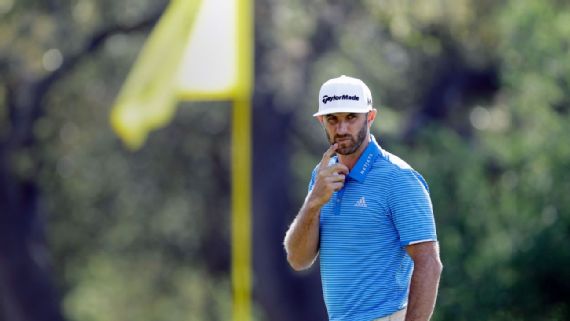 Bob Harig reports for ESPN.com:
"After a great deal of thought and consultation with my team, I have decided to withdraw from this week's Shell Houston Open,'' Johnson said in a statement. "Having played seven rounds of competitive golf in the last five days, I feel it is best to give my mind and body a much-needed rest heading into Masters week.''
Meanwhile Jason Day says he hasn't touched a club since his match play WD and a Masters appearance will depend on his mom's prognosis.
From an AP story:
“It’s very, very difficult to even think about playing golf when a loved one is going through such a traumatic experience,” Day said. “Once I get past this initial stage, hopefully I’ll find some balance and I’ll be able to kind of move on and really focus on getting my game back.
“Unfortunately, I’m human. I like to feel like I’m always on it, I’m always … ready to go and trying to compete and I want to get back to that stage but sometimes it’s very, very difficult.”
Tim Finchem's greatest legacy may be his support of match play despite annual consternation over a format that literally grew the game. After three years of round robin guaranteeing players three matches, there is still some kvetching about the loss of knockout dramatics, but even after a year where two WD's had the potential to issue a fatal blow, the WGC Dell Match Play was an enormous success: high energy, international intrigue and so much great skill on display. As I wrote for Golfweek's weekly issue, match play is enjoying a renaissance through some strange combination of Finchem's devotion to saving the format, the move to round-robin play, the increased affinity for team match play events and the high risk, huge reward alternation in NCAA team format.
Match play is cool again.
Considering that the sport was built on match play centuries ago its little wonder that Jordan Spieth said last week it should be deciding a major. Television ultimately put the kibosh on a return of the format, making it ironic that television now embraces match play because of the faster pacing, raw emotions and overall excitement it brings.
In our ADD world, each match has stories to tell and each hole produces a result. And in our crowded sports landscape, worrying about filling 33 minutes of post-match dead time takes a back seat to putting forward an event generating buzz.
This long post will try to resolve how the WGC Dell Match Play can get better and how can we work more match play into the schedule?
Two Small WGC Tweaks
The first is simple: lose the halves. Fans and media are asked to work too hard during the round robin play trying to figure out pod scenarios which include half-points for halves. They are not interesting and sudden death playoffs add much-needed tension to the first three days.
The second solution would not have had a huge impact in 2017, but should be considered and was suggested to me by fine souls not seeking credit: reseeding after round robin play by world ranking. The NHL seeded its playoff teams for several years and then reseeded after each round to reward top seeds. But due to travel-planning issues, the practice ended in 2014.
Given the randomness of the initial bracketology in the WGC Dell Match Play, the emphasis should be on giving higher seeds some reward for their standing while giving fans hope for the occasional dream match up. Consider what the weekend bracket would have looked like after a reshuffle of the group winners by their tournament seeding, not the placement of their bracket pools:
Dustin Johnson (1) vs. Soren Kjeldsen (62)
Alex Noren (8) vs. Charles Howell (61)
Paul Casey (12) vs. Hideto Tanihara (54)
Bubba Watson (13) vs. William McGirt (48)
Phil Mickelson (14) vs. Ross Fisher (47)
Brooks Koepka (20) vs. Kevin Na (46)Jon Rahm (21) vs. Zach Johnson (44)
Marc Leishman (28) vs. Bill Haas (42)
Again, this is for years when the ranking form holds better and seems like an easy solution.
More Match Play Options
As I noted in the Golfweek piece, European Tour Commissioner Keith Pelley is all-in on match play due to its faster, edgier elements as well as providing tangible results to chew on during Thursdays and Fridays. He is said to be quite protective of the new Perth stop and has introduced a team match play event called Golf Sixes this May.
So before you vote, I'd like to nominate some other fomats. Naturally I want to see them all but realize it's likely unrealistic on a crowded schedule. Then again, after Zurich enjoys much admiration for its new better-ball format this May, other sponsors may be looking to alternative formats. Here are the five I could come up, though I'm sure there are others. --Four ball. Imagine the fun of two-player teams, only at match play. The players pick their partners ala the new Zurich Classic format. I'm suggesting best ball instead of some combination including foursomes play because...yep, it's for the stymie!
Imagine the intrigue of teammates nursing a putt up to stymie the opposition! The strategic and dramatic possibilities would make this must see TV, and it would be good to see players play the ball down again on the green. Shoot, we'll let you clean your golf ball even, but then you must replace so that the fun can begin.
--9-hole round-robin and 9-hole matches. Why not just cut the entire thing in half? Shorter matches with more urgency legitimizing the 9-hole round.
--Stroke play, followed by knockout. This is a solution suggested to remedy the WGC Match Play when it was under fire would give players two rounds of stroke play qualifying that determine seeding. Matches are then played in a traditional single elimination bracket.
--Corporate or nationality. Team match play is beloved, so why not have an event that is a miniature version of the major international events or the NCAA team format? The European Tour's GolfSixes is using two-person teams by country. How about three or five person teams by corporate affiliation of some kind? Team RBS, Team Titleist, Team Mercedes, etc...
--PGA Championship. What if the top 32 players are exempt from two rounds of qualifying? Perhaps as with the Ryder Cup, there is a PGA Championship points race that determines the exemptees and helps build excitement for the event. Once the matches start, every now and then a club pro might qualify and face a top player in round one. Better yet, the PGA would have an epic identity.
Ok, vote away!
As the PGA Tour leaves Austin and the spotlight on the dire Lions Muny situation there--Adam Schupak at MorningRead.com filed a nice look at the place and the fight--we at least get to hear a happier story in Houston this week.
 Rendering of renovated clubhouse at Gus Wortham ParkUnder the leadership of Steve Timms, President/CEO of the Houston Golf Association, the organization has turned the Shell Houston Open into a must-play tour stop for many pre-Masters. They are behind the effort to save Gus Wortham Park Golf Course, a potential model for other communities.
In year 16 as tournament director, I asked Steve to answer a few questions about how they structured the effort to save Wortham and also the upcoming end to Shell's run as sponsor. Timms also oversees the largest First Tee chapter in the U.S.
Given the importance of this topic in so many cities across the land, we all know how important it is to hear from those successfully tackling this vital issue for golf. Oh, and to see the project underway!
GS: Explain how the Houston Golf Association got into the management and renovation effort at Gus Wortham, and the role Shell Oil Company played?
ST: In 2014, Houston Golf Association (HGA) assumed operations of F.M. Law Park Golf Course, taking over maintenance and turning the public golf course into a dedicated The First Tee (TFT) Facility. That same year, we learned about a proposal to turn the historic Gus Wortham Park Golf Course into a botanic garden. As advocates and stewards of the game, we felt it was our duty to help save this golf course and restore it to its former glory.
Houston Golf Association, backed by the financial engine of the Shell Houston Open (and Shell Oil Company), was in a position to pursue a solution to manage and operate the courses, raising private funds as a nonprofit self supporting enterprise to maintain facility quality for years to come. Given our proven track record maintaining F.M. Law Park Golf Course, City Council unanimously approved a resolution that Gus Wortham would remain a public golf course operated by the HGA. As we approached our second fundraising milestone needed to initiate the construction start, Shell Oil Company stepped up to provide funds needed for the proposed community center.
 The Gus Wortham Park property has much potentialGS: Is the non-profit model for this much-needed work something you see as repeatable in other cities with tired courses or is this unique to Houston?
ST: The original non-profit model was implemented in Baltimore in the late 80s. We feel that this model is applicable in other cities because it has six main benefits:
1) Lessens the financial burden on the government
2) Sets up a sustainable business model (long-term operating lease agreement in our case)
3) Allows for private fundraising to upgrade the facilities
4) Allows cash flow generated from the facilities to be reinvested back into the facilities (by design as a nonprofit)
5) Improves accessibility of affordable golf, and in our case, extends our youth programs (The First Tee of Greater Houston and HGA Junior Golf) into more underserved communities
6) Acts as economic development stimulus in the surrounding communities (in our case, Houston’s East End)
GS: Are you looking at ways to revitalize the other city courses?
ST: Yes. We have developed an overall master plan for four additional facilities that’s currently being evaluated. We are also proposing the establishment of a new The First Tee location on an old golf course property, Inwood Forest, whose land is owned by the City of Houston.
GS: What has been the most difficult aspect for your organization in getting this restoration/revitalization effort going?
ST: In January 2015, we signed the contract with the city and were required to raise $5M by the end of that year -- a time period that was challenging for fundraising. Now, with our fundraising needs met, we are experiencing the normal challenges of any organization involved in a major, multi-phase construction project. We are seeing great progress though and are excited about the project’s eventual completion later this year.
 Construction underway at Gus Wortham ParkGS: From your perspective, what are some of the best ways to “grow the game” and attract new junior golfers?
ST: We think it’s important to attract young people and pique their interest in golf at an early age. Through The First Tee of Greater Houston, we reach almost 300,000 students in 455 schools throughout Houston. Access and affordability are also important in trying to foster interest. Public golf courses serve as a key expansion of our The First Tee program into underserved communities. These courses, when revitalized, can provide kids from every walk of life with a place to practice, grow their skills and move into competitive opportunities like our HGA Junior Golf program.
GS: Have you seen any impact from the Drive, Chip and Putt Championship in the Houston area?
ST: We are proud of our two The First Tee participants, Ariana Saenz and Bella Saenz. Ariana qualified for the Drive, Chip and Putt in 2015. Now her sister is following in her footsteps. Bella is headed to Augusta to participate in the 2017 competition. The fact that they are sisters has certainly generated a lot of buzz and excitement in our community.
GS: What is the hoped-for best case scenario for the Shell Houston Open going forward as it looks for a sponsor and the PGA Tour potentially juggles the schedule in a few years?
ST: As our 26-year partnership with Shell wraps up, we are continuing to work hard to secure a new title sponsor that will help us continue to do so much in our community. We have enjoyed success with our date before the Masters and hope to keep that date on the schedule, which is dictated by the PGA Tour.
**We discussed this effort on Morning Drive today.
Not since Tiger Woods--with Jordan Spieth's 2015 possibly in the mix--has a player been so expected to win, as Doug Ferguson noted in his 2017 WGC Dell Match Play lede:
The final day lasted longer than Dustin Johnson wanted. The outcome was what everyone expected.
 After beating Jon Rahm 1 up despite a valiant comeback by Rahm, Steve DiMeglio notes for USA Today that even the opponent is in awe.
"It's amazing how he's able to keep cool the entire round," said Rahm, who beat Bill Haas, 3 and 2, in the semis. "He's just a perfect, complete player."
In addition to beating Rahm and Tanihara, Johnson topped major champions Webb Simpson, Martin Kaymer, Jimmy Walker and Zach Johnson. He also beat Alex Noren in the round of 16.
Not a bad roster of players he knocked off!
Rex Hoggard says that Johnson is insisting it's not as easy as it looks:
Dominant? Sure, just don’t call it easy.
“I mean, some days it does [feel easy],” Johnson said. “But about 95 percent of the days it does not. But some days, yeah, it's easier. I feel like when you're rolling in putts, that's when the game gets pretty easy.”
Hoggard also notes this on Johnson's run:
Since winning the U.S. Open last June, Johnson has won six of 17 starts, including the WGC-Dell Technologies Match Play in dominant fashion. That’s a 35 percent winning clip that includes a major and three World Golf Championship keepsakes to become the first player to claim all four WGCs
ESPN.com's Jason Sobel pointed out arguably the most impressive stat of the week in considering how easy Johnson makes things look:
These are the words of a player who went 112 holes this week and never trailed. A player who competed against seven world-class opponents and, one by one, watched them retreat like he was playing a five-day-long game of Whack-A-Mole.
Todd Lewis's interview with Johnson for Golf Channel immediately after play:
Johnson takes home a nice check, but also some sweet loot:
A post shared by Golf Magazine (@golf_com) on Mar 26, 2017 at 5:02pm PDT
Check out the player gift from Dell that Johnson Tweeted:
Thanks to @Dell and @DellMatchPlay for the cool player gift this week! Custom guitars! pic.twitter.com/Glok9gcoco
— Dustin Johnson (@DJohnsonPGA) March 21, 2017
The final round highlights from PGA Tour Entertainment.
**The 324 must have been into the wind...
Dustin Johnson's drives on No. 12 at @DellMatchPlay
— PGA TOUR (@PGATOUR) March 27, 2017
• 401 yards
• 419 yards
• 325 yards
• 325 yards
• 346 yards
• 394 yards
• 424 yards pic.twitter.com/s8EAMYGLQ8
Hideto Tanihara collects the fourth ace in Dell Match Play history and continues an epic week in Austin on his way to a visit to Augusta.
🚨 ACE ALERT 🚨
— PGA TOUR (@PGATOUR) March 26, 2017
Hideto Tanihara collects the fourth ace in @DellMatchPlay history. #QuickHits pic.twitter.com/8Opgn6KR5V
I really love this final group of four in the 2017 WGC Dell Match Play and here's why:
-Dustin Johnson, the best player on the planet.
 -Jon Rahm, Spaniard trending to become the best player faster than even his biggest cheerleaders expected.
-Bill Haas, immensely talented veteran who plays quickly, yet overcame Kevin Na's horrific pace and is also peaking in time for Augusta.
-Hideto Tanihara, hard-swinging Japan Golf Tour vet who puts the world in World Golf Championship. Oh, and he's going to the Masters now, Rex Hoggard notes for GolfChannel.com.
Doug Ferguson's AP game story has Johnson and Rahm trending toward the final based on their stunning dominance.
Ron Green Jr. for Global Golf Post delves deeper into the ways Johnson and Rahm have dominated.
Rahm has a chance to be the event's youngest winner, writes Ben Everill.
The 13th hole will figure prominently in Sunday's matches, but Dustin Johnson won't be driving it, writes Hoggard.
The 12th hole has proved pivotal again and it's one of the better holes Pete Dye has designed. I can't wait to see where the flag is placed on the double plateau-ish green Sunday. However, beware of bailing right, as I noted for Morning Drive in this short on-course segment.
In the ShackHouse bracket, Mike.E.Jensen takes a slim lead into Sunday. I'm at 168th with no hope after picking Spieth to win it all.
The quarterfinals highlights from PGA Tour Entertainment.
The @DellMatchPlay field of 64 is down to four.
— PGA TOUR (@PGATOUR) March 26, 2017
Roll the highlights. 📽 ⛳️ pic.twitter.com/uVSkSRyNMk
Paul Harral explains in detail what UT's new Dan Jenkins Medal For Excellence in Sportswriting means and talks to His Ownself about the honor. Writing for The Fort Worth Business Press, Harral notes:
Jenkins is known from here to Baja Oklahoma as one of the best sports journalists to ever grace the pages of a newspaper or a magazine and both fiction and non-fiction books.
“I get a tie with Red Smith and Ring Lardner, who have awards for sportswriters,” Jenkins said. “In fact, I've received the Red Smith from the AP sports editors and I am receiving the Ring Lardner from the Union League of Chicago the week after the Masters. Usually, you don't get these things when you're still vertical.”
The event also exposed many of us non-Horns to the Stark Center, a stunning collection of sports memorablia and papers stored in a huge, impressive archive. Jenkins pledged during the evening to leave some of his papers at the same place Harvey Penick's Little Red Book is housed.
I discussed with Gary Williams what it was like to see the book and read some of its contents, and Tweeted a few pictures from the night:
Besides hearing His Ownself @danjenkinsgd speak a few of us got to see & touch Harvey Penick’s Little Red Book housed at UT’s Stark Center pic.twitter.com/rFZNc3rLcK
— Geoff Shackelford (@GeoffShac) March 22, 2017
Guy Yocom wonders if Mr. Secrets in the Dirt Ben Hogan would have embraced Trackman and what his numbers might have said about his swing.
 Talking to top instructors like Chuck Cook, David Leadbetter, Sean Foley, Charlie Epps and Joe Mayo,
The near-universal belief that Hogan swung the club slightly to the left through impact requires that his clubface not be open relative to the target. An open clubface combined with a leftward path, is a lethal combination—slice city. Thus, the teachers who voted for a -1 path, all combined it with a clubface that was at 0—perfectly square to the target line. This indicates that Hogan was, above all, a “path fader.” The very slight left-to-right fade he imposed—again, we’re talking a few yards here—was the result of his path, not an open clubface. One teacher (Leadbetter) suggested that Hogan’s clubface could have been -1, or closed to the target line. But he combines it with a path that was possibly -2, making it a safe and reasonable opinion.
I think another fun question for the group: how much would Hogan have used a Trackman? Before and after every round, or just on occasion? Or not at all?
The ramifications could be significant for golf on television and its appeal to a broader audience, therefore the DraftKings push this spring will undoubtedly be watched closely. How successful it all becomes could even influence television negotiations, fan interest and the overall health of professional golf. (You may recall Golf Channel's Rich Lerner asking new PGA Tour Commish Jay Monahan about this in January and receiving a surprisingly open-minded response.)
 Dustin Gouker at League Sports Report notes the pre-Masters push DraftKings is making to go all in to grow their audience via enhanced app and site, uh, games.
According to DraftKings, fantasy golf on its platform has “experienced a 23x growth and more than 15 million entries” since launch.
Gouker explained the difference in DraftKings and rival/future partner Fan Duel's approach to fantasy golf here.
The ad campaign is clever. Though how much of this is real, I don't know. But it's entertaining and of course, will lure many of us to make a donation to their cause!
In an open letter to fans, NFL Commissioner Roger Goodell made clear he's looking for ways to speed up the game experience with clocks and eliminating a silly post-touchdown commercial break.
 Goodell writes, according to Deadspin:
Regarding game timing, we’re going to institute a play clock following the extra point when television does not take a break, and we’re considering instituting a play clock after a touchdown. We’re also going to standardize the starting of the clock after a runner goes out-of-bounds, and standardize halftime lengths in all games, so we return to the action as quickly as possible. Those are just a few of the elements we are working on to improve the pace of our game.
This has Goodell joining Major League Baseball and the NBA seeking ways to expedite their proceedings. The PGA Tour and once-hot-to-trot European Tour, meanwhile have not budged in their stance on pace of play.
New European Tour Commissioner Keith Pelley had shown signs of taking action, but has gone quiet.
New PGA Tour Commissioner Jay Monahan has said he sees no need to expedite the pace of rounds.
Players, on the other hand, do not agree.
Check out the results from SI/Golf.com's player poll:
Is slow play a problem on the PGA Tour?
YES: 84%
NO: 16%Loose lips: "It's not as big a deal as people make it out to be."
"Rookies are too slow because they overanalyze everything."
"One million percent YES."
"Sometimes."
"It's a small problem."
"Only a few guys cause a problem."
Regarding a shot clock, I'm not sure how it would work and I'm guessing most players don't either. But that didn't stop a surprising number from voting for one.
Should the PGA Tour institute a shot clock
NO: 58%
YES: 40%
No comment: 2%Loose lips: "I'm not opposed."
"No, there are other ways without doing that."
"There have to be other solutions."
"I like the idea, but there has to be something better."
"How about we enforce the current rules instead?"
"No, we just need more common sense. It's silly when a guy takes forever from the middle of the fairway. There needs to be give and take."
"How about we enforce something sometime? And not on a 13-year-old kid at the Masters. What a joke!"
"There is no way that's going to happen."
"Yes, and we need to enforce penalties."
"No, but slow players need to penalized. They're hurting the field."
Society is changing, sport is changing and golf is holding its ground on the length of its already long proceedings. Mind-boggling.
After walking off at the seventh hole in his match against Pat Perez, Jason Day walked into the Austin Country Club clubhouse and requested to meet with media.
Through understandable tears for someone who lost his father to cancer, Day announced that he was withdrawing from the WGC Dell Match Play to be with his mother Dening Day. She is undergoing treament at Ohio State's James Cancer Hospital for lung cancer, with surgery scheduled Friday.
Here was Day making the announcement:
Jason Day explains the reason behind conceding his match @DellMatchPlay. pic.twitter.com/XtYSiogt1r
— PGA TOUR (@PGATOUR) March 22, 2017
Here is a fun recent memory of Dening, who is no doubt going to fight hard.
 Karen Crouse filed a superb story on Day and the role Dening played in raising him to be a champion golfer.
“With everything that went on, for me and my sisters to come out pretty normal on the other side, I think a lot of that has to do with our mom,” Day said.
Continue reading the main story
From his father, Day, 28, learned to play golf and fear failure. From his mother, he learned how to work as if failure were not an option.
On the eve of Australia Day in January, the tide of productivity had gone out in Day’s homeland, scattering workers to near and far vacation destinations. The national holiday fell on the last Tuesday of the month, and a sizable portion of the country’s work force opted to take a four-day weekend, leaving few hands on deck during Monday morning business hours at a shipping company in this port city.
**Jeff Babineau on Day's decision to return to his mom's side for Friday's surgery.
Mike Stachura and Mike Johnson try to consider what Costco aims to achieve in filing a lawsuit against Acushnet over patents, especially since they note the effort is to invalidate the works of a company known to vigorously defend their patents. Reading the reporting by Stachura and Johnson, it's hard not to wonder if the case was started in part as a publicity plot, especially with a new version of the ball likely coming soon. However, the risks and costs in such a legal battle would suggest such a move merely to sell some golf balls could backfire for Costco.
Acushnet was asked for comment in an analysts call an declined.
"You know based on past experience that we never comment on the competition, and as you would expect, we don't comment on any outstanding litigation," he answered to one analyst's specific question about the impact of the Kirkland Signature ball. "We do respect the fact that you're going to ask questions of a competitive nature and of a litigious nature and hopefully catch us at a weak moment, but we'll take a pass on both of those."
This analysis from a legal expert suggests Costco made a bold and shrewd move in the approach to its filing.
“It’s a problem for the alleged infringer if the patent holder doesn’t sue them, so this does two things,” said Rochelle C. Dreyfuss, the Pauline Newman Professor of Law at New York University School of Law. “It accelerates the lawsuit, which sometimes the alleged infringer wants, and it also gives the alleged infringer a choice of court.”
Johnson and Stachura draw this conclusion that I'd agree with, except for the buzz and store traffic likely increased by the Costco ball craze.
For all the media hype and the cult-like status afforded the Kirkland Signature ball, fact is its contribution to Costco’s bottom line is likely no more than an accounting rounding error due to its inability to produce more than limited quantities of the ball.
As always the SI/Golf.com players poll features a nice mix of fun and provocative questions, and while there several to chew on, the drumbeat of talk about a PGA Championship move to May is building.
 The players are on board...until the check out the mid-May forecast for Rochester.
Should the Players Championship be moved to March and the PGA to May?
YES: 66%
NO: 22%
Don't know: 12%
Loose lips: "That would be a much better fit." "We have to, if we want to avoid competing with the NFL."
Geoff Shackelford is a Senior Writer for Golfweek magazine, a weekly contributor to Golf Channel's Morning






Copyright © 2022, Geoff Shackelford. All rights reserved.