Lindsey Graham Digging In On The 73 (Or Maybe 74) Claim

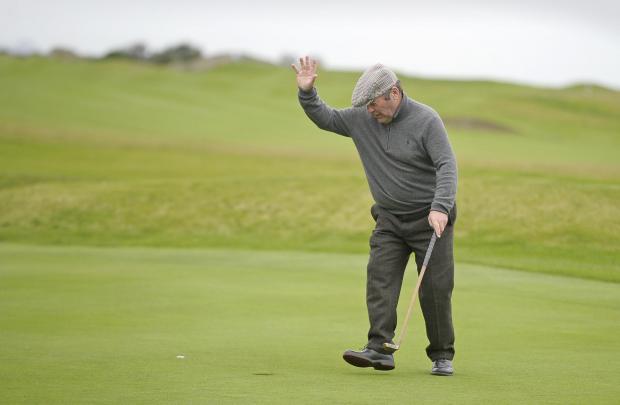
Michael Bamberger spent 33-minutes on the phone with Senator Lindsey Graham, who apparently had nothing else better to do than review claims of POTUS Donald Trump nearly shooting his age.

Graham says there wasn't a mulligan, only one birdie, one or two bogeys and mostly pars despite playing Trump National Washington at a yardage similar to the Senior PGA Championship setup in May.

"On the front nine, he shot even par," Graham said. "I shot a 41, which is good for me. He hit almost every fairway. He had seven Hogans, driving it on the fairway, hitting it on the green. On the back nine, he was one over, two over at the most. He had one birdie on the back, and just really hit the ball well. On the front, he made four 10- to 12-footers for par. That's what got him to shoot even-par on the front. He missed a four-foot birdie putt. He could easily have been one under."

Golf Magazine posted this video of the President chipping during the round. Nice to see everyone holding still while the leader of the free world is playing!


Compact!

FYI those wagering with Graham on the course or hoping to see a post-round gratuity, you know, for the effort...

Graham is sticking by his claim of 73 for the president—or 74. At the end of the round, he owed the president $30, but had only $5 with him, which the president accepted.

Shark Announces "One-Time" Return To Golf, Comparisons To Hogan's Comeback To Never Begin

Nothing conjures up images of Ben Hogan's return following the accident like a big time, one-off comeback. Well, that is, until you hear it's the retired (who knew?) Greg Norman returning to the PNC Father-Son.

I'll let the goosebumps subside before we continue.

Note the matching Shark-branded workout shirts for the big video announcement that was cut with some slick 1986 music and production touches. Think Magnum PI meets Body by Jake:

Excited to make a one-time return to professional golf with my son @gregnormanjr - see you at the @pncfatherson

A post shared by Greg Norman (@shark_gregnorman) on Oct 9, 2017 at 5:28pm PDT


Diaz On The Lure Of Short One-Shotter And Par-3 Courses

With the short, risk-reward par-5 almost impossible design, the short par-4 has become the go-to for those still craving strategic holes. But closing fast on the must list of even the most novice design critics is a short par-3. Even better, the tough sell that was recommending a par-3 course to a developer has become an easy sell.

All of these issues are considered by a par-3 course golfing descendant, Jaime Diaz, who uses Pinehurst's new par-3 to hit a number of short par-3 angles for Golf World.

The Cradle follows a trend of alternative course openings in 2017, with the new Jordan Spieth-backed six-hole course at the University of Texas, Tom Doak’s 12-hole par 3 at Ballyneal, and Dan Hixson nine-hole pitch-and-putt at Silvies Valley Ranch.

You may note a bias toward par 3s in my commentary. Like a lot of guys my age, my first rounds were on scruffy short courses, in my case the Fleming Nine at Harding Park and Golden Gate G.C., both in San Francisco, both enduring jewels from the city’s golfing heyday.

I’ve also seen a big appetite for pitch-and-putts overseas. They can be found in a bunch of little towns in Ireland, usually teeming with an informally dressed crowd whose members tend to nonchalantly pull off very useful bump and runs. And when the Open was held at Muirfield in 2013, the so-called children’s course next to the west course at North Berwick was a big hit with visiting American pros and their families.

To me, a good par-3 course works on many levels besides just the price and the pace. A little funkiness in design and even conditioning is a plus, as the capriciousness invites improvisation. The mood should be informal and promote a hint of relaxed raucousness.

Sure, the American hunger for optimization has started a trend toward par 3s for the golfer who has everything. Such courses can be pricey, too penal to avoid slow play, and over spectacular topography that isn’t ideal for walking. There have been a few such creations.

But done right, a high end par 3 can become destination golf.

"Storm brews between players, LPGA Tour over transparency"

Reading Beth Ann Nichol's Golfweek story on players fuming at the LPGA Tour over recent weather delays and non-delays, the short term discussion of 54 vs. 72 holes isn't as eye-opening as the obvious loss of faith in leadership.

Nichols writes:

Player president Vicki Goetze-Ackerman has fielded plenty of calls from players in the past week. Some feel they can’t talk publicly about the issues.

“I feel like there is a gag order on this tour,” one veteran player said.

Goetze-Ackerman said “the big thing” she has gotten from players is the issue of safety.

“They should never feel like they’re unsafe,” Goetze-Ackerman said. “That’s something we need to address as an organization.”

Fans also put in harm's way would agree!

Fraser Mann Wins 2017 World Hickory Open

An unbylined East Lothian Courier report says former Musselburgh pro Fraser Mann has taken the 2017 title with rounds of 70-71 to edge Rick Valentine by four strokes.

The World Hickory organizers shared this in their game story by Ginny Lawson:

As in past years, the field reflected most of the best exponents of hickory golf in the world. Indeed, the organisers were delighted with support from more than a dozen countries. Out of the 120 competitors, 28 arrived from Switzerland, where their game is centred on Engadine near St Moritz, where members also tend indulge in toboggan racing in the winter on the infamous Cresta Run.  But don’t be bluffed by these remarkable facts, the Swiss are serious hickory golf experts. For example, Paolo Quirici is one of the top seeds this year, and he was Championship winner in 2013.
 
It also true that the game is sufficiently challenging to eliminate the wanabes. Indeed 80% have competed in the past. That said, the game continues to grow in this extraordinary but incredibly beautiful new location of Scotland’s Golf Coast.
 
Sweden is the other European country to embrace hickory golf at a very accomplished level. With literally thousands playing the game back home. The World Hickory welcomed 19 of them this year.
 
The next largest team was not unsurprisingly from the USA, where former champ and one the world’s best known known hickory adherents, former US champion Mike Stevens, comes from. In addition, England led by Andrew Marshall from Norfolk has been well represented this year. Andrew was our Open champion at Carnoustie in 2015. Other nations entered included both Austria, Denmark and another half dozen countries, emphasising the rapid growth of the game at a European level.
 
Whilst Fraser Man was one of those representing Scotland, a small team of talented international junior golfers from Loretto’s much vaunted Golf Academy, led by former Hickory Champion Rick Valentine have also been playing this week.

The World Hickory Open was played with original or pre-1936 replica hickory shafted clubs. The 2017 edition took place at East Lothian's marvelous Kilspindie Golf Club, a must visit on the East Lothian trail.

Full field scores here.

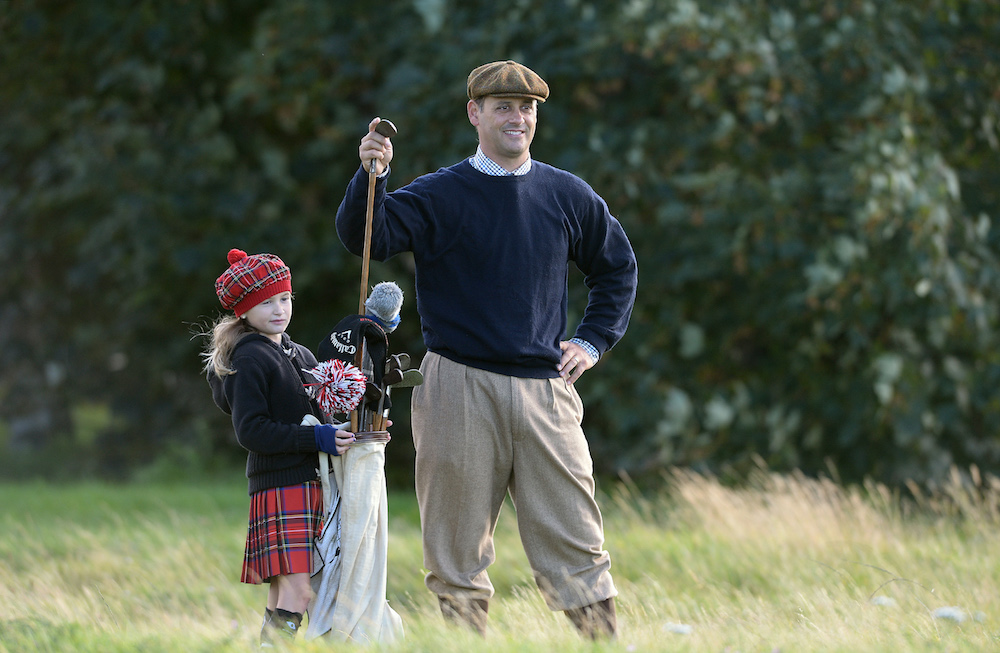
Neil Hanna captured this wonderful image:

Reminder: MLB Commissioner Rob Manfred On Callaway Live

You can set a reminder and get a preview here of Major League Baseball Commissioner (and big golf nut) Rob Manfred appearing on this week's Callaway Live, obviously recorded just prior to the Commish's busy time of year.

The show debuts at 6 pm Pacific Tuesday and can be viewed on YouTube any time after that.

State Of The Game 73: Geoff Ogilvy, Presidents Cup, Etc...

We've put the band back together and talk to Geoff Ogilvy about this recent Presidents Cup gig as an assistant captain along with other issues in the game.

For those wanting to hear Geoff's appearance on Playing With Science alongside Neil degrasse Tyson, it will be here when it is pushed out to devices.

The MP3 version is here and of course the show is available on iTunes.

And here:

Mell: Backstopping Must Stop, PGA Tour Must Intervene

Randall Mell at GolfChannel.com is the first outside of posts here to take on the backstopping matter. With the PGA Tour Player of the Year trying to argue the practice is almost non-existent and it's his right to take advantage of another player's golf ball as a backstop.

Yikes!

Anyway, Mell notes that a Rules of Golf does cover this issue in the Decisions two ways, with the latter requiring, the players admit intent. What is still not addressed in any of this discussion is the obvious thumbing of noses to the spirit of the rules, something that has left many long time elite players aghast watching the practice evolve.

But if the spirit of the rules angle doesn't impact today's young players, maybe the dollar figure side will.

Using Sunday's Tony Finau incident as his example, Mell writes of the shot saved:

Finau took home $669,000 for finishing second on Sunday. Phil Mickelson and Chesson Hadley finished a shot behind Finau and took home $359,600 for sharing third place.

If Finau had not saved par at the 12th and fallen into a three-way tie for second, he would have taken home $462,933, as would Mickelson and Hadley.

That matters, and so do the FedExCup points at stake.

Mell says the PGA Tour cannot wait for the governing bodies to address something that imperils the integrity of the tour when it's trying to make sure it has all integrity ducks in a row.

The PGA Tour’s administration ought to step in, too, to address whether Thomas is right in his thinking, or whether there is more for players to consider. Fans should know whether the PGA Tour deems Thomas is correct in asserting he has “a right” to play quickly. This isn’t about trying to craft specific language for a new rule. It’s about examining hearts and creating awareness about the importance of even the appearance of impropriety.

There’s no definitive solution here, but if the Tour’s going to implement an integrity program to protect itself from gambling issues, then framing backstopping issues for players that will reduce the possibilities they become a powder keg some Sunday soon is worth flushing out.

Trump Golf's UK Courses Suffer Losses In 2016

I'd caution against judging the losses at Turnberry as anything beyond the cost of renovation. And as detailed in Severinn Carrell's Guardian story, these 2016 numbers are pre-election, pre-madness.

However, the losses for Trump International Links in Aberdeen appear to be caused by a combination of factors and do not speak to a strong future for the Martin Hawtree-designed course, which appears to have been ruled out as a Scottish Open venue this summer by the tournament sponsor.

The latest accounts for his network of Scottish companies show he had to plough another £1.3m into his debt-ridden resort in Aberdeenshire to keep it afloat after the North Sea crisis saw its popularity slump among local golfers.

Trump International Golf Links Scotland lost nearly £1.2m in 2016, forcing Trump to increase his interest-free loans to the resort to nearly £41m ($54m) while he was campaigning for the presidency last year.

In their annual report, the Trump organization cited various factors.

The “crash in oil price and economic downturn” which had hit the north-east of Scotland had seen its income fall by 12.4%, he said, while winter storms had badly damaged part of its 18-hole championship course.

Video: Mickelson Says "Let's Take A Moment To Admire That I Just Hit A Fairway"

Fun stuff in the final round at Safeway Open, where Mickelson hit 15 of 56 fairways, though as he noted post-round as captured by PGATour.com's Mike McAllister, some are as narrow as 13 yards in spots.

Despite only hitting his 15th fairway of the entire tournament, Phil’s got jokes... 😂😂😂

A post shared by PGA TOUR (@pgatour) on

Today In Backstopping: Finau Saves A Shot, Thomas Says It's His "Right" To Play Quickly To Use Ball On Green As An Aid

During Sunday's Safeway Open final round we had yet another example of the backstopping practice prevalent only in men's professional golf (here, here and here for 2017 samples). In case you haven't been watching, this is the now-regular practice where golf balls are left down on a green unless it's in the path to the hole, with various motives and theories as to why this has become practice instead of players simply marking their ball to protect the field. Speed of play is cited as the reasoning.
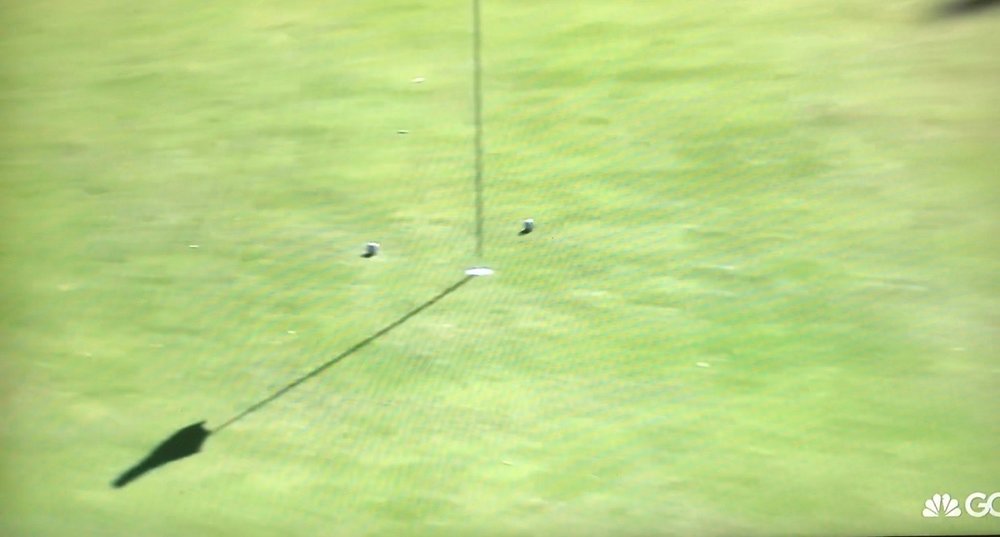
As Will Gray points out here for GolfChannel.com, Tony Finau was likely saved a shot during the 2017 Safeway Open final round when he had a buried lie with playing partner Jason Kokrak's 34-yard wedge shot was near the cup. In a post round interview with George Savaricus, Finau said he'd forgotten Kokrak's ball was by the hole when he hit. 

"Funny thing is, I forgot he hit. I was so focused on what I needed to do and how hard my shot was," Finau said. "I hit a perfect shot, but it was still going to go about 25-30 feet past. It was a bonus to hit his ball. I used the rules to my advantage, I guess, not knowing."

Finau finished second, one ahead of Phil Mickelson and two behind winner Brendan Steele.

Here is the shot that elicited a response from PGA Tour Player of the Year Justin Thomas.

In responding to Gray, Thomas said the practice of playing with a ball down by the hole happens "MAYBE" five times a year and is "part of the game, if I want to rush and hit a shot for that reason, it's my right."

So to recap: the player of the year says it's his right to rush a shot before a player can mark it, to gain an advantage that happens maybe five times a year. There you have it!

The implication of Thomas' second tweet is unclear to me. He retweeted a fan's thought related to grandstands and spectators that suggests he views this as a rub of the green matter, even while believing it's his right to take advantage of a competitor's ball on the green.

Somewhere Bobby Jones is harumphing at this admission.

The Rules allow a tournament committee to disqualify a player if they determined "players have agreed not to lift a ball that might assist any competitor."

Thomas also suggested the players are often too far away to mark a ball in time and this is why the practice occurs...five times a year, "MAYBE".

Half the time in these cases--that's MAYBE 2.5 times a year in Thomas's thinking--the walking distance is apparently too great for a player to wait, as Thomas demonstrated on the final day at TPC Boston earlier this season when Marc Leishman chipped up to the sixth hole and Thomas played quickly to enjoy what we now know was a hoped-for advantage.

But if we take the Kokrak-Finau example at Safeway, it would require an extra 20-22 seconds to have walked the 34 yards to slap a coin down before Finau played. Since Finau forgot Kokrak had hit, this wasn't possible. I'm not sure how you forget that a playing partner hit a shot, but alas, this is the situation.

Thomas believes too much attention is being paid to the subject, but prominent others are not agreeing.
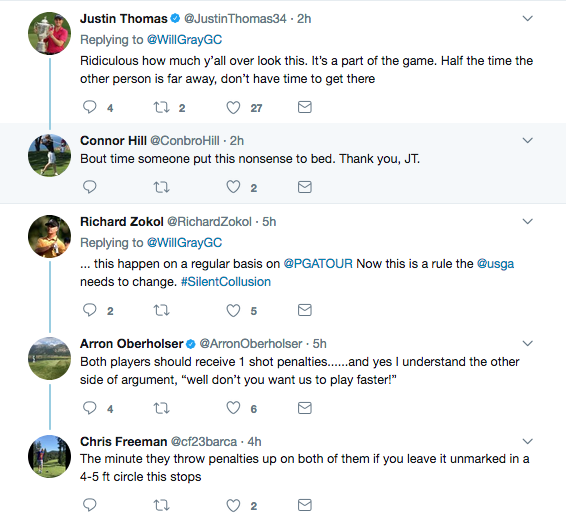
While many don't see this practice as a major issue, I do not agree for the very simple reason that professional golf's success is built on the integrity of its players. Corporations pay handsomely to be part of professional golf because they view the athletes as the most honest and upstanding in all of sports. Many fans follow the sport and love it because the athletes have such integrity.

Having a top player openly confessing to taking advantage of a ball on the green to possibly better his chances of finishing near the hole, is not great. If we found that his peers knows he does this and leave the occasional ball down to help him, we'd have the makings of disqualification for violating the rules. That this is even a "thing" speaks to a cultural shift and behavior that, if it becomes commonplace, could cause some to question the integrity of the players. Or, at the very least, make fans question if the players are legitimiately competing or colluding for peculiar reasons.

Besides, play can be sped up in much better ways than this.

European Tour To Unveil Shot Clock At '18 Austrian Open

Alasdair Reid reports for The Times that a shot clock will be part of next June's Austrian Open, replete with group referees, 40 second limits and one-shot penalties.

Reid says European Tour tournament committee member David Howell supports the idea but is concerned that we won't see great recovery shots if this became a regular practice. However, Howell says the committee signed off because the event in question can have its field size reduced.

“We’ve discussed it and agreed it should take place,” Howell said. “Among the committee, we think it’s worthwhile trialling that week in those specific circumstances. The field is not the strongest so it can be shortened without doing anyone too much harm. That allows the opportunity to get around quickly, so that’s why it is that week.”