"U.S.G.A.’s Long Relationship With Shinnecock Indians Frays Ahead of U.S. Open"

Bill Pennington of the New York Times says negotiations aren't going well between the USGA and the 1,500 member tribe. A parking area rented for $100,000 in the past is not being used by the USGA this time around, but the Shinnecock logo most certainly will be.  

The USGA is offering to sell products made by tribe members.

The U.S.G.A. also wants to include the Shinnecock in the event’s opening ceremonies and during the trophy presentation at its conclusion. And the U.S.G.A. has suggested other ways that the tribe could generate income during the championship, such as inviting the Shinnecock to sell a locally made product in its massive and usually mobbed merchandise tent.

“We’ve had great success with locally made products in past years — they’re a fan favorite wherever we go,” Annis said.

Annis added that the Shinnecock had also asked to set up a tent and a display for a putting simulator manufactured by a tribal partner. The U.S.G.A. agreed to find a high-traffic place for the tent.

Bomb And Gouge Is Back And Stats Support The Tactic

Screen Shot 2018-05-18 at 10.12.07 AM.png

Thanks to reader JB for the Brian Costa's WSJ look at our old pal Bomb and Gouge, the method of attacking a golf course with all power, accuracy be damned. 

Talk of playing golf that way had subsided in recent years after the craze began a decade ago, but as we've seen in subtle ways and in blatant ones, the practice is validated by stats. 

“It’s still easier to hit from the fairway than it is to hit out of the rough,” said Tony Finau, who is driving the ball 317 yards while hitting just 52% of fairways. “But I would rather hit a pitching wedge out of the rough than a 6-iron from the fairway.”

Mark Broadie, a Columbia University business professor who pioneered modern statistical analysis in golf, said it’s not as if today’s bombers are wild. More power simply makes misses look bigger, he said, and his analysis has proven the added yardage to be more valuable than the accuracy lost. “Players are intuitively optimizing their score by making good tradeoffs there,” Broadie said.


Intuitively optimizing!

Or, just overpowering courses thanks to their improved diets and astute use of medicine balls.

Lahinch! 2019 Irish Open Headed To The Historic Links

Screen Shot 2018-05-18 at 10.22.51 AM.png

The race to secure the most exotic venues for European Tour events continues, as Lahinch was announced as the 2019 Irish Open site by host that year's host, Paul McGinley. Crossing fairways, a blind par-3, Old Tom, MacKenzie and goats, what's not to love?

Simon Lewis's Irish Examiner reports quotes Lahinch general manager Paddy Keane saying that McGinley was instrumental in the course landing the Irish Open.

“Paul’s introduction to Lahinch was caddying for his father (Mick) in the South of Ireland, he broke 80 for the first time on the Castle Course here. Then he came and played himself in the South and won it in 1991. That got him his place in the Walker Cup and that ultimately gave him the opportunity to turn pro.”

It was a return visit to Lahinch last year that Keane believes put the Old Course, whose architects since 1894 have included Old Tom Morris, Alister MacKenzie, and Martin Hawtree, firmly in McGinley’s thoughts when he was asked to consider possible host venues for the Irish Open.

“He came back for our 125th-anniversary celebrations last year when we hosted a day for our past South of Ireland champions."

Jason Scott Deegan with the GolfAdvisor wrap up on all you need to know regarding a popular golf trip destination.

Ran Morrissett's GolflClubAtlas.com review from 2003.

It takes a while to get going but the wait is worth it to see the aerial flyovers in this 125th anniversary video.

Bethpage, Other Northeast Venues Confident They Are Ready For May PGA

Screen Shot 2018-05-17 at 9.36.32 PM.png

GolfDigest.com's Joel Beall checks in with several northeast venues on the PGA Championship schedule a year out from the even't first May playing date.

Bethpage agronomy director Andy Wilson says all is well, other than this week's weather. 

“We came out of this winter fine," he said. "We are a little behind a typical spring, but the course is green and the park has a spring look to it.”

Wilson admits the rain, snow and cold complicated matters, and mentions the trees aren’t as far along in leafing out as usual. However, all systems are operational. “The greens, fairway and tees are ready for the PGA,” Wilson says. “The playing surfaces are very good right now. We will have to change some practices in taking care of rough, especially high rough, to leave certain areas undisturbed in the fall to have a good look in the spring.”

A recent visit by Golf Digest confirmed as much. Contrasted against other Northeastern facilities, both public and private, you’d be forgiven if thinking Bethpage was sheltered in a dome the past six months. 

Doral Revenue Falls $41.1 Million In One Year

Harvested from President Donald Trump's asset disclosure, Trump Doral has shown a massive revenue decline from 2016 to 2017. 

Without a PGA Tour event and other lost business, this is a pretty steep decline:

The statement, released Wednesday by the Office of Government Ethics, show how much his properties, golf clubs and businesses earned last year. The highest-grossing Trump property was the Trump National Doral Golf Club at 4400 Northwest 87th Avenue with $74.7 million in 2017, according to Business Insider. While it raked in the most cash last year, the Doral resort also experienced the biggest dip in revenue compared to the previous year’s $115.8 million.

Kinnings Named European Tour Deputy CEO And Ryder Cup Director

Screen Shot 2018-05-17 at 8.48.10 PM.png

Replacing the retiring and superb Richard Hill, the European Tour has named longtime IMG agent Guy Kinnings their Deputy CEO and Ryder Cup Director.

Kinnings was a candidate for the Chief Executive job race ultimately won by Keith Pelley, making the appointment a tad eye-opening. As Golfweek's Alistair Tait notes, this positions Kinnings to be the next European Tour head.

Kinnings’ appointment should provide a seamless future for the Tour when Pelley moves on. The Canadian hasn’t averaged long in his previous roles with Rogers Media, Canada’s Olympic broadcast media consortium and the Toronto Argonauts. Pelley was challenged at two board meetings last year about his long-term future with the tour, amid concerns his tenure was going to be shorter rather than longer.

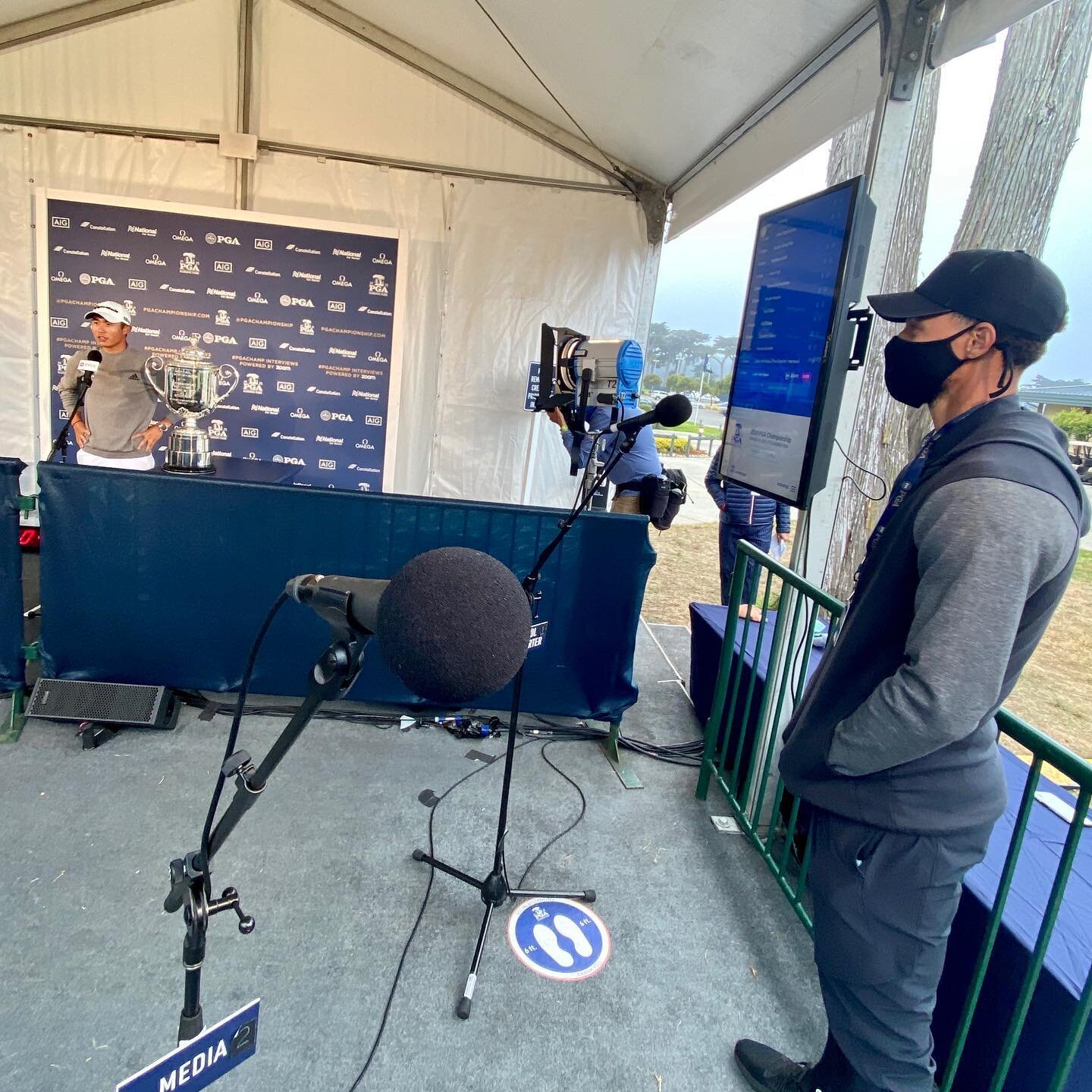
A Steph Curry Hosted PGA Tour Event In The Works?

That's what Darren Rovell reports is in the works, with hopes for a fall schedule slot in the Bay Area. 

From the ESPN.com report:

Frank Zecca, a managing director at Octagon who has worked with the Curry family for more than 25 years, would not confirm that a deal was inked but did acknowledge that conversations happened.

"Besides family and basketball, philanthropy, investing, technology and golf are high up on his list," Zecca said. "Culinary, community and the Bay Area are also priorities."

Culinary?

The PGA Tour acknowledged the plans and of course, suggested right out of the gate that he might attract the M's!

"There's no doubt Stephen Curry brings a young, new, diverse audience to the PGA Tour through his passion for this great game and support for the community," said PGA Tour spokeswoman Laura Neal. "We're excited about the prospect of partnering with an iconic athlete of his caliber in the future."

Time For Trinity Forest: One Last Preview Of Minimalism's Big Moment

TrinityForest12.jpeg

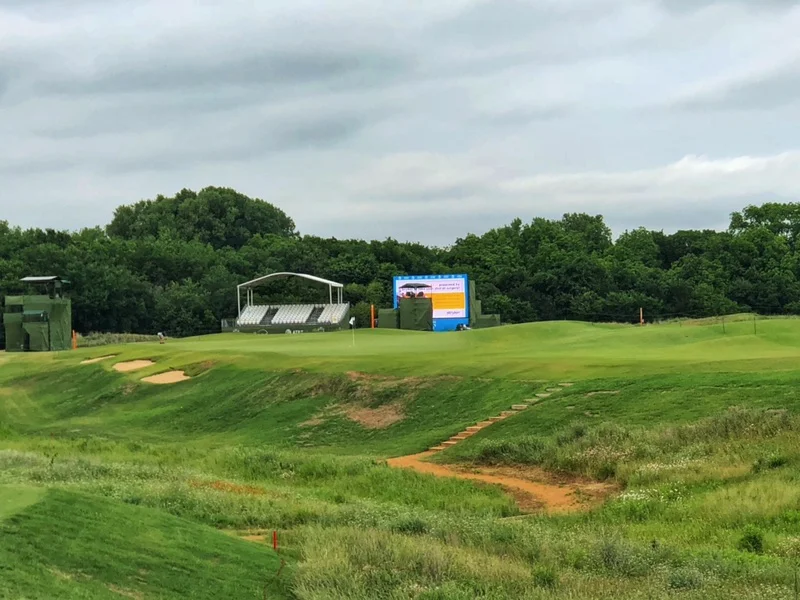
Minimalism's big moment arrives with the AT&T Byron Nelson Classic's bold move to Trinity Forest.  The Bill Coore and Ben Crenshaw design features some of their boldest and best design work to date. I'm very jealous of the select few who get to play here on a daily basis, like LPGA star So Yeon Ryu!

I explain in this Golfweek piece my first impressions and why this is a high risk week for the minimalist movement and why you're going to see some fascinating golf played. 

The course's speed dial has been turned down a touch by the PGA Tour wanting to ease into this one, and I explain in this Golfweek piece--with supporting quotes from the firm of Mahan, Scott and Ogilvy that his isn't the worst idea ever.

Here is my Morning Drive chat with Kasey Kauff, the first employee hired by the founders

We discussed what hole has most grown on Jordan Spieth today on Morning Drive:

A&Q: Read An Unusually Terrible Global Golf Post Interview On The USGA Distance Project

Screen Shot 2018-05-16 at 8.25.23 PM.png

With news of the USGA and R&A allowing everyone to submit views on distance, this is obviously cause to rage against the machine threatening to take five yards away from angry golf scribes.

It's never a good sign when a writer's rhetorical questions battle the answers for word count supremacy. Nor is normal for a journalist to flood the conversation with so much rage, particularly since the issue involves how far a little white ball flies.

But this unique blend of hostility overtakes Steve Eubanks interview of the USGA's Rand Jerris about the "Distance Insights Project."

The Post: Everyone’s perspective is based on their own life experiences. For example, there’s nobody left who can tell us what the distance impact was like when the game transitioned from hickory to steel shafts. And there was very little data accumulated at that time. So, how do we have this overarching discussion about distance without a legitimate, verifiable and texted data set?

Pausing here to let you ponder the joys of reading the words "texted data set." 

Jerris: There are various sources of information at which we can look. One is aerial photography thanks to the United States government. We can look at the evolution of the footprints of golf courses around the country over long periods of time, not just in terms of length but in terms of breadth and how much space they’re taking up. Because we can look at the times of those changes, hopefully we can determine what elements of those changes are directly attributable to distance. 

The Post: That last point requires a logic leap. Yes, you can see where the footprints of courses have changed over time. But how do you make the leap, based on that evidence, that those changes were attributable to distance? 

Maybe because no one has ever said, the game goes by too fast and we need to drag this out longer.

We must--MUST--spend more time walking back to tees and taking up more space so we can spend more money on maintenance. Now!

Jerris: That’s a fair point.

You are too kind, Rand. Too kind.

The photography will be just one component of the comprehensive data. We will couple that with input from as many external, legitimate sources as we can find. Teachers have been collecting data from their students. Avid golfers have been collecting data about their distance. Then it’s a matter of analysis. That’s where we get all interested parties together and say, “Here’s what we’re seeing in the data. Now, let’s talk about what it means.”

The Post: Going back to the report that we receive in February, the changes in distance have been remarkably small. The incremental increases, and in some cases decreases, surprised a lot of people. A lot of that was confirmation bias. Everyone you see seems to be hitting if farther, so we believe that there must be these huge jumps in distance. But when you look at the data we’ve seen so far, that doesn’t appear to be the case. To launch this program under the aegis that ‘We know distance is an issue,’ doesn’t that fly in the face of the data you’ve already collected and analyzed?

Now that's some confirmation bias!

Adam Scott On Golfers Forced Out Of Their Comfort Zones

On the eve of the 2018 AT&T Byron Nelson Classic, Adam Scott was asked about the PGA Tour locker room talk surrounding Trinity Forest and the uncomfortable demands the course will make.

Look, just most majorities just don't like different, do they? This is just different than what we normally roll out and play.

You know, people are going to get put out of their comfort zones and not many people like that, you know.

The greatest players have all managed to succeed out of their comfort zones and learn to love links or learn to love a parkland golf to succeed, and I think the greatest champions over time have all done that and whoever is going to be here this week will be someone who really embraces the different challenges of this golf.

You're not going to be able to fight it out there this week. You're going to have to go with it and hit a nice shot from 200 out one time and catch the wrong side of the hill and you'll have some putt that you would never feel like you deserve but that's a different style of golf than target golf that we're used to playing.

You're just going to have to do your best to two-putt it or however many putts you need to make to get down and move on and get the right rub of the green on the next one. That's probably the links side of golf. There's a bit more rub of the green, a little less predictability.

I think if I think about Tiger who has grown up playing golf in America but just had this instant desire to love links golf and win the Opens and he showed so much creativity in his game that was apparently just suited to win on the U.S. Tour, he embraced the challenges of all parts of the game and he did it all.

So, it's kind of how I see it. The guy that does that this week will do well.

Doug Ford Remembered

Golf's oldest living major champion, Doug Ford, passed away Wednesday.

Jim McCabe filed this excellent tribute and remembrance of a golf life well-lived.

For proof, consider that Ford – who considered a professional baseball career before choosing golf – was like a lot of young men of the World War II era and put military service first. After a stint with the Coast Guard Air Division, Ford returned to playing competitive golf, but didn’t decide to turn pro until 1949, when he was 26.

Why the delay? Ford said it was because he made a better living by playing money games. “In fact, he told me that (former USGA Executive Director) Joe Dey walked up to him at a tournament and said, ‘We know you play for money, so you can’t enter as an amateur,’ ” said grandson Scott Ford, a teaching professional on Long Island. “My grandfather told me that’s pretty much the day he decided he was a professional golfer.”

Here is Ford recalling the shot that won The Masters.

Will Sports Gambling Bring Fan Interference?

Here at the AT&T Byron Nelson Classic, players are slowly beginning to realize the economic benefits of sports gambling may come with a downside.

While they aren't ranting like Randall Mell did in his piece for GolfChannel.com, they are sharing the same concern.

With legalized gambling, there promises to be a billion new reasons for fans to root against a player, just as there will be a billion new reasons to root for a player.

Thomas had a right to be annoyed at the Honda Classic. Golf isn’t like the NBA. A fan screaming in a player’s backswing is different than a fan screaming at a player on the free throw line. A golf fan can control the outcome of an event a lot easier than an NBA fan can.

Nobody’s paying to see Joe Blowhard dictate who wins. But that’s the thing about legalized gambling. It’s a pretty good bet we’ll see more Joe Blowhards coming into the sport. And I’ll wager one of them costs a PGA Tour player a chance to win.

Will Gray talked to some veteran players who see potential issues. Ernie Els sees pushback when a player lets a fan down, while Jimmy Walker pointed to the intimacy and quiet of golf.

“Golf is so much more intimate, player to fan base, than any other sport. Tennis may be the only other one where it’s so quiet and the fans can get so close,” Walker said. “I think that’s the big deal, and that’s what people have to realize when they come out here, is that you can stand 5 feet from the best players in the world. You can’t do that at a football game. It’s hard to do that at a basketball game because it’s so loud, nobody can hear all that. So I just think we need to police it a little better.”

Bill Coore Explains Trinity Forest's Short Par-4 5th Hole

Great stuff here from Andy Johnson combining Bill Coore's explanation with a flyover of Trinity Forest's 5th hole.

I just love how he describes the issue at hand for players in just barely driving over the fairway bunker to get to the green. That kind of attention to detail--and the time put into getting that element just right--is why Coore, Crenshaw and The Boys are the best.