"The Sports Industry’s Gen Z Problem" And Golf

Screen Shot 2020-09-29 at 8.16.29 AM.png

Move over M’s!

The Z’s are here and if the last decade’s millennial pandering is any indication, Generation Z is the sports industry’s new focus.

At least, given the numbers presented by The Morning Consult’s Alex Silverman showing less Gen Z enthusiasm for sports than millennials.

Simply put, those born from 1996 and on do not appear to be serious sports viewing fans.

Gen Z’s relative disinterest in sports is reflected in its viewing habits: While 42 percent of all adults, and 50 percent of millennials, said they watch live sports at least once a week, only 1 in 4 individuals ages 13-23 said the same. In addition, Gen Zers were twice as likely as millennials to say they “never” watch live sports.

They are, apparently, degenerate gamblers in the making…

Zach Leonsis, senior vice president of strategic initiatives at franchise ownership group and media company Monumental Sports & Entertainment, said the keys to growing live viewership among young fans are accessibility and opportunities for engagement.

“Sports properties need to make sure that their games are digestible and available via streaming products,” Leonsis said. “They need to make their games engaging by fostering gamification, daily fantasy, free-to-play games and, ultimately, sports betting.”

Golf did not fare too well in the findings, failing to make the chart above showing avid or casual numbers, landing in the 17% or below group that includes MLS, F1 and the Premier League but below UFC, NASCAR and the WNBA.

The polling was conducted a month ago, thereby not accounting for this summer’s pandemic-related spike in recreational interest. Either way, expect golf organizations to lose their minds over this data and make the millennial pandering pale by comparison.

As for “engagement” of teenagers via gambling, I wonder if that’s data-based or just wishful thinking for an industry looking to expand revenue streams.

"Inside Bryson DeChambeau’s meticulous process to tame Winged Foot’s rough"

Screen Shot 2020-09-28 at 9.00.45 PM.png

I’ll leave it up your judgement to decide how you feel about Bryson DeChambeau’s process to outsmart the Winged Foot rough, as outlined by Jonathan Wall at Golf.com. But you have to admire the dedication of both DeChambeau to give himself added confidence, and of the Bridgestone R&D to spend the last Friday night before Labor Day on a Zoom call talking shot pattern standard deviations.

Nice work by Wall and the folks at Bridgestone to piece together this U.S. Open aftermath piece on DeChambeau’s quest to prepare for the high rough and how his 8, 9 and PW would react.

With one of the fastest club-head speeds on Tour, DeChambeau figured he could generate sufficient spin, and a playable ball flight, from the rough to score around the course — even if he wasn’t finding the fairway with a nuked drive.

“If he normally generates 10,000 RPMs with a pitching wedge from a clean lie and knows a flier will knock the spin down to 7,000 RPMs, he’s able to calculate how much longer he’ll hit it in that situation. A lot of players are just guessing when they get a flier. The testing we conducted was all about helping him build those numbers for the clubs he figured he’d use often on approach shots — 8-iron, 9-iron, pitching wedge.

Again, tip your cap to him. But is this where we begin asking if things are maybe not headed in the right direction?

First Review And Aerial Tour Of Jura's Stunning Ardfin Links

Screen Shot 2020-09-28 at 10.14.42 AM.png

The Scotsman’s Moira Kerr had the backstory on the Australian millionaire Greg Coffey buying the Ardfin Estate ten years ago on the remote Hebridean Island famous as George Orwell’s happy place to write 1984.

And now the £50m renovating later, the Jura House and farm buildings is an upscale “accommodation” with another £20m spent on Bob Harrison’s 18-hole golf course that opened to just a few people in 2015.

The UK Golf Guy’s full review can be read here, but a snippet:

However, in early 2020 it was announced that the course would be open to visitors – but only for those willing to pay stay on the property. I cover the logistics, accommodation and overall package in the Tour Tips section below.

But if you strip away the myths, strip away the cost and strip away the exclusivity, what is the course itself actually like?

Oh why give a more, check out the link and here’s the hole-by-hole flyover.

Not April Fools: This November 3rd (Eleven) Pine Valley Residents Voting On Ballot Initiative

Screen Shot 2020-09-28 at 8.38.30 PM.png

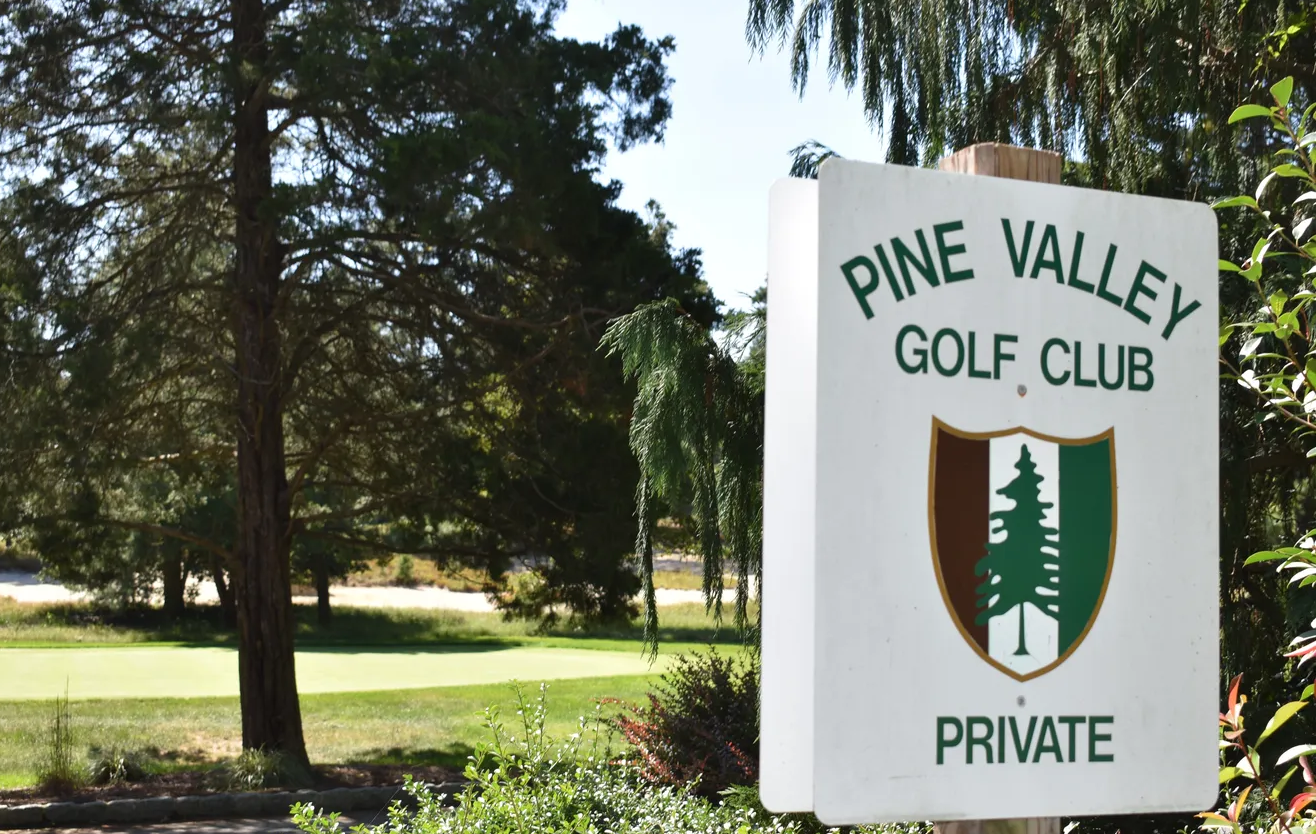
Jim Walsh in the Cherry Hill Courier-Post paints quite the bizarre picture of a ballot initiative facing the eleven constituents of the borough of Pine Valley. Yes, that Pine Valley.

The club’s George Crump and H.S. Colt course is typically ranked first in most rankings of top American courses despite losing some aesthetic and architectural edge in recent years. The “borough” of Pine Valley now appears to be adhering to Governor Phil Murphy’s push for shared services between boroughs with lower property taxes as the end goal.

So this November 3rd, you Pine Valley borougherers—all eleven of the thirteen registered to vote—you must decide whether to form a citizens’ commission to decide shared services in the region!

“This is a preliminary step, but an important one that the borough believes is prudent to consider,” Pine Valley Mayor Mike Kennedy said in a statement provided to the Courier-Post.

The ballot question – to be decided by the borough’s 11 registered voters — is “consistent with these goals,” Kennedy said.

The Camden County borough, which was incorporated in 1929, keeps a low profile in a forested area behind a rail line along East Atlantic Avenue.

There’s an understatement. I wonder if there are lawn signs with the lucky few Pine Valley residents announcing their position?

Anyway, Walsh paints a picture of Pine Valley from just outside the gates and tries to describe the exclusive club—errr, borough—that might like some help from neighboring areas despite its all-male membership, claims that the borough has “no say” in the club operation and the famous once-a-year open door policy.

One cabin-like building serves as the borough hall. The six-officer police department, which has reported no major crimes for the past two years, occupies a smaller structure next door.

That opportunity comes on the final day of the Crump Cup, a four-day competition for “mid-amateur” and senior golfers. The event is named for George Crump, a Philadelphia hotelier who began designing the course in 1913.

Mid-amateur senior golfers. That had to sting. Here’s a weird one:

This year’s competition, initially scheduled for Sept. 24-27, was canceled due to the COVID-19 pandemic.

But the one-day opening drew almost 800 spectators in 2018, including four who were “evicted for tossing things onto the course,” according to minutes of a borough commission meeting from that time.

Tossing things? A divot back to a golfer? A green reading book? A pine cone? Details!

Anyway, it’s all bizarre and I recommend reading it from Walsh.

NGF Head On Golf's Newfound Popularity: "Nothing about the past few months seems structurally different for golf"

Screen Shot 2020-09-27 at 8.11.27 PM.png

In Joe Beditz’s National Golf Foundation analysis of August’s 20.6% year-over-year increase, this was interesting:

But nothing about the past few months seems structurally different for golf, whether with the product itself, the service that supports it, or the overall user experience … unless you count extended tee time intervals, which for a time seemed to produce faster, smoother and more enjoyable rounds. Either way, we weren’t suddenly marketing ourselves differently, onboarding new players differently, or managing customer relationships differently. (In fact, remote check-in procedures may have made it more impersonal.)

Time, time, time, safe, time and safe.

And more on the huge summer for retail, already noted here with regard to evening golf becoming popular. Beditz writes:

Total sales of golf equipment on- and off-course were $331 million in August, extending a record-setting summer for the retail side of the business.

Golf retail sales in August were up 32% over the same period in 2019 ($251 million) and readily surpassed the previous record for the month of $287 million in 2006. Golf Datatech has been tracking golf retail sales since 1997.

Five equipment categories set all-time sales records for August: balls, irons, wedges, bags and gloves. Bags were the best-performing equipment category for the month, up 55% over last year.

Wait, but not drivers after golfers were inspired by Bryson DeChambeau? That must be an oversight!

The 2020 Ryder Cup That Wasn't: COVID-19 Hotspot, Week After U.S. Open Makes The Postponement Look Wise

Screen Shot 2020-09-27 at 8.37.24 PM.png

It would have been a somber, fan or partially fan-free Ryder Cup last weekend played under ideal weather conditions. But with Wisconsin reporting 2000 new cases four days in a row and a huge positivity rate as well, combined with the lack of fan access, and it looks like the 2020-In-2021 Ryder Cup looks like a wise postponement to 2021.

While I still think toning down the fan element and other theatrics would have been a good thing, a date the week after the rescheduled U.S. Open was, in hindsight, less than ideal and might have led to a severely diminished event.

The Golf.com Confidential crew addressed and noted things lost, all of which might not have had their usual luster set against the 2020 backdrop.

Shipnuck: Being right. I have no doubt the young, talented Americans who have been dominating the golf world were going to win to touch off a decade of dominance. Now, who knows how much momentum will be lost over the next year. Alas, Europe even wins the pandemics.

Dethier: The crowds. The frenzied Midwestern crowds waking up on a crisp Wisconsin morning, getting out in some hideous star-spangled garb and rooting on their beloved Yanks in a too-close Ryder Cup on a super-fun golf course. Oh, and figuring out if Tiger Woods should be on the team — that would have been a blast of a debate too, no doubt.

Bamberger: The parades of the WAGs. The parade of self-importance, pre, post and during. 

Piastowski: The fans. They made the right call to not go on without them. It’s the event that needs a crowd the most. The one event where you can cheer for your team – and get after the other one. 

Finau's, Agent Chris Armstrong Sued By Utah Businessman Molonai Hola For More Than $16 Million

Screen Shot 2020-09-27 at 7.00.18 PM.png

The Deseret News’ Mike Sorenson reports that PGA Tour winner Tony Finau and his team have been sued by Molonai Hola for more than $16 million. The story says he’s known the Finau family since 1997 and as part of his Icon Sports, “began financing expenses for Tony and his younger brother Gipper”, the suit says.

Also named in the lawsuit are Finau’s brother, Gipper, his father, Gary, his agent Christopher Armstrong and the Wasserman Media Group.

When reached for comment on the lawsuit, Armstrong said in a statement, “We are aware of the matter and have the utmost faith in the legal process. We will not be making further comment at this time.”

I’m not clear what role Finau’s agent plays from the story. The timing of the assistance Hola gave suggests it might have crossed over into Finau’s amateur and NCAA career.

The suit claims Hola paid for the Finau family’s mortgage payments, medical insurance, a new car as well as golf-related travel expenses for Tony and Gipper, including living expenses for the Finau family to reside in Florida for approximately a year while they received lessons from renowned golf instructor David Leadbetter.

Later, Hola helped form the Finau Corporation to help promote the young golfers and was designated as the corporation’s registered agent.

The expenses, according to the suit, added up to $592,371.37 over several years.

"Since 2000, Mr. Trump has reported losses of $315. 6 million at the golf courses that are his prized possessions."

Screen Shot 2020-09-27 at 6.50.47 PM.png

The New York Times’ Russ Buettner, Susanne Craig and Mike McIntire report on two decades of President Donald Trump’s income tax returns showing he’s paid no income taxes in 10 of the last 15 years.

Trump’s investment in golf plays a central role in revealing “struggling properties, vast write-offs, an audit battle and hundreds of millions in debt coming due.”

When “The Apprentice” premiered, Mr. Trump had opened only two golf courses and was renovating two more. By the end of 2015, he had 15 courses and was transforming the Old Post Office building in Washington into a Trump International Hotel. But rather than making him wealthier, the tax records reveal as never before, each new acquisition only fed the downward draft on his bottom line.

Consider the results at his largest golf resort, Trump National Doral, near Miami. Mr. Trump bought the resort for $150 million in 2012; through 2018, his losses have totaled $162.3 million. He has pumped $213 million of fresh cash into Doral, tax records show, and has a $125 million mortgage balance coming due in three years.

Overseas, the losses at Doonbeg, Aberdeen and Turnberry have been reported in annual corporate filings required-by-law.

His three courses in Europe — two in Scotland and one in Ireland — have reported a combined $63.6 million in losses.

This could explain the urgency to see Turnberry return to the Open rota. A near-term prospect that seems more in question than ever given the financials.

And the grand total?

Over all, since 2000, Mr. Trump has reported losses of $315. 6 million at the golf courses that are his prized possessions.

There was also this conflict of interest situation noted in the Times reporting.

At the Mar-a-Lago club in Palm Beach, Fla., a flood of new members starting in 2015 allowed him to pocket an additional $5 million a year from the business. At his Doral golf resort near Miami, the roofing materials manufacturer GAF spent at least $1.5 million in 2018 even as its industry was lobbying the Trump administration to roll back “egregious” federal regulations.

Mooooo! Irish Open's Only Spectators Resist Social Distancing, Masks

Screen Shot 2020-09-26 at 9.58.47 AM.png

Great stuff from the Dubai Duty Free Irish Open today—if you look past he lack of distancing and facial covering apparently just off the 14th hole at Galgorm Resort and Spa. Aaron Rai leads heading into the final round.

But the scenes just off the course got most of the broadcasters and social media attention Saturday, and why not:

"Mark Calcavecchia recounts COVID-19 ordeal as he returns to play"

Screen Shot 2020-09-25 at 11.37.05 PM.png

ESPN.com’s Bob Harig talked to 13-time PGA Tour winner Mark Calcaveccia about his COVID-19 bout and efforts to get back to normal.

"It's the worst I ever felt," he said. "Every bone in my body hurt."

Calcavecchia can't pinpoint where he picked up the virus. And he said the fact that neither his wife, Brenda, nor any of the people he played with on a weeklong golf vacation in Nebraska (including two-time U.S. Open champion Lee Janzen and tour pro Scott Dunlap), contracted COVID-19 is "a minor miracle.
"

He goes on to describe a harrowing cross-country journey with worsening conditions each day until heading to the hospital for testing and treatment.

Augusta National: No Damage From Sally Remnants, Overseed On Schedule

IMG_1268.jpeg

While the rescheduled U.S. Open played out last week in New York, hurricane Sally made landfall and then hit Augusta, Georgia, home to the Masters this November.

A whopping 4-7 inches of rain in just under 12 hours and despite rumblings of possible, a club official says the course suffered no damage. The fall overseed of ryegrass remains on schedule.

The above photo posted September 24th to Eureka Earth’s Instagram account shows the course in a shaved down appearance with “50 days to the Masters 2020.”

In Augusta, the account also posted this image of the area behind Amen Corner. A new road has been installed on property purchased from Augusta Country Club and a distinct arc in the road provides room to length the par-5 13th hole to offset the impacts of Peloton and Whoop bands.

Do We Really Want Young Golfers To "Pull A Bryson"?

Screen Shot 2020-09-24 at 8.56.15 PM.png

In wrapping up Bryson DeChambeau’s revolutionary U.S. Open win, we long time technistas have seen new dimensions added to the distance debate.

From how the game is played, to the relentless “athlete” marketing push, the debate includes fresh dimensions courtesy of Bryson’s brusque style. Just look at Cameron Champ. He is probably capable of longer drives and has a pair of nice wins along with a run at the PGA Championship to beef up his credentials. But there is something more revealing about the sight of Bryson’s weight gain in a matter of months and the violent nature of his swing.

The aesthetic of it is cringe worthy. But golf has always had aggressive lashers. There’s more to this than style.

Seeing someone combine an excessive diet with a Happy Gilmore swing is one thing, but it becomes a bit less fun when you sense injury is inevitable. But he’s a grown man and he’s entitled to do what he likes with his body. At least, within reason and under rules meant to maintain the integrity of the competition.

So about the children.

At certain ages we are able to observe and absorb tiny details that are sometimes channeled into golf swings. Or into mannerisms. Or how we practice, prepare and dress. With kids getting serious at younger ages able to access more information than ever, this is a careful way of asking: do we want kids seeing what Bryson’s doing and copying the methods to his madness?

Today’s equipment and launch monitor technology allows a talented golfer to maximize their implements to absurd driving-distance effect. All credit to Bryson, he outsmarted the system. But the rules are supposed to consider whether it is a good thing on many levels, including preventing young people from taking extreme measures to gain distance.

With that in mind, here are a few final reads regarding Bryson and the U.S. Open, starting with a reminder that any talk about rules changes must start with praise for DeChambeau. An adjustment to the rules was already in mind before he made his changes thanks to the Statement of Principles, so the next discussions should never feel like a rebuke or de-legitimization of his win.

His instructor in this transformation, Chris Como, was quoted by Doug Ferguson in this AP analysis of DeChambeau’s overhaul:

“How many people have changed their body, changed their golf swing and lost their career?” said Chris Como, who works with DeChambeau as a swing coach and speaks his language with his background in biomechanics.

True. That said, there should be a place in the rules to modify equipment to allow a player to swing hard, but return some sanity to the player-club symbiosis. Again, hats off to Bryson and you can keep your new body, but in the interest of the sport and future generations, we also need to draw a line in the sand. Or, gasp, go backwards.

In The Met Golfer magazine, Bill Fields tackled this notion with DeChambeau in mind, then reminded us of past distance talk—100 yards ago off the tee—and explained why golf has to stop fussing so much over a minor move backwards.

The circus will still be the circus, whether the high wire is fifty or five hundred feet above the floor.

Now to the headline of this post: the children. They are our future!

And in golf, our immediate present, with some undoubtedly throwing another package of bacon in the shopping cart and pricing Creatine options online.

To this point, an Eric Sondheimer Los Angeles Times story appeared in August and I asked a few folks about the ethics of posting it in this context. I ultimately chose not to because I don’t want to pick on a 16-year-old aspiring player for simply doing what you’re supposed to do: see what a leading player is doing and copying.

The lad in question is a former child star and now a good player for a legendary southern California high school. He has aspirations to get better and longer off the tee. This being 2020, you know where this is going.

When on-campus classes stopped in March, golf courses also closed, leaving the then-sophomore scrambling. His mother bought him a target to practice his chipping in the backyard. He tried hitting off a mat, but that doesn’t help for real golf. He went for runs, rode a bike and worked on building his strength while trying to keep his slender 6-foot-1, 145-pound body in shape. He can drive a ball 280 yards but says he’s been “eating a lot.”

He and his golf friends have been talking nonstop this summer about PGA sensation Bryson DeChambeau, who gained 40 pounds and has been hitting balls beyond 400 yards.

“That’s who we’re chasing in the fitness world,” he said.

Long drives with friends this summer produced, “You pulled a Bryson.”

Today’s equipment and fitting allows for players to grow-up swinging more efficiently than past generations. But at what point does skill become diminished by technology or worse, do training regimens and expensive protein diets turn golf into a pursuit of unhealthy behaviors and gluttony?

Is anyone at the highest levels concerned about the idea of encouraging teenagers to push their bodies before they’re ready? In a sport that has always been about more than just getting stronger?

To date there has been little urgency to act for any reason, including child safety. But maybe the sight of Bryson’s transformation and his promise to pursuing more weight gain will convince the regulators to better regulate. For the children.


SOS Appeal To England, World: Old Tom And MacKenzie's Cleeve Hill Set For Closure

Screen Shot 2020-09-24 at 3.58.55 PM.png

Leigh Boobyer reported a couple of weeks ago on the non-renewal of the wonderfully bizarre and historic Cleeve Hill Golf Club, a place that has to be seen to be believed (video below). A second story by Boobyer reports the plan is to tear down the clubhouse and return the course “to the natural state of flower-rich limestone grassland".

The unique word gets thrown around a lot these days but if ever a course earned the name, it’s Cleeve Hill.

Check out this video posted by Cookie Jar Golf (and some of their other works) capturing the majesty of this original Old Tom Morris design, which enjoyed some touch up work by Alister MacKenzie.

This GolfClubAtlas discussion thread features an excellent summary of changes by Sean Arble. It details what’s left of Old Tom and MacKenzie’s work and more about the overall singularity of the place.

Also, an absolute must-listen is this podcast with architect Robin Hiseman and America’s Arble that covers the course, its place in the area, the architectural charm of Cleeve Hill, the maintenance and the “common ground” success of it for both golf and walkers.

Finally, this page offers a petition to sign.

Padraig: Bryson's Doing A Twelve-Second 100 Meters, Has Another 20 Percent In The Tank

Martin Dempster quotes Padraig Harrington in advance of this week’s Dubai Duty Free Irish Open and the 2020/21 Ryder Cup Captain shared thoughts on a variety of topics. He’s also monitoring the weather that might have been this week at Whistling Straits (it’s literally as perfect as you could hope), but also chiming in on Bryson DeChambeau’s U.S. Open victory.

“With the capabilities at the moment, I would say Bryson is swinging at about, if you compare it to 100 metres, he’d be running at 12 seconds. The human capability, he’s running 100 metres at about 12 seconds at the moment, so he’s still got another 20 per cent more in the tank in terms of human capabilities for other players to come along.

He also made this prediction about the women’s game and the speed chase:

“I actually think the biggest change could come in women’s golf. You’re going to get a woman out there playing well into the mid-170s ball speed and would be competitive on the men’s tour.”

Yale Golf Course Is (Finally) Back September 28th

Screen Shot 2020-09-23 at 9.41.50 PM.png

The closure of an American gem ends September 28th when Yale Golf Course reemerges from an extended pandemic closure and ensuing deterioration.

Anthony Pioppi first reported the news of our nation’s top college course finally reopening for play long after almost all golf facilities have enjoyed upticks in play during the COVID-19 pandemic.

Thanks to reader Tim for sending this compilation of photos and news items related to Yale in 2020. You’ll see some of the conditioning issues as well as efforts to get the CB Macdonald and Seth Raynor masterwork back in playing shape.