Latest From GolfDigest.com
Latest From Local Knowledge
Twitter
Books
  • Lines of Charm: Brilliant And Irreverent Quotes, Notes, And Anecdotes from Golf's Golden Age Architects
    Lines of Charm: Brilliant And Irreverent Quotes, Notes, And Anecdotes from Golf's Golden Age Architects
  • The Future of Golf: How Golf Lost Its Way and How to Get It Back
    The Future of Golf: How Golf Lost Its Way and How to Get It Back
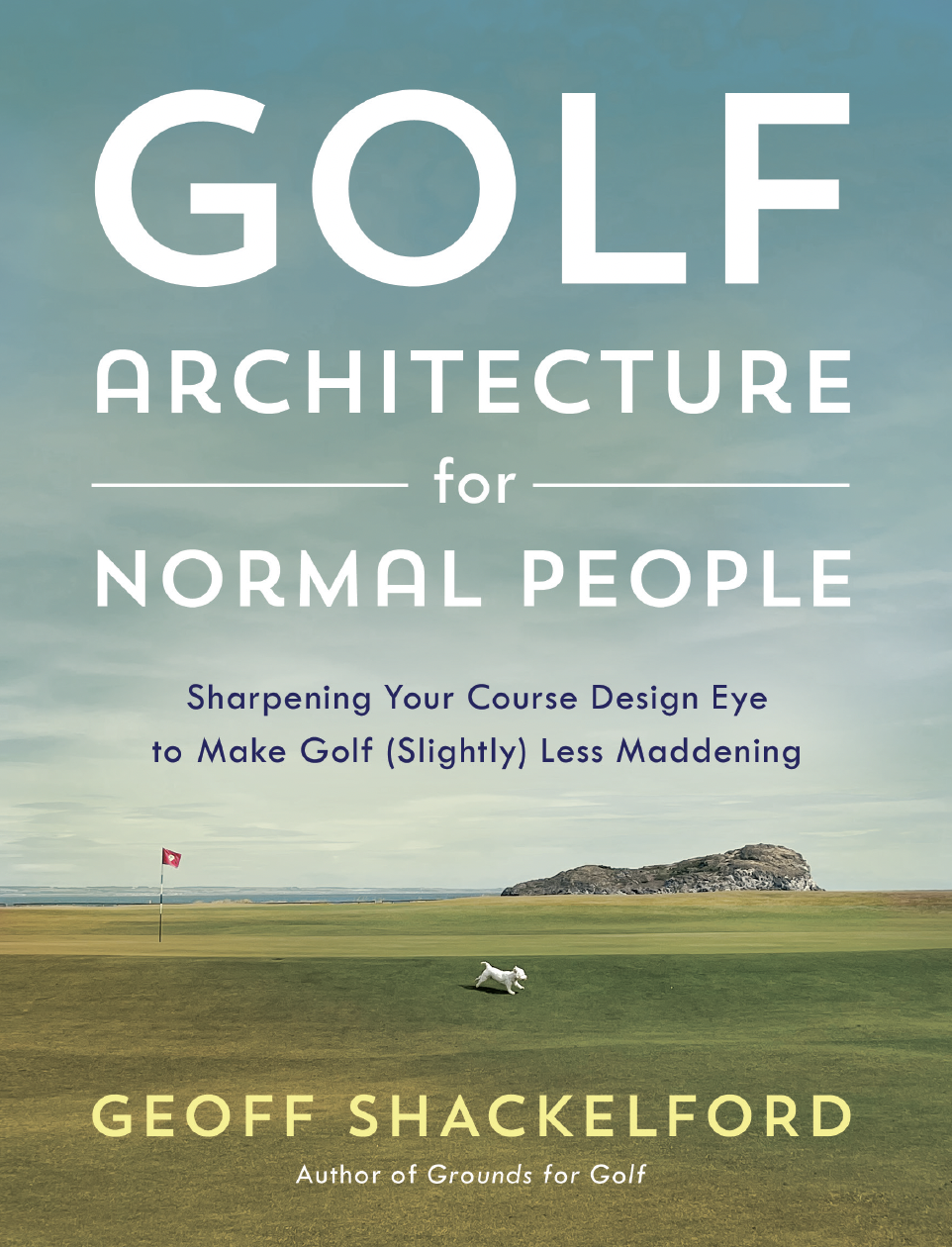
    by Geoff Shackelford
  • Grounds for Golf: The History and Fundamentals of Golf Course Design
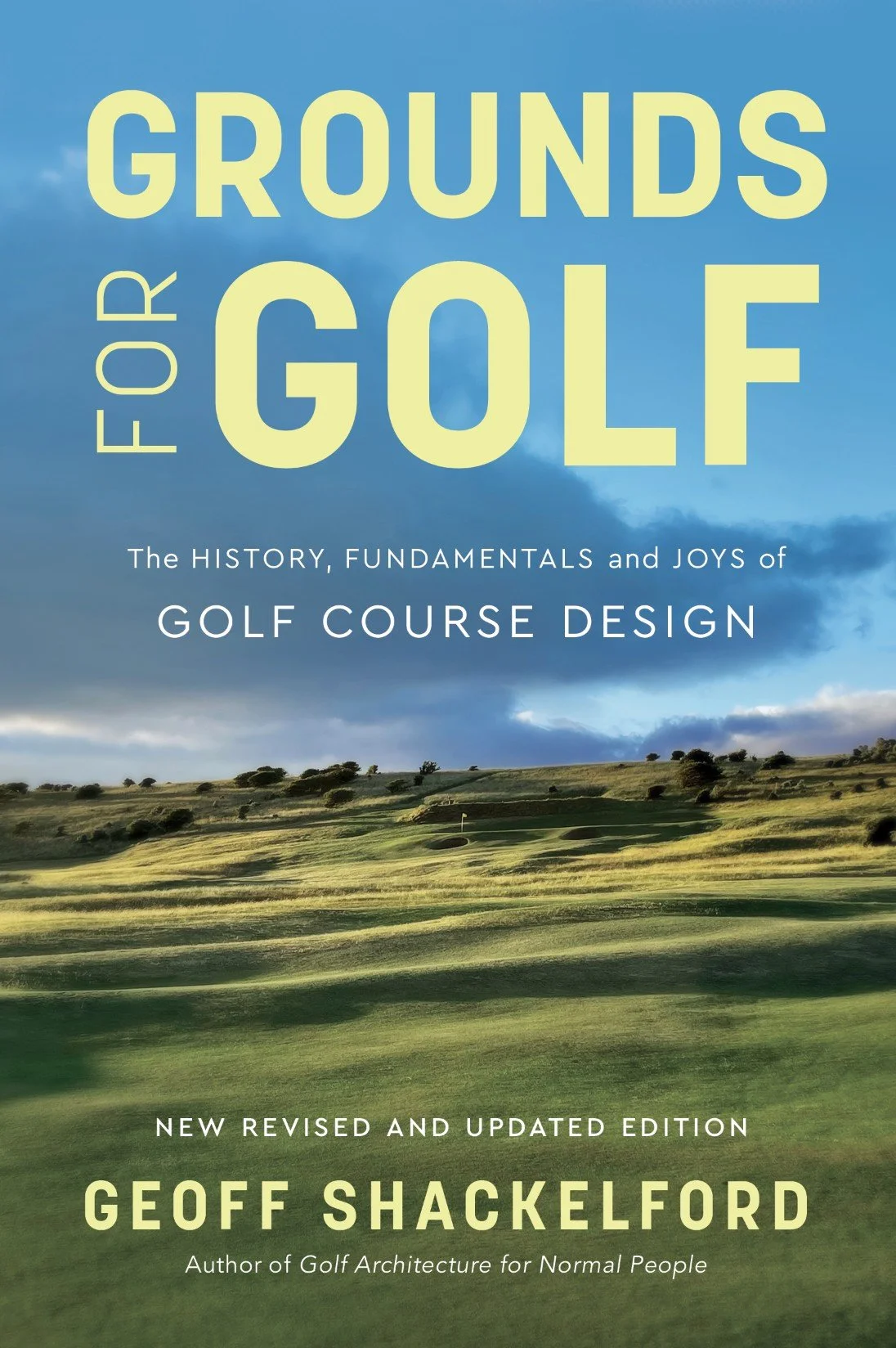
    Grounds for Golf: The History and Fundamentals of Golf Course Design
    by Geoff Shackelford
  • The Art of Golf Design
    The Art of Golf Design
    by Michael Miller, Geoff Shackelford
  • Alister MacKenzie's Cypress Point Club
    Alister MacKenzie's Cypress Point Club
    by Geoff Shackelford
  • The Golden Age of Golf Design
    The Golden Age of Golf Design
    by Geoff Shackelford
  • The Good Doctor Returns: A Novel
    The Good Doctor Returns: A Novel
    by Geoff Shackelford
  • Masters of the Links: Essays on the Art of Golf and Course Design
    Masters of the Links: Essays on the Art of Golf and Course Design
  • The Captain: George C. Thomas Jr. and His Golf Architecture
    The Captain: George C. Thomas Jr. and His Golf Architecture
    by Geoff Shackelford
Current Reading
  • The Big Miss: My Years Coaching Tiger Woods
    The Big Miss: My Years Coaching Tiger Woods
    by Hank Haney
  • Wonder Girl: The Magnificent Sporting Life of Babe Didrikson Zaharias
    Wonder Girl: The Magnificent Sporting Life of Babe Didrikson Zaharias
    by Don Van Natta Jr.
  • Deane Beman: Golf's Driving Force
    Deane Beman: Golf's Driving Force
    by Adam Schupak
  • The Swinger: A Novel
    The Swinger: A Novel
    by Michael Bamberger, Alan Shipnuck
Classics
  • Golf Architecture in America: Its Strategy and Construction
    Golf Architecture in America: Its Strategy and Construction
    by Geo. C. Thomas
  • The Course Beautiful : A Collection of Original Articles and Photographs on Golf Course Design
    The Course Beautiful : A Collection of Original Articles and Photographs on Golf Course Design
    Treewolf Prod
  • Reminiscences Of The Links
    Reminiscences Of The Links
    by Albert Warren Tillinghast, Richard C. Wolffe, Robert S. Trebus, Stuart F. Wolffe
  • Gleanings from the Wayside
    Gleanings from the Wayside
    by Albert Warren Tillinghast
  • Planet Golf USA: The Definitive Reference to Great Golf Courses in America
    Planet Golf USA: The Definitive Reference to Great Golf Courses in America
    by Darius Oliver
  • Planet Golf: The Definitive Reference to Great Golf Courses Outside the United States of America
    Planet Golf: The Definitive Reference to Great Golf Courses Outside the United States of America
    by Darius Oliver
Writing And Videos
Blogs
Feedblitz
Enter your Email


Powered by FeedBlitz
« Sharp Park In Different Hands? | Main | FedEx Cup (Not) On Their Minds »
Wednesday
Mar142007

"To make the golf course a little more competitive to par"

Doug Ferguson looks at the utter meaninglessness of par as a barometer of a successful championship, and why everyone still clings to it's value even though they know better.

"We can get caught up too much in numbers," Ben Crenshaw said Monday. "You still add up your score at the end of the round. And they're still going to give the trophy away to the guy with the lowest score."

That's worth noting because twice in the last three weeks on the Florida swing, the courses have played as a par 70. Mark Wilson won the four-man playoff at the Honda Classic after finishing at 5-under 275 at PGA National, which sounds like a more grueling week than if they had finished at 13-under 275.

Now, Palmer has converted Nos. 4 and 16 at Bay Hill into par-4s, and it will play as a par 70 for the first time in the Arnold Palmer Invitational Thursday through Sunday.

"I did it just to make the golf course a little more competitive to par," Palmer said.

Oh joy! Thank God the NCAA tournament will be on at the same time.

A couple of players earn big points for these comments...

Todd Hamilton might have the best solution. The former British Open champion would like to see only one number on the signs at every tee, and that would be to identify what hole you're playing.

"Get rid of the par. Get rid of the yardage," he said. "Go play the course."

And...

If a player was trailing by one shot coming down the stretch, the last reasonable place to make up ground was the 16th. Find the fairway and you would have a shot at reaching in two and make birdie at worst.

"I thought 16 was a great swing hole," Trevor Immelman said. "You have to hit the fairway, and then you might have a mid-iron to the green. And if you miss the fairway and lay up, you could spin the ball off the green and then you could make bogey. I felt like it was such a great hole coming to the end of the tournament."

And, in lieu of one of his snappy baseball metaphors, David Fay at least hovered on the verge of a Yogi-ism:

"I do think there's a school of thought out there that the USGA is fixated on par," Fay said. "We're not fixated on par, but we like the idea that par is a good score."

Not fixated, but we really fixate on the idea of as a good score.

PrintView Printer Friendly Version

EmailEmail Article to Friend

Reader Comments (14)

Scoring in golf is based on how many strokes it takes to get the ball in the hole. You add them up, and get some total. In a tournament, that carries on for 4 days, so you get triple digit numbers.

An easy way to get over the fixation on par is to eliminate "par notation". When people are faced with small figures (one to two digits), their sense of spacing between two numbers is pretty accute. 5 feels very different from, say, 11. 17 also feels different than 23. But am I the only one who feels that the difference between 5 and 11 is greater than that between 17 and 23, even though they are the same?

What about when we get to, say, a number like 280? How would this stack up to 260? Or 300? Does the gap between them seem as big as the gap between 1 and 21, even though they are the exact same?

If we're gonna play number games, we may as well get the boys up top to put those MBA marketing classes to use. Remove par notation from tournaments, and we might have solved our problem.

(Cold medicine kicked in about 5 minutes ago... thanks for asking)
03.14.2007 | Unregistered CommenterScott S
The concept of using strokes in relation to par to position players on a leaderboard during an ongoing tournament where individuals have played different numbers of holes was invented by CBS Sports' Frank Chirkinian (The Ayatollah).

I haven't given it much thought, but is there a better way? While I agree the concept of par has been muddled by today's top-notch agronomy practices and the superior conditioning of the combatants, the TV folks who lay out the big bucks for broadcast rights would never agree to it.

Or change every hole to be a true, two-shot par-4.

4p
03.14.2007 | Unregistered CommenterFour-putt
Well, there has to be some kind of number that can illustrate a basic idea of where a player is in relation to the rest of the field at any given time, that can be quick and easy for audiences.

I don't know how people discussed this sort of thing before over/under par came into parlance, obviously it worked OK.

With par, it's easy to relate two player's performances at a glance. If Tiger is 4 under through 16 and Phil is 2 under through 17, it's easy to deduce that Phil will need to "birdie" the last hole and hope Tiger does not.

I suppose Phil has accrued 279 strokes through 17 vs Tiger's 274 through 16 doesn't take a whole lot longer to compute, but it's
enough head math to turn off the average viewer I'd bet.

But par by itself is totally meaningless. Make everything a par 1 if you want to see par be a "good score".
03.14.2007 | Unregistered CommenterJosh Hoisington
Worrying about whether the viewers can keep up with big numbers might not be the best attitude. After all, we're expected to keep up with quadruple digits for the different Cups everyone seems to be coming with. Not that too many people outisde the Commish is paying attention to them.
03.14.2007 | Unregistered CommenterScott S
Thank you Scott. I never understood why players complain about converted par 5's. It might look better on the scorecard at the end of the week, but in no way does it influence your scoring in relation to the rest of the field. When looking at scoring averages, we all know that tough par 4's are really 4.5's and likewise for easy par 5's. However, amateur players can't really give half strokes in a weekend game.

This almost bothers me as much as Geoff's correct notation about the handicap system being based on what a couple of course raters have concluded for the playing public. It would take 30 seconds to enter your score per hole to determine a true handicap (at least at your home course).

Don't get me started on the jaw dropping when commentators mention somebody is hitting a 200 yard 7 iron. The lofts/lies/shafts on tour clubs have no relation to the recreational player. We don't strong-bend, load up the lead tape, build up the left side of wedge grips, grind soles or store dozens of PRO V1's in the sauna.
03.15.2007 | Unregistered CommenterNRH
As for commentators describing scores, I have always liked how Peter Alliss did it on the old ABC broadcasts: using the old British "level fours." For instance, at the 2000 U.S. Open, Tiger's final score would have been described as 16-under level fours--when his winning score was 12-under.
03.15.2007 | Unregistered CommenterSmitty
A few observations:

1. When you change a par 5 to a par 4, you don't change the hole's status as a "swing hole," as suggested by one of the pros. You merely change the nature of the "swing." Instead of the chance of a positive swing with an eagle or birdie, you increase the chance of a negative swing with a bogey.

2. Score relative to par is indeed a very convenient way to keep track of players standing against one another when they are on different parts of the course. So it's critical to TV golf.

3. The concept of par seems out of whack today, but that's because golfers have advanced so much. I'm not sure when the concept was finally accepted and applied fairly universally to golf courses, but I'm pretty sure it was long, long ago, like in the early 1900s, or earlier. At that time, the number of expert players, and the difference between an expert and an ordinary avid golfer was probably quite a bit small than it is today. Someone in the golf industry told me that the difference between a tour pro and a club champ (scratch to plus-1 or 2 golfer) was as great as the difference between the club champ and an 18 hcp club golfer. Maybe this is exaggerated, but it's probably not far off.

Put scratch golfers and ordinary club pros on most of the PGA tour venues, as they are set up for tour events, and they're going to shoot high 70s to low 80s probably on average, maybe a bit worse. I think a club champ scratch golfer might be unable to break 100 on a US Open set up.

I think that the fact that things seem "out of whack" with par is a phenomenon pertaining almost 100% to ultra-elite level golf. Very similar to the distance debate.
03.15.2007 | Unregistered Commenter86general
Were the new par 4s poorly designed par 5s?
If not, are they now poorly designed par 4s?

In the past, the practice of converting some holes from a par 5 to a par 4 met with considerable criticism.

In those cases, the objection was to the relationship between the green and the length of the approach shot. As a par 5, the green was designed for a short approach shot. As a par 4, the green that required an accurate approach was now being attacked with long irons.

Why is so much attention being given to changing the course par from 72 to 70 and so little to changing approach shots from short irons to long irons?
03.15.2007 | Unregistered CommenterGeorgeM
The Road Hole at S:t Andrews was converted from a Par 5 to a Par 4 47 years ago. It has a green that is certainly not designed to hold a long-iron approach, and it's still constantly regarded as one of the best Par 4's in the world. As for the 16th at Bay Hill, well, for the last 15 years it has only played as a Par 5 if a player missed the fairway, so I think it's about time Par was reduced. It's supposed to be a challenge to go for a Par 5 in two - how many Par 5's on Tour live up to that these days?
03.15.2007 | Unregistered CommenterHawkeye
News flash to Doug Ferguson - it was a hybrid that Mark Wilson hit on the second playoff hole, not a fairway metal.
And how about his comment that if the hole (#10) were a little longer and playing as a par five "Wilson would have laid up"...???

Why would he have laid up? There was no trouble around the green save for some greenside bunkers.

jb
03.15.2007 | Unregistered CommenterJB
86, how is a +5 or +6 player 18 strokes better than a scratch player? I saw where someone calculated Tiger's index based on his tour scores as something like 6.7. If your source had said the difference between an 8 or 10 handicap I might buy it.

I played a practice round with a friend of mine at Dubsdread the Sunday before the Western Open started (he's a local pro who scored one of the three spots the WGA gives to local pros). We played the course all the way back, right foot in the rough and I shot 79 -- at best, I'm a 5 (tho I'd like to be better). The rough was unbelievably brutal. I had to chop it out with my sand or lob wedge, but Billy was still able to hit shots from it. To me that's the difference -- the elite players are so much stronger than I am. Not weightlifting strength necessarily, but golf strength. Maybe it's technique. All I know is I was glad to have hit 12 fairways that day.

As for the discussions about the pros clubs vs. ours, I hit Michael Allen's 7 iron on the range just as far as I hit mine. I'm fairly certain he can hit my 7 iron 180 yards -- the only way I can do that is by doing a Don Johnson in Tin Cup
03.15.2007 | Unregistered CommenterSmolmania
I think the golf channel's "win zone" should replace the relation to par.
03.15.2007 | Unregistered CommenterRM
I'm just glad to finally have a reason not to like Trevor Immelman - other than his haircut.

FWIW - I'm in favor of level fours. It keeps the numbers simple for the viewing public, and eliminates the modern notion of "par" for the active golfer.
03.15.2007 | Unregistered CommenterKLP
Smol:

I think there's a bigger difference between Tiger and a scratch player than 6.7 strokes.

I don't know how anyone can calculate a reliable handicap for a tour pro, since the courses they play are all set up more difficult than usual. If the slope for the TPC at Sawgrass is normally 140 (I have no idea what it really is, just guessing), when it is set up for a PGA Tour event it could be as high as 160 or 165.

But you'd have to ask my friend to know exactly why he thinks there's so much difference.

As for you shooting 79 on the Dubsdread course set up for the Western Open, from the tips, well, congratulations, but that score makes me think you must be a wee bit better than a 5, or you had the round of your life. Someone at the USGA explained in an article about handicapping that the HCP number represents your _potential_ score, not your average score. So, an 18 hcp player will not average 90 on a 72 rated course, but will actually average about 94, with a rare 90 or 89 and a rare 100-101. If you are a true 5, that would mean your potential score on that course (rating 75.4) is maybe 80-81, and you would average about 83-84 playing it regularly. Add to that the difficult set up and the added challenge of the slope, and I think a 79 indicates a very competent golfer.

But I won't tell your gambling buddies. ;-)

I think you're right, too, about pros equipment. They may have some of the lofts adjusted a little, but they don't trick up clubs--particularly short irons--to get more distance. They have plenty of that already.

I think the thing that's misleading about the announcers' discussions of how far the players hit the clubs in tour events ("he's got 180 to the front Johnny and it's between a smooth 7 and a hard 8") is that they don't give you the entire picture of the shot. Downhill, downwind, hook or flier lie, whatever...many things can make a club 10-15 yards longer.

It's actually another aspect of the distance discussion that irritates me. We know Stuart Appleby hit it 400 yards on some extreme hole in a tour event. How far do the players hit it on level ground, without wind, at normal altitudes, etc.? There is no question that there are many pros who are just pounding the ball now. But there are _not_ 500 guys out there routinely hitting 350 yard drives and 220 yard 6 irons. It just isn't happening like that.

03.16.2007 | Unregistered Commenter86general

PostPost a New Comment

Enter your information below to add a new comment.

My response is on my own website »
Author Email (optional):
Author URL (optional):
Post:
 
All HTML will be escaped. Hyperlinks will be created for URLs automatically.