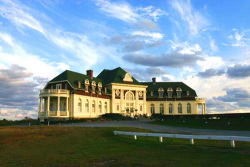

Trump International Aberdeenshire?

According to Frank Urquhart in The Scotsman:
Mr [Donald] Trump is believed to be determined to open an exclusive international course and luxury home development in Scotland to rival his company's flagship course, the Trump National Golf Club, at Briarcliff Manor, New York.

The potential development was welcomed yesterday by tourism and golfing organisations. Mike Young, the golf marketing consultant for VisitScotland Aberdeen and Grampian, said the staging of the seniors' championship last year had already done a lot to raise the profile of the area's golf courses with an American audience.

He said: "I think it is hugely exciting for Aberdeen and Grampian. I think somebody with Donald Trump's international reputation would bring a completely new focus to the area. He would arguably create a new market, rather than compete with what is existing. It is a huge opportunity and if we can do anything at all to help we will."
Tough = Fun, Vol. 9,231

Thanks to readers Josh and Scott for the heads up on Chris Baldwin's excellent rant on the impossible=fun mentality in modern day golf. 

Especially fascinating (well, depressing) are the quotes from Barrie McWha about 6,600 yards becoming the new minimum yardage that he sees many golfers perceiving to be the line in the sand for course legitimacy.

Wi' O' Wi'

From the Desert Sun:

Tribal leaders of Cabazon Band of Mission Indians on Friday chipped onto the first green of what will become an 18-hole, championship Ka´ Wé aH´ Golf Course at Fantasy Springs Casino Resort in an elaborate ground-breaking ceremony.
Renowned golf course architect Clive Clark will design the $10 million project. With carvings that look like alluvial fans already etched into the desert landscape of the 150-acre course, tribal chairman John James called the moment precedent-setting.

Huh? The desert already has a hundred other overbuilt, forgettable layouts. What's the precedent?

He is also the designer of the "Clive" Course at The Hideaway Golf Club in La Quinta and the new West Course at The Golf Resort of Indian Wells. Clark said he keeps getting asked how he'll fashion a course out of a flat piece of land.

"I believe that has advantages,'' as it can be shaped to fit the backdrop of the mountains.

Shaped to fit the backdrop of the mountains? People actually bought that?  

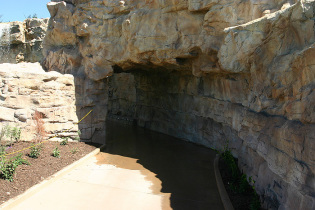
Clark said the Cabazon course will sport roughly 1,500 trees, and include lakes and waterfalls. The 18th hole will also include a water design element that Clark believes has yet to be tried in America, a tumbling water feature with a 30-foot drop. It has been designed in such a way golfers in their carts will roll along a path taking them out onto a lake and through a cave, emerging with a spectacular back view of a massive water fall.

Cutting edge, I tell you. Sad to break the bad news to Clark, but the Donald has "tried" the tumbling waterfall with cart cave at Trump Trails:

1_waterfall.jpg 


Golfers Prefer Well-Conditioned Courses...

How about that newsflash from the city!

At the sixth annual Golf 20/20 Conference last fall, attendees heard a variety of presentations on how to deepen the connection between the game and its best customers, as well as how to further golf among the corporate community...Among the presentations was a detailed look at a survey of avid golfers presented by Jon Last, vice president of research and development for the Golf Digest Companies. According to Last, there are a number of key factors that affect participation by golf's best customers – those defined as avid and core golfers. (Avid golfers play 25 or more rounds a year, core golfers play 8 to 24 rounds.)   Among those factors, the work of golf course superintendents ranked right at the top. When these groups were asked, "Do you generally prefer to play a course that is very challenging, not top condition" or one that is "challenging but in very good condition," 88 percent of them said they'd choose the course in very good condition.   

Really? You don't say? So hard-and-lousy condition lost out to not-as-hard and in great shape. Okay.

They were also asked to rank conditioning against course design in a decision to pay 25 percent higher green fees. The two key groups selected "better course conditioning" twice as often as "better architectures and layout." 

Better architectures? 

Finally, golf's best customers ranked the factors that drive their enjoyment of the game on a scale from 1 to 7. The conditions, people and their own performance received the following mean scores:   

Well maintained greens & bunkers - 6.34
Well maintained fairways & tees - 6.28
The people you play with - 6.24
Playing well on the course - 5.84
Availability of practice facilities - 5.68
Beautiful surroundings and scenery - 5.74
Scoring well - 5.65
Challenging course - 5.65
Fast pace of play - 5.39
Knowledgeable marshals and starters - 5.38

And they forgot to ask about the design of the course...score another one for architecture(s).  

So conditioning is why everyone is going to Bandon? We know it's not because of the weather.

Thanks to reader Josh for this. 

To Go Or Not To Go?

Listening to LA sports talk radio shows slam Pete Carroll over the decision to go for it on fourth down of yesterday's national title game, I got to thinking how rare it is in modern golf to have those essential do-or-die moments that are debated for days, weeks, or even years after. 

It should happen every few weeks. We're lucky if it happens once a year.

A reader told me today about watching Jack Nicklaus at Pebble Beach during the 1982 U.S. Open final round. Nicklaus was debating whether to go for No. 6 in two, concerned that he could not get the ball high enough to clear the hill that bisects the par-5. After an agonizing few minutes, Nicklaus finally decided to go for it. When he pulled his 3-wood headcover off, the crowd went wild.

How rare have those moments become when the player stands in the fairway, actually fretting and debating between a lay-up or go-for-broke shot as we fans debate the situation. How unusual are those memorable events (Curtis Strange at Augusta in 1985 and Chip Beck in 1993 come to mind) when the anticipation is so great that there is an emotional release from the crowd when a decision is made to go-for-broke?

It should happen a lot more in tournament golf, but sadly seems relegated to the times someone drives a par-4. 

Bland architecture is part of the problem, but mostly, the game is just played differently. With trajectory and questions of having enough distance so rarely part of the equation for today's player, we rarely see the golfing elite placed in that tempting, awkward, annoying but possibly rewarding situation that can make golf viewing so captivating.

Well, this rambling rant is just something to remember when you wonder why all of the questions here about the wonders of technology. Or if you wonder why television networks have trouble justifying an investment in televised golf, which just isn't the "product" it could be if the sport was in balance.

On Site Training

LOVEmain.gifLinks has posted my January cover story on player architects Love, Lehman, Faxon, Faldo and Mickelson. The five were included because they are devoting plenty of site time to their projects.

I know, that's not saying a lot when we can count the number of minutes certain legends spend trying avoid getting dirty. But these guys are looking to changethe image and practice of the typical modern player architect (you know, the whole impersonation of an orchestra conductor, designer sunglasses, fawning entourage, Rolex, film crew and design associate whispering-the-owner's-name-in-their-ear motif). 

The Links posting includes my top 5 player architects of all time (and I can already here Jack squealing about coming in fifth behind Weiskopf, Jones, Crenshaw and Old Tom). There is also a short sidebar that looks at Tiger and other young players' possible entry into design.

The Year In Courses: A Preview

newportclubhouse.jpgMy latest Golfobserver.com column is now posted.

2005 really spoiled us in terms of unique, exciting, and must-see courses hosting major events.  Still, there's Newport, Winged Foot and Prairie Dunes. Thank God the USGA Executive Committee still picks courses they want to play the day after.

I know, that doesn't explain going to Rees-stored Torrey Pines. But sometimes you have to pay the bills.

Poppy Hills: You Like Me, You Really Like Me

PoppyField.jpgPoppy Hills is named National Golf Course Owners Association of America course of the year. The cutting edge addition of GPS to the carts made the difference.

In 2005, Poppy Hills made numerous improvements, including the addition of Global Positioning Systems to its golf carts and an Inpractis 4View video system for the driving range. Course conditioning has also been a priority with noticeably firmer and drier conditions now more prevalent.

"We're honored to have been given this award considering the numerous qualified courses across the country," said Poppy Hills General Manager Tyler Jones. "The hard work that [Superintendent] Manny Sousa and [Assistant Superintendent] Kregg Bush have put into course drainage and design improvements is really paying off."

Past winners of the National Course of the Year award include World Tour Golf Links in Myrtle Beach, S.C.; Bay Hill in Orlando, Fla.; and last year's winner, Saratoga National in Saratoga, N.Y.

Thanks to our in-house digital satirist Naccarato for his "Poppy Field" piece accompanying this thread.  

Rees-toration of a Rees-toration?

I can't keep up with all of these brilliant modern classics going under the knife.

First we had Best New Remodel of Best New's, and now we have Rees Jones renovating his own Rees-torations. A Rees-Rees-toration? Or a Ree-ees-toration? Eh, either way, thanks to reader Frenchie for this from PGA.com.

Atlanta Athletic Club is turning Rees loose on their Highlands Course...again. He apparently didn't make it forgettable enough prior to the 2001 PGA Championship, so he's back to install more tees, more 2-d bunkering and more nonsense just in time for the 2011 PGA.

 --All fairway and greenside sand bunkers will be reshaped and made deeper, with new drainage and bunker sand installed.

--The locations of all greenside bunkers will be studied in detail to promote variety and develop more challenging approach shots and hole locations. When reshaped, all greenside bunkers will be shifted closer to the adjacent putting surface.

To promote variety? Hmmm...guess that monotonous left bunker/right bunker thing made every hole bleed together? Shocking.

--Fairway mowing patterns will shift closer to the edge of each renovated fairway bunker.

--All fairways to be regraded and drainage to be installed.

--All tees, collars, approaches, green surrounds that are cut at fairway height and fairways will have Diamond zoysia grass.

All of the holes will undergo some revision, although the greens will not be rebuilt. Most holes will have a new championship tee built, adding length to nearly every hole.

Length? It was plenty long enough in 2002...what happened?

Lost Canyons...Estates and Country Club?

Thanks to reader Scott for the heads up on this Ventura County Star story on Lost Canyons potentially going private and developing the "Shadow Course" into high-end housing. This has been rumored for quite some time.

"I think there is a demand in the town for that kind of land use," said John McClure, a senior vice president with Hillwood Capital, the group that owns the club. "I think it would attract a different kind of client given the number of courses built in the area. We are trying to do something different for ourselves and the city."

As of now, the plan calls for 314 custom-built homes on what is now the Shadow Course, which sits toward the back of the 1,750-acre club. 

And this...

Councilman Steve Sojka sees the good and bad of the proposal and wants the input of residents.

Having the type of exclusive housing that attracts chief executive officers is a boon to the city, Sojka said, but "taking away a public amenity now and making it private for the rich" bothers him.

"My concern is with the community and not the developer's bottom line," he said.


Sherwood Shallow

TargetWorldLogo05.gifStrolling around Sherwood on a cloudy, cool (gosh it never hit 70!) day, I took in some of the Target World Challenge. This is the first time in six years I've seen tournament play at Sherwood after never missing the 11 Shark Shootouts played there.

The late 80s Nicklaus-designed greens, while generally reflective of the dreadfully overdone stuff he built in that era, feature some interesting backslopes, tiers and other banked features that allow the player to play away from the flag to funnel a shot down to corner hole locations.

While not exactly a stellar example of architecture (and certainly not conditioned like it used to be), Sherwood has always been a fun spectator course thanks to the greens. Players have traditionally used the supporting features to work balls down to the hole, allowing the crowd to root balls down a slope and to see players occasionally show flashes of creativity.

Several hole locations today provided fine opportunities for the creative shotmaker to throw a ball to a safe spot away from the hole, and then let it find it's way toward the cup. And every time a player had the opportunity to use these features, they passed.

The most painful example came when Padraig Harrington missed it right of the par-5 fifth green in two, and then he attempted to lob it next to the hole. He ran his third shot right past the hole and off the green. If he had played ten yards right of the hole, a backstop would have slowed his ball down and then sent it toward the hole, leaving him a 10-footer for birdie.

Afterwords, I asked a veteran writer if the players just weren't as creative as they used to be, or if it's a lack of local knowledge. He believes the players are just used to playing shots straight at holes and having them hold. They don't know any other way of playing anymore.

So there you go architects. Are you hoping to separate shotmakers from the rest?  Then create wing and peninsula hole locations that require the placement of a shot landing in a certain spot away from the hole.

Brian Silva suggested that he'd love to see more of this concept on TPC for a Links story, and his observation is looking wiser by the day.


"New Look" Remodel of Another Best New

Just in case you were on the fence about booking a trip to Doral, this press release might help:

DORAL GOLF RESORT & SPA & GREG NORMAN TEAM-UP TO
UNVEIL “NEW LOOK” GREAT WHITE GOLF COURSE
Norman’s Use of Coquina As Primary Design Element Makes Great White Only Course Of Its Kind In The Southeast; One of Five Championship Golf Courses On-Site At Famed Doral Resort
Miami, Fl. – December 6, 2005 – Doral Golf Resort & Spa, A Marriott Resort, home of the famed Blue Monster Golf Course and the PGA TOUR’s Ford Championship at Doral, today unveiled the “New Look” Great White Golf Course, one of five championship golf courses on property at the luxury resort.   A Greg Norman design, the refined Great White Golf Course was officially re-opened on December 6, as Norman, Marriott executives, VIPs and media all participated in an inaugural round in South Florida.

Didn't they just redo this course a few years ago, say 2000?  Sorry, I interrupted before the best part.

The 7,171-yard, par-72 Great White, a Greg Norman Signature Course, is the only golf course of its kind in the Southeastern United States that utilizes coquina -- crushed shells -- as the primary design element on every hole.  In creating the Great White, Norman blended strategically demanding fairways with hundreds of palm trees and sporadic Scottish-style bunkers.  He then laid out the course in a manner where water comes into play on 14 of the 18 holes, which makes for a challenging, but picturesque Great White Golf Course.

Coquina? Sounds like Tony Montana's little friend.

On the heels of Marriott International assuming management of the property in August 2004, the Great White has undergone a series of refinements designed to further enhance the course, which was rated as The Best New Golf Course when it opened in 2000, according to the National Golf Foundation. 

The National Golf Foundation has a ranking? There's a news flash from the city. Oh, and another Best New goes under the knife. What is it with these Best New's lately?

“With increased areas of turfgrass and the liberal use of crushed coquina shells, we have enhanced both the challenge and the playability of this golf course,” Norman said. “It’s a departure that complements the other four courses at Doral very well.”

Oh, this must have been the one that was too hard. Well maybe they got it right this time.

Barona Had Just One Obstacle...

Five-year-old Barona Creek (No. 78 in Golfweek's Top 100 Modern) has overcome its dated back tee yardage to earn the right to host two Nationwide Tour Championships. Tod Leonard writes:

With a hotel/casino on site and plenty of room for corporate hospitality and the expected 5,000 spectators, Barona's only obstacle to getting a top-level event was its length. At 7,088 yards from the championship tees, it was deemed short for today's big hitters with high-tech clubs. In October's Collegiate Cup, for example, Denver's James Love shot a 10-under-par 62 in the first round and went on to card 15-under in three rounds.

But the club has made extensive renovations this fall, adding 12 new tees to lengthen the course to about 7,500 yards. Several jagged-edged bunkers – among the course's standout design traits – were added.