Martin Flashback: Did Jack Really Support The Commissioner's Case Against Casey?
/With Casey Martin qualifying for the U.S. Open at Olympic Club, it's worth revisiting
Read More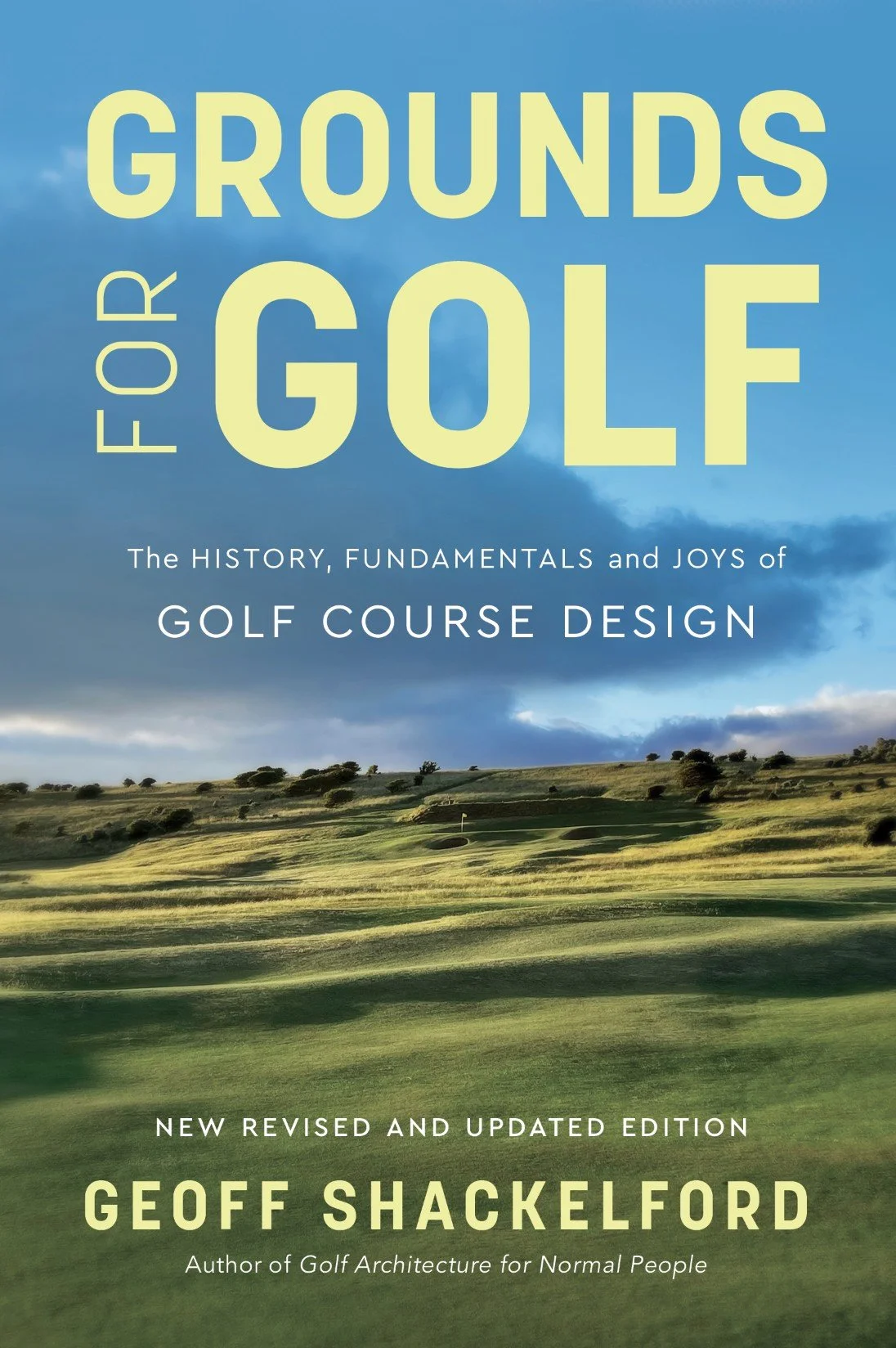
It’s back!
Twenty years later Tatra Press has kindly allowed me to bring back Grounds For Golf now that golf architecture is of more interest to the masses. A new Introduction looks at what’s driven the interest growth and two new chapters I had a blast adding (plus a few edits to keep things up-to-date).
The Amazon purchase page for the book arriving June 15, 2026.
I suppose it is wise for PGATour.com to edit out references to the darkest days of Commissioner Tim Finchem's tenure. After all, Commissioner Aladeen, who appealed all the way to the Supreme Court but who won't endorse penalty shots for slow play, might realize he once made a truly awful, career-defining executive decision.
 But gosh it's fun to read the red-lined version of the AP story.
Here are two separate paragraphs from the PGATour.com version:
Martin, who won the right to ride a cart because of a rare circulatory disorder in his right leg, earned a spot in the U.S. Open on Monday night when he holed a 5-foot par putt in darkness on the final hole at Emerald Valley Golf Club.
Martin earned his way onto the PGA TOUR in 1999. He failed to keep his TOUR card after one year, and eventually became the golf coach at Oregon.
 And how the story appeared on the wires, with underline added to highlight the dreaded truth cut from the PGATour.com copy:
Martin, who successfully sued for the right to ride a cart because of a rare circulatory disorder in his right leg, earned a spot in the U.S. Open on Monday night when he holed a 5-foot par putt in darkness on the final hole at Emerald Valley Golf Club.
Martin earned his way onto the PGA Tour in 1999 and eventually won his lawsuit to ride a cart. He failed to keep his PGA Tour card after one year, and eventually became the golf coach at Oregon.
 John Huggan profiles Rich Beem, who has a lot to say about life on the European Tour (playing off his major championship win exemption) compared with the PGA Tour. This was interesting:
“In the US we sometimes lose sight of what is important. There’s a lot of ‘flash’ over there right now. Wins are what really count though. And major wins count even more. Ask anyone how many events Jack Nicklaus won and not many will know. Ask how many majors he has and almost everyone knows. I would hope that the young kids on the PGA Tour think that way too, because it’s very evident to me that their counterparts over here think of nothing else. They want to win any tournament, but they really want to win the big ones.”
From Doug Ferguson's notes column as the BMW Championship prepares to get underway at Wentworth. The World Top 50 plus past major winners are exempt. Only Shaun Micheel, Rich Beem and Ben Curtis are representing the Stars and Stripes.
Luke Donald wishes it would attract more Americans, though he understands the reasons not to play.
"You don't have to travel far to play in a $6 million event at a great course at Colonial," Donald said at Sawgrass. "But I've always been a proponent of to get the most out of your game, it's important to travel and to experience new places. I think at least go try it once, and if you don't like it, fair enough. But it's a big event on our tour. It's considered our Players Championship of the European Tour. And I would have thought that would incite some interest in some of the big Americans that would be exempt for it."
I did an informal poll of players at The Players and asked what question they'd most like to have me ask Commissioner Tim Finchem during his 2012 Players "state of the tour" presser. Slow play on the tour won in a landslide and the Commissioner Denial didn't disappoint!
Let's go to the tape...
Q. Top players like Luke Donald have said that they believe slow play is killing their sport, our sport. Do you feel an urgency at all to address slow play, and do you feel the TOUR has an obligation to set an example for the game when it comes to pace of play?
COMMISSIONER FINCHEM: You know, as long as I've been in the game, this has been a constant discussion. There really isn't any difference.
No, just about an hour more tacked on to the round. That's all. Go on...
A lot of people look at the deliberate nature of the way we play the game at the TOUR level and relate that to when somebody says it's impacting the game negatively, they are referring to the amateur or average player making a determination whether they want to play golf if it takes me X long to play.
Now if you look at my question, I tried to help the Commish by mentioning Luke Donald's name, but he didn't take the hint and I'm guessing he's not a big Twitter guy. So for the Commish: here are Luke's comments, most definitely not directed away from the tour, or, TOUR level.
After bellowing on about his preferences for fast play at the "club" level (he's sooo in touch with the everyday game he only mentioned club golf multiple times), Commissioner Fast Play got to the legitimate argument about field size...
When we put 156 people on the golf course, they are not going to play in four hours, typically.
Now, when we cut, on the weekend, and we go to, let's say we have got 70 and ties and we are at 74, then we are playing, what, if we play in twos, we are probably playing in 3:45.
These are the same guys that played on Thursday and Friday. These are the same guys that are showing the same deliberation. But when you put that many people on a golf course, that's just not going to happen.
On a Pro‑Am day when you play four amateurs and a professional and now you're five, you're playing a good Pro‑Am at 5 1/2. We elect to continue to do that because we want that many people playing in the Pro‑Am, and it's kind of a different experience, anyway.
We are all ears to suggestions to help make the game of golf either faster, or funner; that's the way I refer to it. Can we make it faster; can we make it funner?
Yes, make it faster! Keep the fields large.
And Jack Nicklaus addressed this at Augusta. He said we architects‑‑ all of us in golf are to blame. Architects are at the top of the list; we made the golf courses too difficult. If it ain't much fun and it's slow to play, that's not what we're looking for.
Anything we can do from‑‑ we reach all of the fans. Anything we can do from a communications standpoint to encourage people playing faster, we will do. But clubs have got to take the initiative to drive play, and the average player has got to take the initiative and say, guys, let's go out here and play in three hours and 45 minutes, and that doesn't happen too many places.
So if I'm watching‑‑ I'm giving you a long answer, but I've been talking about this for a long time. If I'm watching a PGA TOUR player, and I'm going to go through the same pre‑shot routine that that player takes, and he's hitting it 69 times and I'm hitting it 93, I'm going to be playing a lot longer than that guy. So it's a different game from that perspective.
Again, this is not a PGA Tour problem. Well, kind of since it's their routines setting a bad example. So...which is it Tim?
And if you notice our players, they move; they don't want to be on the clock.
Except Webb. And Ben. And Zach. And...
They hit a shot and they move. But there are different variables out here at this level and we measure it pretty carefully.
One thing we are sensitive to is a player who is slow and as such impacts his fellow competitor, which is a different thing from how long it takes to play. That results in some counseling, and we have had good success with counseling.
Counseling!
But I don't think PGA TOUR golf is the culprit here. I think the culprit is taking steps to drive the pace of play for the average player, and if we can be helpful in that regard, we're open to it.
Q. The USGA has a pace of play system they have implemented in all their championships except the U.S. Open, and they feel they need the TOUR to implement a similar system with penalty shotsfor them to be able to introduce it to the U.S. Open.
COMMISSIONER FINCHEM: I actually think we might want to experiment with penalty shots. But I don't think penalty shots make a difference to be honest with you.
Experiment with them? Pssssst Tim. You have slow play rules you don't enforce. Are you saying you don't believe in the rules in place? Not a big rules guy these days?
Conceptually it makes sense. If you're going to put a couple of shots on a guy, it's going to make him play faster. But that's not the culprit. The slow player, even though we have some slow players, is the system that's creating what you're seeing on television.
In today's world, we go to a golf course like we just left in California, Poppy Hills, and you've got like three drivable 5s and a drivable 4, and with a full field in our tournament, you're going to back up.
I'm sorry, Poppy Hills? Last played in 2010? That Poppy Hills? Go on...
People are going to wait. That's just the way it is. The only way, we have to have smaller fields.
Now, you have players on our TOUR who would say, yes, we do; let's have them. Let's put 130 players out there, 122 players. At Augusta, they get nervous if you are going over a hundred players. And let's have a good pace of play.
We elect not to do that, because as much as we like to see a stronger pace of play, the playing opportunities for the number of players we have had are more important, and we'll generate the playing opportunities first and take our lumps second. It's as simple as that.
At least he was honest in that last part. It's as simple as that.
Geoff Shackelford is a Senior Writer for Golfweek magazine, a weekly contributor to Golf Channel's Morning

Copyright © 2022, Geoff Shackelford. All rights reserved.