
New Golf Rules: A Closer Look At Changes Related To Bunkers

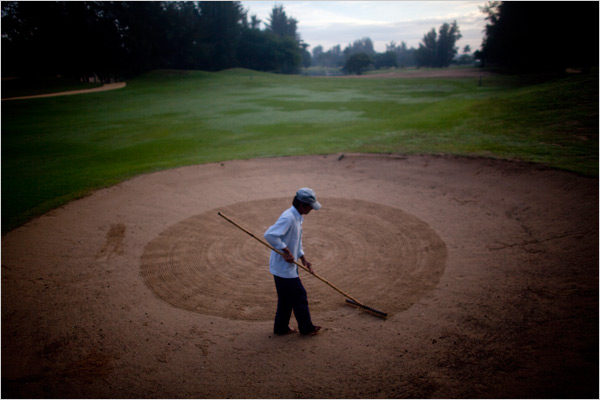
I'll leave some of the proposed Rules of Golf changes to the wonks to dissect after they are unveiled, but from an architecture and course setup perspective, I'm fascinated by the change of approach to bunkers.
Here is what is outlined in the proposal:

•    Relaxed restrictions on touching the sand with your hand or club when your ball is in a bunker: You are now prohibited only from touching the sand (1) with your hand or club to test the condition of the bunker or (2) with your club in the area right behind or in front of the ball, in making a practice swing or in making the backswing for your stroke.

We all know this is a response to multiple video replay issues where the club could be seen touching the sand and the player was prosecuted for an inadvertent mistake. No one will miss those days.

•    New unplayable ball relief option: For two penalty strokes, you may take relief outside the bunker by dropping a ball back on a line from the hole through where your ball was at rest in the bunker.

I haven't a clue what this unplayable option does to improve the game other than speed things up on a golf course with quicksand bunkers, so let's ignore that one.

•    Removal of special restrictions on moving loose impediments: There is no longer a penalty if you touch or move loose impediments in a bunker.

"Play it as it lies" is a principle of importance since it was a bedrock of the original rules. Rules, Decisions and other changes in the game have dented the meaning of playing it as it lies in a sport that originally resonated because it was nature-based. So will this new language make bunkers more or less hazardous and more or less maintained.

I'm hoping more hazardous and less maintained.

We all hate rocks in bunkers and what they do to a pretty new wedge. And perhaps with a loose impediment rule the governing bodies are actually applying reverse psychology here by saying to courses you don't need to spend so much time on making bunkers perfect, rock-free sanctuaries for recovery.

Yet I can't help but think that given the freedom to fidget with the playing surface, modern players will continue to see bunkers as a sacred place where all golfers are entitled to a recovery and pristine lie at all times. Or, play it as I want it to lie.

Yuck!

We shall see...

First Look: Proposed Changes To The Rules Of Golf, What Stands Out?

Scheduled for a rollout on Golf Channel's Morning Drive (7 am Wednesday) along with a media teleconference at the same time, the new Rules of Golf will aim to "modernize the Rules and make them easier to understand and apply."

The expedited proposal, going out for public consideration with a January 1, 2019 implementation goal, appears determined to speed up the game and, intentionally or not, bifurcate elite tournament golf and the everyday game.

From the materials I've seen and in discussions with those briefed, here are the highlights of the many "relaxed" rules (where have I heard that term?):

--No more penalties for accidentally moving a ball on the putting green or in searching for a ball

--Golfers may putt without having the flagstick attended or removed. A speed of play, play.

--Repairing spike marks and other damage on the putting green to be allowed. Not a speed of play helper.

--More red hazard lines to include desert areas and no penalty for touching the hazard in such an area, which also includes moving loose impediments.

--In bunkers, no penalty for touching loose impediments or for touching the sand with a hand or club. Still no grounding the club next to the ball or in front of the ball. We'll call this the Anna rule.

--We trust you, we really really trust you rules. This is a video evidence situation again, allowing for "reasonable judgement" when estimating point of entry drops, etc...

--Reduced time for searching for a lost ball from five down to three minutes

--You can keep playing a damaged club during a round. No penalty for an altered club, even if you wrapped it around a tree in a childish hissy-fit.

--Use of distance measuring devices permitted at all times, except by Local Rule (this should be fun for Augusta and the PGA Tour).

--No more caddies lining up players before a shot. This was almost strictly an LPGA Tour problem.

--A new “Maximum Score” form of stroke play, where your score can be capped to a number set by the Committee. In this proposed format you can pick up and move to the next hole when your score "will be at or above the maximum."

--New presentation of how the rules are presented

--New "plain" language in the writing of the rules

So what stands out?

For my money, the positives are various headache situations in everyday tournament golf coming to an end.

The use of rangefinders will be applauded, hailed and declared the key to speeding up the game. Little difference will be seen, but at least we'll be able to put another savior to bed on the pace of play front.

The ability to repair "spike" marks in a sport almost devoid of spikes contradicts the efforts to speed up the sport and appears to be mostly for tour players.

Hey Siri: Rules Of Golf Figure To Look Different In Two Years

Ryan Herrington reports for GolfDigest.com on the likelihood of seeing a vastly revamped, simplified and codified Rules of Golf by January 1, 2019, a year earlier than expected.

Surprising, however, are the plans to take the visual and technological presentation of the Rules to a different level.

In aiming to make the Rules more easily understandable, the modernization project has focused on using visuals to help articulate the Rules in a more impactful way than mere words. Bodenhamer said that the use photos, images and even video to provide greater explanation has been explored and is likely to be implemented.

Davis, too, stressed a need for technology to help update and deliver the Rules in the 21st century.

“How come we can’t have an instance where someone can [take their phone and] say ‘Siri, I hit my ball into a water hazard. What are my options?’ ” Davis said.

It pains this Apple fanboy to say it, but Alexa would probably do better on the Rules of Golf test.

Local Rule! Intent! The R&A And USGA Wisely Relent On Accidental Ball Movement

The governing bodies have long resisted introducing the question of intent to the Rules of Golf. They've also been loathe to introduce Local Rules because players have shown a tendency to not understand read them and not all courses get the message (but they do often lead to progressive Rules shifts).

But with one smart gesture preventing the game from three more years of silliness (until the next Rules of Golf update), they've introduced a local rule that eliminates a penalty for accidental ball movements. While it'll inevitably be dubbed the Dustin Johnson rule, there were many victims along the way.

Josh Sens at Golf.com scored an exclusive (well, embargoed) interview with the USGA's Thomas Pagel who wisely doesn't shy away from the motivation.

"Oakmont certainly did bring the matter to a lot of people's attention, and it did prompt us toward further conversation," Pagel said.

Phil Casey with this account of the change and quotes the R&A David Rickman:

"It was certainly a very difficult case but within the rules environment it was more the repetition of incidents rather than one or two which was of greater concern.

"We had one or two situations at the Open which happened the following month, a couple at the Olympics.

The full press release:

New Local Rule Eliminates Penalty for a Player Who Accidentally Causes a Ball to Move on the Putting Green

FAR HILLS, N.J. (Dec. 8, 2016) – The USGA and The R&A today announced the introduction of a new Local Rule that eliminates the penalty when a ball is accidentally moved on the putting green.

The Local Rule will be available for any committee in charge of a competition to use starting Jan. 1, 2017. It will be adopted by the USGA and The R&A in all of their championships, qualifying competitions and international matches.

“Eliminating this penalty responds to the concerns we have heard from both golfers and committees about the difficulties in applying the current Rules when a player accidentally causes a ball to move on the putting green,” said Thomas Pagel, USGA senior director, Rules of Golf and Amateur Status, said. “This change is a good example of the type of Rules Modernization changes we hope to implement after completing our fundamental review of all of the Rules. We are looking for ways to improve the Rules by making them easier to understand and apply.”

David Rickman, executive director - Governance at The R&A, said, “For the past several years, as part of The R&A and USGA’s Rules Modernization initiative, we have considered the penalty for a ball that is accidentally moved on the putting green. Both Rules Committees agreed that it needed to be changed and decided that in this particular case it was important to act now, through a Local Rule, rather than wait for the next overall set of revisions to the Rules of Golf.”

The Local Rule has been welcomed by all of the major tours worldwide, and the PGA Tour, European Tour, LPGA, PGA of America and the Masters Tournament are among the golf organizations that will implement the Local Rule for all future events, beginning Jan.1, 2017.  

If a committee wishes to introduce this Local Rule, the following wording is recommended:

“Rules 18-2, 18-3 and 20-1 are modified as follows:

When a player’s ball lies on the putting green, there is no penalty if the ball or ball-marker is accidentally moved by the player, his partner, his opponent, or any of their caddies or equipment.

The moved ball or ball-marker must be replaced as provided in Rules 18-2, 18-3 and 20-1.

This Local Rule applies only when the player’s ball or ball-marker lies on the putting green and any movement is accidental.

Note: If it is determined that a player’s ball on the putting green was moved as a result of wind, water or some other natural cause such as the effects of gravity, the ball must be played as it lies from its new location. A ball-marker moved in such circumstances is replaced.”

For more information about the new Local Rule, including explanatory diagrams, videos and a detailed question-and-answer document, please visit www.usga.org/2017localrule.

Now we just have to get the word out to all golf courses, though this is really largely an issue where High Definition television and people who don't hit the ball any longer than they did five years ago converge with greens Stimping 14.

Kostis: "The USGA and R&A look like ambulance chasers, eager to find fault with you at every turn."

If you can get Golf.com to hold still for a second and stop playing irrelevant videos, this Peter Kostis piece on the current state of golf's rules is worth a read.

Strong words here on how the rules seem to no longer be our friend, but instead, the golfer's enemy:

In addition to updating the "Ball at Rest Moved By Player, Partner, Caddie or Equipment" rule (18-2), which went into effect at the start of this year, the USGA also decreed that you may no longer post scores for handicap purposes if you play by yourself. It's another example of the governing bodies looking over our shoulders, like Big Brother. Apparently, they don't consider golfers to be trustworthy. So we have an issue: Golf is either the pristine, righteous game they proclaim it to be, or it's not—in which case the USGA and R&A look like ambulance chasers, eager to find fault with you at every turn. The latter mentality mocks everything the game is supposed to stand for.

USGA, R&A Eye Rules Overhaul As Grow-The-Game Initiative!?

We've known the governing bodies have been meeting for some time to work out simplification of golf's bloated Rules book, but it's a bit disappointing see from the initial rollout that this will be branded as a grow-the-game cause.

I find that disappointing because (A) golf needs another grow-the-game initiative like another 72-hole stroke play even, and (B) the numbers of interested golfers staying away from the sport due the rules are outnumbered by those sitting out due to cost and time.

Brian Costa, writing for the Wall Street Journal, was the first to get to channel the hoped-for USGA message which is not, "we've made the rules a bloated mess and are fixing them." Instead, it's, "the rules can be intimidating to new players and we're here to change that. #growthegame"

“This is just a chance to reset,” said USGA chief executive Mike Davis. “The idea is if we get this right, many more golfers will embrace and understand the rules.”

The USGA is hoping to release a draft of the new rules for feedback from recreational players in 2017, though it could be another few years before they take effect.

John Bodenhamer, the USGA’s head of rules, competitions and equipment standards, likened it to the 1971 publication of the Living Bible, a more accessible version of the King James Bible. “I think it’s fair to say that some golfers, perhaps many, are intimidated in picking up the rule book,” Bodenhamer said. “We want to be able to help golfers with that.”

Again, I just don't think many golfers are sitting on the sidelines because of the density of the Decisions book. There are many golf fans on the fence right now about the governing bodies given the various TV rules situations. But beginners upset at the seven ways your can drop the ball as outlined in Decision 18-2? No.

There also is effort here by the USGA (in particular) to get the conversation away from their handling of situations like Dustin Johnson at Oakmont and onto an everyday game impacted by the rules. However, the USGA perception is no longer one of a body that doesn't care about the average man. Instead. it's viewed as one that is insensitive to all classes of player in the implementation of the rules. Fixing that perception will be beneficial from all of these closed door meetings with the R&A.

To understand their branding/PR issues, consider this quote from Daniel Summerhays, picked up by CBS/Golf Channel mics during Barclays round two play as Rory McIlroy thought his ball moved on the green.


At least in the minds of tour players, the USGA and R&A tried to fix the issue of balls moving on greens cut to absurdly low heights, and still didn't get it right.

Diaz: What Really Happened At Oakmont

Now that Dustin Johnson has spoken and has not had his mind changed a bit about his actions at Oakmont (Will Gray reports), Jaime Diaz has filed an in-depth, definitive account for the September Golf Digest of the 2016 U.S. Open's Dustin Johnson penalty. While most of the facts will still be very familiar, Diaz brings in views of some notable rules figures and tries to figure out the options for changing the rule.

This from two noted USGA veterans stood out, starting with comments from David Eger:


Eger believes the right call was made based on the rule as written, but admits his experience writing, interpreting and administering the rules gives him an uncommon perspective. “All the rules officials I know think Dustin broke the rule, but none of my friends who I play golf with think he did. None of my friends have all the information. They use the wrong criteria to judge. But the rules are so fastidious, precise and often complicated.”

But David Fay, the USGA’s executive director for two decades, who served as the Fox telecast’s rules expert, contends the Johnson ruling was a close one even for officials. “You could get 10 rules experts and show them video evidence of Wattel and Johnson’s actions around the ball. I guarantee some would say Wattel deserved a penalty and Johnson didn’t, or that neither deserved a penalty, or that both did.”


Wonderful!

There was also this from Diaz:


In retrospect, executive director Mike Davis, didn’t take charge at a time when an accountable leader was desperately needed to speak for the organization. Hall and Pagel were too careful and scripted in their interviews on Fox and Golf Channel, clearly looking over their shoulder. At Oakmont, the buck had no place to stop.

I think this next part is where the average golfer differs from the rules expert, but nearly two weeks later I'm still not entirely sure why the experts are so sure of their stance.

But in trying to solve a problem, the new rule created new ones that are arguably worse. The main one? When it comes to determining what made a ball move short of the club hitting the ball, there is almost never anything close to “proof” that a player’s actions were the cause. “More likely than not” or “51 percent of the evidence” is a recipe for too many close calls that will leave a feeling of player victimization, especially if and when it costs someone a championship.

U.S. Open: "It was clearly an institutional breakdown in communication and procedures."

Watching how replay has been used in other sports (particularly baseball, football, tennis), most sports fans have accepted the use of technology to get calls right. We've seen so many calls either confirmed or overturned for the betterment of the competition we are watching, and, let's face it, in a way that has made the sports more entertaining. Yet the USGA ruling at Oakmont stands as the most confusing, unnecessary and frighteningly dangerous use of video replay most sports fans have seen, even if it was an accurate interpretation of the Rules of Golf "Decisions".

So no matter how great a story Billy Hurley is, or what a magnificent weekend golf enjoyed with a combination of old (Ernie, Vijay, Henrik) and young names (Rahm, Lydia, Ollie) playing so well, the U.S. Open continues to be the 19th Hole subject of discussion.

And I'm still waiting to hear how it gets better for the USGA.

The SI/golf.com roundtable is not the place for the folks in Far Hills to look.

Alan Shipnuck, senior writer, Sports Illustrated (@AlanShipnuck): It was a brutal public relations hit for the USGA, and Davis’s quasi-apology didn’t really help. I got the first interview with him at Oakmont. Davis was upstairs in the locker room changing into his tie for the trophy presentation and I pounced on him. At that point DJ was on the 16th hole and Davis still hadn’t seen video of the incident! He was just going by reports from other staffers. It was clearly an institutional breakdown in communication and procedures. This will all lead to some soul-searching and clearly the USGA needs to overhaul how it handles things on the ground at big tournaments. 

That's just bizarre.

Bamberger tries to see nuance and both sides and comes closest to defending the decision, even though he's no in agreement:

In my opinion, the videotape was completely inconclusive and I would have not accessed Johnson the shot, but to reach another conclusion is entirely reasonable. Now if you want to say there should be a new rule by which these minute movements shouldn’t matter, go ahead and try to draft such a rule. But right now, the rule is that any movement must be accounted for and the USGA was trying to do right by Johnson and the rest of the field. That is its obligation. The rest -- including Tiger and Jordan and Big Jack himself -- is noise. The USGA is not in the public-relations business. Its purpose is to stage a championship and assure that the rules, which it tries constantly to improve, are applied fairly to all. 

And the last word from Gary Van Sickle speaks to what I sense many golfers feel:

Nice of Davis to apologize for delay in penalty assessment, a terrible mistake. But by Monday, he had plenty of time to recognize that Hall and Pagel had wrongly assessed a penalty and ignored USGA’s own definition that “unless the facts show that a player caused the ball to move,” there is no penalty. I lost a lot of respect for the USGA on this one. This can’t happen again.