Video: New Nike Ad Spoofs Ball Regulationists
/Tip of the cap to Kyle Porter for
Read More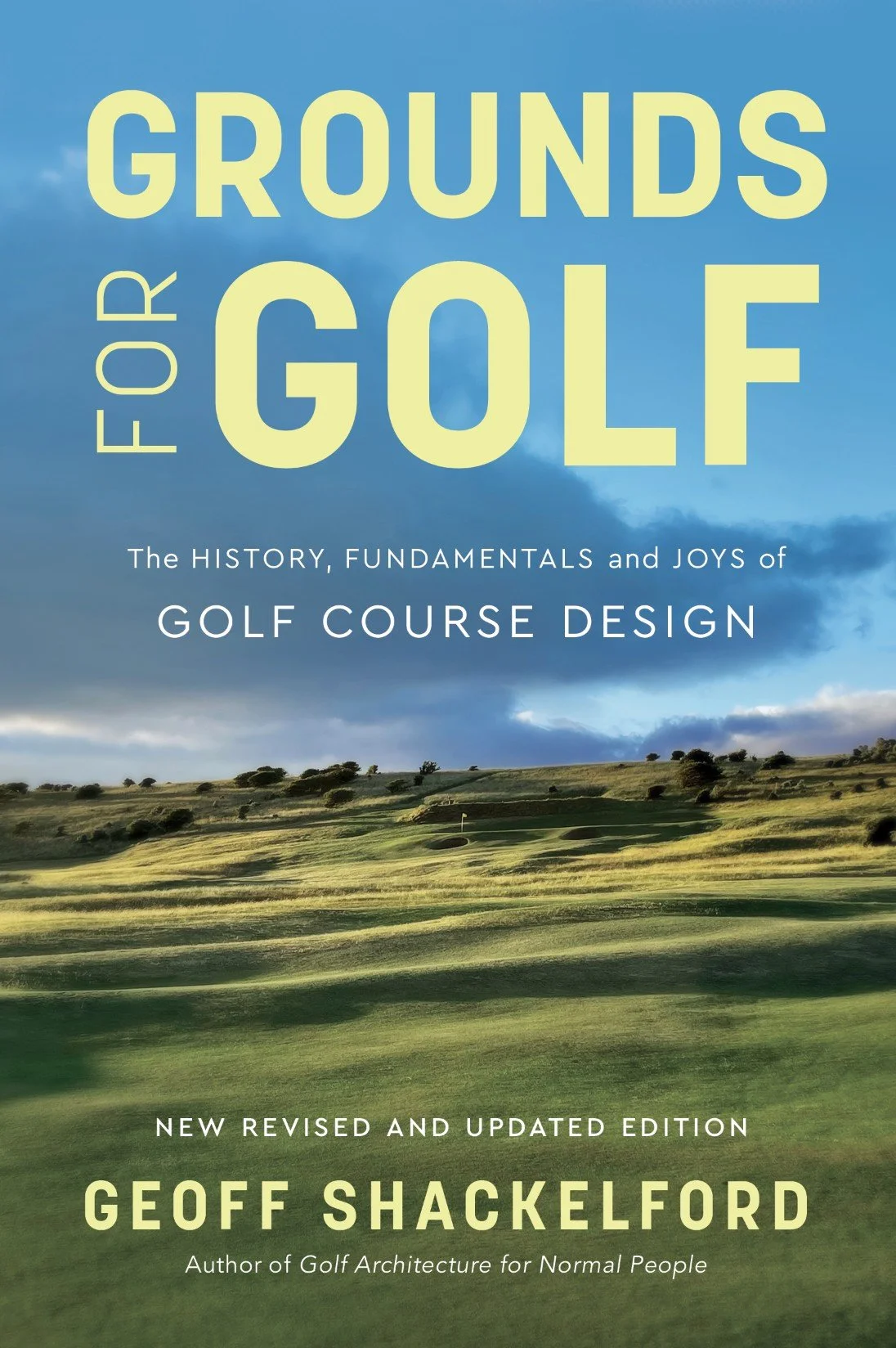
It’s back!
Twenty years later Tatra Press has kindly allowed me to bring back Grounds For Golf now that golf architecture is of more interest to the masses. A new Introduction looks at what’s driven the interest growth and two new chapters I had a blast adding (plus a few edits to keep things up-to-date).
The Amazon purchase page for the book arriving June 15, 2026.
In the latest Golf Digest, former USGA Executive Director David Fay explains the issues involved with changing equipment rules and eventually gets to the point on many minds: the golf ball.
If the USGA and R&A are really serious about rolling back the golf ball, the important constituents who had a vote on the grooves change will be at the decision-making table. And they'll have veto power, too, because they represent their constituents' interests. (Other than restoring approach-shot values on classic older courses at which his players seldom perform, I imagine Tim Finchem wondering what the upside would be for the PGA Tour, and not finding much.) But who will speak for the rest of us: the 99 percenters, who've already been encouraged to "tee it forward"?
 Of course it was Fay who alerted us last year to the ability of rulesmakers to merely use a condition of competition to usher in a rolled back ball without fussing with the masses.
Tucked away near the back of the R&A/USGA Rules of Golf is a section titled Conditions of the Competition. The portion dealing with clubs and ball requirements begins: "The following conditions are recommended only for competitions involving expert players." Key word: only.
Which leads me to Missy Jones' GolfTraditions.com story wondering what all the fuss is over with the latest rules bifurcation talk.
Another argument for bifurcation that I hear is that the pros need to have a golf ball that doesn’t go as far and amateurs need a ball that goes farther. So? Why would you have to change the rules for that? Again, the Rules of Golf are flexible. Handle that in the Conditions of Competition or Notice to Players part of the championship. You know those sheets of paper that players rarely read?
Which got me thinking: tennis quietly alters the dynamics of tennis balls during the grand slam events, why not allow for this in golf? Bifurcation at times when it's necessary--when tournaments are played at places like Merion, Riviera, Olympic Club, Pebble Beach, St. Andrews--and today's ball in play at the Dove Mountain's and TPC San Antonio's of the world?
Yes, this adds another ball to the world and enforcement issues, but maybe we can satisfy all interests by using the Conditions of Competition to get the best out of all venues?
Jaime Diaz takes the pulse of folks at recent industry shows and the bifurcation word just keeps coming up for golf, no matter the context whether it be rangefinders, equipment or putters.
 Diaz makes the case for rules tweaks that impact the professional.
The professional tours, and especially major championship golf, would be better with a golf ball that underwent a distance rollback of 10 percent. Don't worry, a Dustin Johnson drive will still look awesome flying 290 yards instead of 325. But more importantly, a rolled-back ball would increase the premium on player skill, bring the driver out of the bag much more often, create more variety in the shape of approach shots, allow the best players to separate from the pack more easily, lead to more classic venues, stop the proliferation of extreme course setups that feature heavy rough and ultra-firm greens, and speed up play. This more interesting version of golf on the biggest stages would make the recreational game more popular and alluring.
When I think of the great places in the game, Rancho Park always comes to mind because it is the only existing course in America to have hosted all three tours (PGA, Champions, LPGA), millions of rounds of golf and remains the essentially the same place the West Los Angeles muni has been all of my lifetime: a special place to play golf. Yes, they've raised green fees and conditioning is in flux with the incompetent city of LA in charge, but the people make the place and always have. Michael Bamberger captures it all in a nutshell after just one recent visit.
In the parking lot, I saw a young guy hop out of his truck, zip oranges into his golf bag, slide into his spikes and march off to the clubhouse. (Such an echt display of pre-round enthusiasm.) In the restaurant/pro shop, a man in a nearby booth ate breakfast with his bag beside him, headcovers on all 14 of his companions. A waitress arranged for my rental set, an interesting assortment of lost treasures: Ping Eye 2s, Titleists likely from another century, Stratas, a Zebra putter. On the driving range, there was a middle-aged man loading up his face with sunblock and his mouth with chew. All the while, over loudspeakers, the starter announced the batters off his ever-changing lineup card: Aiello, Shapiro, Chu. The American tapestry.
Working off of Tom O'Toole's Annual Meeting speech outlining an emphasis on growing the game, Ron Sirak proposes a few ways they can spend Fox's their newfound millions. The two I liked most:
• The USGA needs to have public golf represented on its 15-person Executive Committee. Not only are all the current members affiliated with private clubs, they come from the most elite clubs in the country. Since the Executive Committee is composed of volunteers -- one told me he spent $60,000 out of his own pocket to attend championships and meetings -- the USGA would have to subsidize public-course representatives. Still, the USGA at its highest level needs to have a direct connection to what life is like at daily-fee and public courses. It would be money well spent.
• It should encourage every private club to grant four "scholarships" a year, giving juniors playing privileges and free lessons. Base the scholarships not on playing ability but community service or grades. The purpose is not to produce pros but rather players for life. Many likely would end up joining their host club.
Author of 14 books and numerous magazine stories, Curt Sampson joins us for the latest State Of The Game.
As always you can download the mp3 here, listen to this episode on iTunes, or subscribe to this and other episodes via iTunes.
Geoff Shackelford is a Senior Writer for Golfweek magazine, a weekly contributor to Golf Channel's Morning



Copyright © 2022, Geoff Shackelford. All rights reserved.