Course Changes Verdict Watch

masterslogo2.gifShould be fun to see how many writers/players declare the course changes:

A) to have been validated by a Phil Mickelson win/Tim Clark 2nd place finish

B) confirmation that only bombers can win

C) that it rained and therefore it was still too wet to judge

D) that the winning score was 7-under-par, therefore it was a success (always such a nuanced take on things!)

The lengthening of the course has been "validated" because Augusta National would have been terribly outdated had they not responded in some way to the recent optimization boom. 

As far as restoring club's that Bobby Jones intended players to hit, there are serious problems with that logic. Not only are lofts different today than when Jones wrote about what players hit into holes, anyone who has read his descriptions knows he was not trying to lay down the law on proper approach clubs. It just wasn't his style.

230136-310793-thumbnail.jpg
(click to enlarge, though I don't know why you would want to)
The narrowness and tree planting designed to force players into less bold tee-shot play (as Hootie Johnson described earlier in the week), has severely impacted that old sense that it was only the players, the design and the Golf Gods dictating the outcome.

Now it feels like a battle between committee and player, with the potential for excitement at the mercy of the committee. That may provide an ego boost for them, but the desire to keep winning scores in check makes it boring for fans.

If they had just added length over the last 8 years but did not add the second cut and trees that eliminate options, would there be any criticism of the changes?

I say no.

Some Quick Final Round Thoughts

masterslogo2.gifWell, I don't know about you, but after those Exxon-Mobil ads, I'm ready to forgive the Valdez, the various shenanigans and the $40 I gave them for 13 gallons of gas this morning.

Any company that loves children that much, must be special.

By the way, if you need to induce a migraine, you can relive those ads here. And if you want to read about some shareholders who filed a resolution accusing the company of discrimination for sponsoring the Masters, you can go here (and even read a quote from the long, lost Martha Burke).

Oh, the golf...

Good thing there was no playoff: Leaders Start Time: 2:52 EST, Finish Time: 7:26, Sunset: 7:55

Angles: Loved the Clampett-Wadkins debate about the talk of angles on No. 11 when Couples and Mickelson had different views of the hole. Imagine if the players could actually pick a side instead of trying to keep it in a 25-yard wide fairway.

"With all due respect, those hugs mean more than the green jacket.": Wow, Phil and Rick Smith are close, but come on Jim Nantz? Oh, you mean the kids...love Lord Fauntleroy suit on Evan. Who's doing his highlights?

Options: Impressed by Peter Kostis's Orwellian take on No. 7, explaining how the new length "gives the players options." A new 12th tee at 275 yards out would install some options there too.

Bored: Did you catch the reclining rules official on No. 13 with his legs stretched out, as if he was sitting on the beach? Classy touch.

Clampett: Minimal nonsense today, only a couple of Hogan's Bridge remarks, and only one head scratcher that came when talking about No. 11: "nobody has figured out a way to make birdie here...except Larry Mize."  Hey, there were 6 birdies just this week! Sorry...

No. 11 Final Tally: Average 4.4745, Rank    1, Eagles 1, Birdies  6, Pars  158, Bogies  86, Doubles  19, Others   4

Driving Distance: The average of all drives recorded was 282.9 yards. The top 5 for those playing all four rounds? Mickelson, Couples , Singh, Pampling, Beem. That didn't stop Kostis from trying to paint Tim Clark as the new poster boy for Hootie Johnson's course changes. Still, Feherty did a much better job Peter and he should win this year's award from the Total Information Awareness Committee.

Your thoughts? 


Sherman: Augusta Unveiled

Ed Sherman points out several things you may or may not know about Augusta National Golf Club:
Burning: You would expect that Masters caps would be the best sellers in the merchandise store here. But Masters scented candles? Apparently, they fly off the shelves. Perhaps nothing sets a romantic mood better than an Augusta candle.

The candles supposedly a have floral scent. But if the club really wanted to get authentic, it would devise a candle that smells like a used towel from one of the caddies.

High-ranking assistance: Augusta's membership roll features the high and mighty, and many are put to work during the tournament. Still, it's surprising to see former U.S. Sen. Sam Nunn of Georgia listed on the media committee.

Nunn hasn't been seen in the press room this year, but he did find his way there last year. It would be a sportswriter's dream to say, "Hey, Senator, can you get me the quote sheet from Rory Sabbatini?"

One Thing We Can All Agree On...

...in this debate over what Bobby Jones or Clifford Roberts would think of what's going on at Augusta today?jimenez_miguel_angel.jpg

I think we can safely agree that Cliff would not tolerate Miguel Angel Jimenez's pony tail. He'd re-open the barber shop, or enlist security to drag Miguel into a broom closet so he could chop that mess off.

So, do you think he would let the hair down for the green jacket ceremony?

There's always hope. 

No Homers Here

masterslogo2.gifThe decision to start at 10:40 yesterday earned some tough love from the Jeff Schultz Atlanta Journal Constitution and Scott Michaux in the Augusta Chronicle. 

Schultz writes:

But some of Saturday's scramble and today's cram session easily could have been avoided. Rain had been forecast for days. By the time the second round ended Friday, it was a foregone conclusion that the next 18 holes were going to be wet, with the possibility of scattered thunderstorms all day. (The AJC even put this tidbit in the sports section, and normally spring football takes up the entire news hole.)

But Masters officials didn't adjust. They didn't start the field early. They didn't split the field and start half on the back nine. They looked at the same weather map as everybody else, and did nothing.

And from Michaux:

With just a little bit of foresight and a little common sense, the third round of the Masters would have been nearly completed as scheduled Saturday.

Neither element was executed.

Augusta National clearly can't control the weather, but it can do just about anything else it wants. With the preponderance of evidence suggesting that Saturday would be marred by foul weather, there should have been no reason for Masters officials not to have decided Friday night to tee off earlier and send players off both sides to work in as much golf as possible Saturday.

"They don't mess around and make a lot of bad decisions here," Mediate, who faces 32 holes today, said during the 4-hour, 18-minute rain delay.

They made a bad decision this time, and it was an unforced error despite a wealth of recent experience with poor weather.

There is no other sports property in the world that is less beholden to TV than the Masters. That's why, twice in the past five years, the Masters went off an hour earlier on Sundays because of potential bad weather that never materialized. That is one of the things that distinguishes the Masters from the other majors.

Ratings might matter to the network, but they don't matter to the golf club. If the final round coverage draws a 4.2 or a 14.2 share, CBS still will broadcast next year and the limited advertising still will include the same sponsors at the same rates.

Why, then, couldn't Augusta National have decided to start earlier Saturday and show whatever happened on a mix of tape delay and live coverage? If they had, most of the field would have finished and only a few players would have a few holes left this morning.

That would have leveled the playing field instead of the leaders facing anywhere from 27 to 32 holes today.

Every decision should be made in the best interests of the tournament and not television. We've always thought the Masters was better than that.

Letter To The Editor 2

A second letter to the NY Times questioned Selena Roberts' column on Carolyn Bivens:

L.P.G.A. Shows Balance

To the Sports Editor:

Regarding the column about the L.P.G.A.'s marketing efforts ("The Loss of Innocence: Making Wie a Brand Name," April 2), it's important to recognize that any strong brand needs the right balance of substance and excitement.

L.P.G.A. players happen to have both. These talented, multidimensional athletes play at a skill level never seen before, and the L.P.G.A. is celebrating their successes on and off the golf course. This helps grow revenues for today's players and for generations to come, while in turn, building the L.P.G.A. brand.

Today's sports fans respond not only to phenomenal athletic prowess, but also to rivalries and personalities. Judging by the 1.8 overnight rating for the final round of the Kraft Nabisco Championship — an increase of 61 percent over last year — they're warming up to women's golf.

Dawn Hudson

Purchase, N.Y.

The writer is president and chief executive of Pepsi-Cola North America and a member of the L.P.G.A. board.

This writer now know how Bivens keeps her job.

Letter To The Editor 1

Seems "Fist Bump" Bradley wasn't a big fan of Richard Sandomir's critical take on the 60 Minutes-Tiger Woods interview.

A Different Standard for TV?

To the Sports Editor:

I was surprised by the Tiger Woods article by Damon Hack ("Raising a Child First, Then a Champion," April 3).

It wasn't tough on Woods, and it seemed as if there was nothing new to report. It conveniently omitted the glares Woods gives fans who speak or click cameras when he swings, and the confrontations his caddie, Steve Williams, has had with those in the gallery who interrupt Woods at his work. Lest we forget — because Hack, a New York Times reporter, did — the times when Woods has punctuated bad shots with expletives or whacks at the tee box.

Those are criticisms leveled at me and "60 Minutes" by Richard Sandomir ("On '60 Minutes,' No News Is Woods's News," March 31). He was appalled that '60 Minutes' could run such a "puffy profile" without, for example, "pressing Woods on what he paid" for his house and boat.

Can we expect a column in The New York Times critical of Monday's Tiger Woods article? And if not, why not? Do you hold us at "60 Minutes" to a different standard than you hold your own newspaper?

Ed Bradley

New York


Back To The Big Bangers Again?

masterslogo2.gifFrom Mike McAllister's live blog over at SI.com:

Stephen Ames, who finished at 2-under, said Augusta National is playing longer than earlier in the week. "It's exceptionally difficult out there," he said a few minutes ago. "It's back to the bangers again. The game is back into their hands."

And Tim Clark just told Bill Macatee that even with good drives, he's not sure he could have reached 17 or 18 in two.

USGA Issues Distance "Myth" Talking Points

Adam Van Brimmer of the Morris News Service reports on a USGA release apparently handed out at the Masters.

The USGA recently released a list of eight myths about golf equipment and performance. The scientific findings, at the least, cast doubt on whether something significant should be done to rein in the equipment advances many say are changing the way the game is played.

"We thought that people who are avid golfers would be interested in actual facts and measurements with respect to the performance of golfers in today's world with new technology," said Walter Driver, USGA's president and an Augusta National member. "We want to give people access to some of the facts and dispel some of the myths that develop around every golf era, and new golf technology in particular."

Note that Walter Driver was available for a quote on this document. The myths are not available on the USGA website. Here they are, according to the USGA:

MYTH 1: Golfers with faster swing speeds hit today's advanced golf balls farther than they did balls introduced before 2000.
MYTH 2: Golf-ball distance is not currently limited.
MYTH 3:Driving distance on the PGA Tour is rapidly increasing.
MYTH 4: The long hitters on the PGA Tour finish higher on the money list.
MYTH 5:Most PGA Tour players swing at 120 mph or more.
MYTH 6:The USGA ball test doesn't control ball distance well enough because pros' swings are different than the test method.
MYTH 7:The average distance for 5-irons on tour is more than 200 yards.
MYTH 8:You get more distance by putting topspin on a drive.

Van Brimmer offers these rebuttal points:

- Though the golf-ball distance is limited, the USGA's overall distance standard limit made a quantum leap from 296.8 yards to 320 yards in 2003 to account for advances in club technology. The swing speed used in the test increased from 109 mph to 120 mph to reflect these changes.

- Though driving distance has flattened out in recent years, as the USGA statistics show, it certainly grew unabated throughout the 1990s and earlier this decade. For example, 29-year-old John Daly led the PGA Tour in driving distance in 1995 with a 289-yard average. Seven years later, an older and heavier Daly led the tour at 306 yards off the tee - a whopping 17-yard increase.

- While fewer long hitters reign on the money list, most of the top players average 300 yards or better. Half of 2005's top 10 money winners, including the top 3 of Tiger Woods, Vijay Singh and Phil Mickelson, crush the ball.

Top players rely more on length now than two decades ago. In 1985, none of the top 10 money leaders ranked among the top 10 in driving distance. In 1984, only three did.

The lengthening of Augusta National and other courses is an architect's way of keeping up. Augusta has added nearly 500 yards since 2002, about the same time the increase in driving distance leveled off.

Now, contrast this with the two speeches USGA's Jim Vernon has given (Annual Meeting and Arizona).

Talk about sending mixed messages.

Best Read Of The Week...

masterslogo2.gifDon't get me wrong, we loved reading about the course changes and all of the wonderfully complimentary things that the players had to say.  But it has not been the most memorable week for fresh, inside-the-ropes reporting.

Doug Ferguson changes that with a must read about the caddies and players waiting out the rain delay. That's right, he made a great column out of a seemingly mundane topic.

Besides a classic Ben Crenshaw-Clifford Roberts story, I loved this:

Rich Beem stuck his head out the clubhouse door, spotted a reporter and waved him over.

"Have you seen this book?" Beem said.

Sitting in the lounge, he picked up a copy of "The Wit & Wisdom of Bobby Jones," a collection of sayings from the man behind Augusta National Golf Club and a tournament now called the Masters.

Beem pointed out one passage that appeared to go against lengthening the golf course, which club chairman Hootie Johnson has done twice in the last five years. The course now is 7,445 yards, the second-longest in major championship history.

"There was good reason to expect that improvements in the manufacture and the introduction of new methods and materials might make even our long courses look silly and make jokes of our championships," the passage said. "It was not practical to think of buying more and more expensive ground to keep increasing the length of holes to make them fit for championship play as the ball became more and more powerful, particularly when this increase in power carried no actual advantage to the game in any conceivable form."

Beem turned the page to show another passage.

"American architecture allows practically no option as to where the drive shall go," it said.

"What about No. 11? And (No.) 7?" Beem said.

He was referring to two holes that have been lengthened to 505 yards and 450 yards, respectively, both lined by trees that allow for a tight driving area and really no other option.

"Good stuff, huh?" Beem said, then went back inside.

A Few Early Filings

masterslogo2.gifLeonard Shapiro has the American take on Saturday's mostly washed out round, Thomas Boswell tells you more than you ever wanted to know about Chad Campbell, who will not win Sunday.

John Huggan picks on poor Monty for The Guardian on Sunday...just kidding. Scotland on Sunday.

Dai Davies writes about Darren Clarke and his wife's battle with cancer on the eve of Sunday's final round.

And John Hawkins blogs about the Saturday tee time mystery and answers what most of us couch potato pundits were wondering (but afraid to ask):

Yet again, we're left to wonder why the third round wasn't moved up to, say, 8 a.m., and why the most crucial stages of a major championship are likely to resemble a Chinese firedrill. Saturday's forecast had called for rain since the beginning of the week. Today's leaders wouldn't have gotten very far before the suspension, but in sticking with the original plan, viewers stood to see little, if any, of the third-round action that matters most.

It was a virtual replay of the scenario that plagued last year's Masters, when Tiger Woods made up seven strokes on leader Chris DiMarco during untelevised play Sunday morning. It's a problem the good folks at Augusta National already have rectified -- the rest of tomorrow's third round can be seen at 8 a.m. on USA Network -- but it doesn't change the fact that the tournament allowed itself to become needlessly inconvenienced by the weather.

A two-tee start at 8 a.m. Saturday would have sent off the final pairing (Chad Campbell, Rocco Mediate) at around 10:10. They would have finished the front nine before the rain, returned after the suspension and putted out on the 18th well before darkness. Not that any sensible scenario makes much difference now.

Cynical Me?

And you think I'm curmudgeon? I'll look like Norman Vincent Peale after you read read this from Kevin Mitchell in The Observer:

I'm not sure I was as excited about my first Masters as Charles Howell III was about his. He grew up three miles down the road, after all. And he was playing. I'm just scribbling, as pleasant a task as that is.

Charles III (what is it about American golfers that their parents can't think of a different first name for them?) said he was so in awe of the Augusta National Club and the event before being invited to play here for the first time in 2001: 'Even if they made us hit wooden drivers and gutta-percha balls, I'd show up and be happy just to be there.'

It was the kid's entry in the pass-the-bucket all-comers' championship for baloney. Golf and Americans love that stuff: the wonder of the game and the history and the honour and how they'd like to be buried at Amen Corner, if only the guys in the clubhouse would let them, and 'please, please, Hootie, let the sun shine on all my hopes and dreams' - and, if you haven't already, God bless America.

The writers write it down because it looks great in print.

Cynical me? A bit. There is romance and history at Augusta and it must be a thrill for any young player to be on that stage. And a heart-arresting experience to win it. But there is no shortage of horse shit in the azaleas, either. This year's programme fairly dribbles with testimonials from players about the orgasmic experience of being allowed in to golf's earthly paradise.
Wow...oh there's more. Wally, close your eyes.
Maybe they are fit to bursting. But golfers, like all professional athletes, are in sport for one reason: the result. As a rival boxing trainer once observed of the all-dancing Sheffield fighter Herol Graham (who had been described as poetry in motion): 'Nobody ever got knocked out by a poem.'

Yet golf, more than any other sport, drowns in its own schmaltz. Which is odd. Because, for all their love of a soundbite, golfers are pragmatists who work their backsides off honing their game by the millimetre to get just the slightest edge on their opponents (and the course). No amount of sentiment is going to distract them from their work when they step up to the tee.

And where they leave the past behind is in the laboratories of the multinational equipment manufacturers. People there, who might otherwise be finding a cure for cancer or shoes that talk, are paid a lot of money to make clubs that look and sound as if they could fly you to the moon.

That's where the pretence stops. It's not Hootie Johnson, Augusta's chairman, who is golf's overlord. The real oligarchs of the game are the guys who run Nike and all the other fat companies.


Hannigan and Hootie

golfobserver copy.jpgFrank's love for the man, which started when he went down to Augusta to file this April 2000 feature, has clearly got him still swooning enough that he writes this column blasting the golf media's coverage of the redesign.

Johnson is a victim of the USGA which failed utterly in its mission to control distance. Since 1995 the distance on the Tour has increased around 10%. Johnson, with his latest changes, has upped the yardage of the course by 10%. It's not clear to me what he was supposed to do: just leave it alone so that Augusta would have become a sort of toy, a museum piece?

Frank, he could have added length without adding the rough and trees and chintzy bunker lips and oh, did I mention the trees?

And he could have left some of the old tees behind so that they would have playing options that keep the players off-kilter, something Bobby Jones loved.

Who's Going To Win...

...the contest between Lanny Wadkins and David Feherty to see who can celebrate the course changes most while earning vital brownie points with the ANGC Total Information Awareness Committee.

Wadkins declared that the quality of the leaderboard appears to be "validating" the changes (which Jim Nantz met with silence).

Meanwhile, Feherty wheeled out his "living, breathing organism" spiel for the second day in a row, apparently working under the impression that the new trees are magically popping up on their own.

Rain Delay Flashback: 1937 and Perry Maxwell

Courtesy of reader Michael... 

AUGUSTA COURSE TO HAVE FACE LIFTED FOR MASTERS' TOURNEY

By Charles Bartlett, Chicago Tribune, Sunday, January 23, 1938

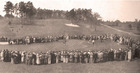
Major league golfers who have been swinging clubs for the last four years in the annual Masters' tournament at Augusta, Ga., which brings a man named Bobby Jones back for his single yearly appearance as a competitor, are going to do a bit of eyebrow raising and glove flexing when they step upon the first tee for the fifth all-star show there, beginning March 31 and ending April 2.
230136-246885-thumbnail.jpg
(click to enlarge)
The reason for their concern may now be called work in progress. It consists of transforming the course from its original Scotch motif to one more adapted to the American topography upon which it was constructed. No official announcement of the revisions has been made, but the presence of a sharp eyed little Oklahoman named Perry Maxwell on the Augusta National course these last few months would indicate that the lads will find a new layout when they set forth in quest of the $1,500 first prize.

Mr. Maxwell is a livestock farmer who, in his spare moments, has become one of the nation's leading golf architects. He has been assigned the chore of making the Augusta National acreage an American course rather than the overseas composite layout it was intended to be when the late Dr. McAllister McKenzie, and Jones himself collaborated on making it a replica of the more famed seaside links.

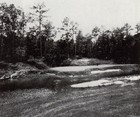
Principal changes in the National course will be in the vicinity of the greens. It was around these that the original sketches aimed to reproduce the foreign touch of St. Andrews, Muirfield, and other noted courses. Four years of competition have proved that while the experiment may have been a worthwhile effort as such, the lovely Georgia countryside is not adapted to it. The quarter mile arch of century old magnolias, leading to the antebellum clubhouse, are only a preface to the wistaria and dogwood with which the course abounds. Attempting to duplicate the austere Scottish coast line, where the early morning mist makes it difficult to distinguish the rolling sand dunes from the gray of the North Sea, is a feat not in tune with the terrain at Augusta. The abruptness of the dunes contours, which frequently caused well-hit approach shots to kick awry, has been done away with. So also have the peculiar undulations in the ground adjacent to the greens been reduced, although at no sacrifice to testing a shot.230136-309828-thumbnail.jpg
(click to enlarge)

The greens at the fifth, seventh and seventeenth holes have been rebult, and an entirely new tenth green has been cut into the hillside behind and at the left of the original green, on high ground. The hole has been lengthened to 449 yards, and is a fine two-shot test for the experts. P.J.A. Berchman, the horticulturist who was born on the site of the course and who has been resonsible for its general beautification, has removed seventy-five pine trees to make way for the new tenth. The change has been made not to eliminate any peculiarity in land formation, calling for what was at best a freakish second shot, but to try a player's ability to hit a long ball to a well built-up modern green. The green proper is the largest on the lot, and will call for precise approach putting.

Not all of the old country features have been eliminated. The "schoolmaster's nose" bunker in the middle of the eleventh fairway, built to duplicate one of old St. Andrews' most notorious sand pits, is still there. It remains the same as it was on that day when Col. Bob Jones (father of Bobby) hit a good drive into it, and was moved to inquire, "What jackass dug that in the middle of the pretty?"