"I haven't seen anybody at headquarters with Kleenex boxes"

Courtesy of AP:

 The LPGA accepted resignations from Deb Richard, senior vice president of golf; Julie Tyson, vice president of partnerships; and Liz Ausman, chief strategic officer.

Asked why she resigned, Richard paused and said, "I've lost faith in the leadership.''

Rae Evans, chair of the LPGA board, said she was not the least bit alarmed by three resignations in one day, and seven resignations over the last eight months. Others who have left the LPGA were Kathy Milthorpe, chief financial officer; Barb Trammell, senior vice president of tournament operations; Rob Neal, vice president of tournament business affairs; and Karen Durkin, chief marketing officer.

"Business is business. People come, people go,'' Evans said. "I haven't seen anybody at headquarters with Kleenex boxes.''

Such warmth and compassion. Go Duke lacrosse!

It also lost network coverage of a major when the LPGA Championship, angry about being asked to move up starting times in the final round starting in 2007, left CBS Sports for The Golf Channel.

"The knee-jerk reaction is we left a network for The Golf Channel,'' Evans said. "It's too early to tell. I probably view networks, because of the audience delivery, as the place to be. But a lot of smart people have invested in The Golf Channel. We'll see where it leads.''

Oh I think we know.

Week in Review, June 4-10: Still Furrowing

WeekInReview2.jpgAs the Open at Winged Foot looms, check out the Winged Foot journal section if you want to check out some of the posts that preview key holes. And to get in the mood, there were several articles worth reading from Westchester's Journal News as well as our second annual attempt to spot the %$#@% pairing.

Steve Elkington's U.S. Open sectional WD over not getting to wear spikes generated a heated discussion...

Smolmania: "Soft spikes make greens better. There's no doubt about it. Come out and see a public course like Dubsdread at 3 o'clock in the afternoon on Saturday. In the old days, the greens looked like there had been an army of elephants trampeling them. Not any more.

Chuck: "the Sectional application let players know in advance what courses were softspike-only. Elkington's position becomes undefensible in that regard -- he could have/should have known long before the qualifier date and acted accordingly.

NRH: In theory, I'm with Elk on this one...it is his profession. One day of a few guys wearing spikes will not ruin the greens and he is correct that it should be the same at every site.

JPB: "The USGA should address this and go spikeless at all the championships and qualifiers next year."

Brian: "Spike marks? What about the bottle cap depressions left with soft spikes by guys over 200 pounds? That's like putting through land mines. Give me spike marks any day of the week."

Peter Kostis wondered why there was no outrage over distance increases on the LPGA Tour and you, like I, just loved his logic.

Reader Barry: "About the time the power game was completely taking over men's tennis in the early 90s, people would trot out this same nonsense. 'Yeah, the men's game may be going to hell...but the women are fun to watch now...'
Be patient, Peter. Before you can say “brand identity," power will beat the life out the women's game too. And then we can kick back and watch robotic, artless play on both tours.

Chuck: "The last time Kostis bubbled up out of the murk of Fortune Brands' marketing offices, he was proclaiming that it was player fitness that was to "blame." If we only had 400 or 500 more 140-lb. 16 year-old girls to prove the point, I'd think he might have a real trend here..."

But besides Michelle Wie's attempt to qualify for the Open, the big story remained Jack Nicklaus's decision to furrow bunkers at Muirfield Village. More final verdicts...

Scott S: "So, if a host decided to use hard as rock greens, or fairways cut at 3/4 an inch, or bunkers which use native sand as opposed to doctored-in-a-lab Bunker Sand (TM), will we see the same complaints? All of these could be viewed as "contrivances" compaired to many tour stops, but are a regular part of life on many golf courses."

Matt: "I don't know about anybody else but I think it definitely takes skill to get the ball out of a bad lie in the sand-it's never just hack and hope. And surely ballstriking precision that avoids the bunkers in the first place is a more important skill than playing out of the bunkers themselves. The bigger issue is that fairways bunkers cannot be placed properly on a golf course anymore because of the disparity between long and short hitters. Just get the ball rolled back and there's no need for this hulabaloo about furrows."

D. Edgard: "Well played Mr. Nicklaus and everybody around trying to preserve the esence of the game,

JM: "I wonder if working with Tom Doak on Sebonack influenced Nicklaus in any way and made it easier for him to make this excellent decision. And it *was* possible to recover with a bit of creativity... I think Mickelson demonstrated this best on #6 when he windmilled it from the fairway bunker and sailed it 160 yards to within 5 feet of the hole. That was creative shotmaking."


Winged Foot With Tilly: No. 11

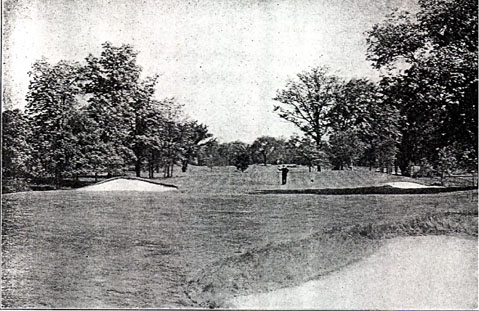
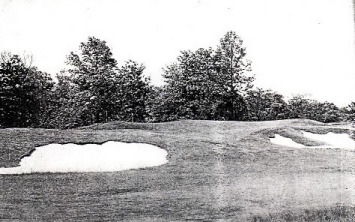
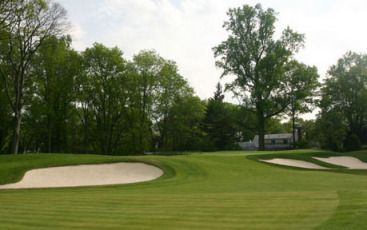
Below are 1929 and 2005 views of the wonderful 11th, which would be even more fun if included an actual fairway. Yes, the wonderful rolling contours and crowned nature of the hole will be bathed in rough, keeping balls near the centerline instead of taking them to real trouble.

Well, maybe that's why this hole will be minus the rough tiers. Remember, this hole is birdieable and we can't allow those!

Note the differences in bunkering from then and now, especially in the front left greenside bunker.

wingedfoot11oldcropped.jpg 


wingedfoot11modview.jpg 

Winged Foot With Tilly: No. 10 Vol. 2

230136-360068-thumbnail.jpg
(click on image to enlarge)
Rick Carpiniello in The Journal News profiles the homeowners/members living behind No. 10 and explains what exactly Ben Hogan said and meant about a "3 iron into someone's bedroom." 230136-360078-thumbnail.jpg
(click on image to enlarge)

As for the grand 10th (which will be called the "signature hole" way too many times by NBC's announcers), it should be 6, 7 or even 8 iron next week. 


Marzolf On Winged Foot

2006usopenlogo.jpegPlan on hearing NBC laud Tom Fazio's restoration work at Winged Foot, but it's actually been supervised by associate Tom Marzolf, who offered this deep architectural analysis in an ASGCA press release. No, it won't exactly remind you of reading any of Tilly's "gleanings":

ASGCA Past President Predicts “Narrow” Winged Foot Will Be Tough Test

Tom Marzolf, Senior Design Associate with Fazio Golf Course Designers and Immediate Past President of the American Society of Golf Course Architects, says Winged Foot Golf Club will be a tough test for this year’s U.S. Open field.

Marzolf, who has been working with staff at Winged Foot and USGA tournament preparation staff for several years to prepare the Mamaroneck, N.Y. layout for the 2006 U.S. Open, says, “Winged Foot is ready for the Open, but the field may not be ready for this year’s Winged Foot.”

“This may be one of the most challenging courses in the U.S.,” explains Marzolf. “The greens are very small, elevated and have interesting slopes that are bold and fast. If you miss the green on an approach shot, your recovery shot will be from thick, six inch rough. Missing a green will make it very difficult for players to save par.”

He continues, “The course is in great shape, and all the recent rain will make for soft conditions. The winner will be a player who hits a majority of fairways off the tee. All the fairways have been narrowed since the 1997 PGA Championship won by Davis Love III. This may be the narrowest U.S. Open course ever and could yield very high scores.”

Editor’s Note:  A picture of Mr. Marzolf is available upon request. Mr. Marzolf can be reached at (828) 693-0052 for additional comment.

Winged Foot With Tilly: No. 10 Vol. 1

1929 and 2005 view of No. 10 at Winged Foot. The photo angles are slightly different, but you can see how the front of the green has changed (I believe raised at some point to stop balls from rolling off). In its original look, the shaping has a settled, rumpled feel. A true work of art. Today, things are a bit more linear and clean, but still pretty awesome, especially with the recent green enlargement.

wingedfoot10oldcropped.jpg 


wingedfoot10modviewcropped.jpg 

Winged Foot With Tilly: No. 6

230136-358770-thumbnail.jpg
(click to enlarge image)
One of the best short par-4s in golf will struggle to display its charm when the USGA hides it in non-tiered rough and in general, tries to prevent those pesky birdies.

This is one of the three holes where there will be no tiered rough, so tall stuff surrounds the left side fairway bunker 241 off the tee. Ben Crenshaw insists there should be fairway up to and around the bunker. This would encourage leftside lay-ups to obtain better approach angles. And as you'll read in the 1929 National Greenkeeper excerpt, that's how Tilly intended it.

But with 22 yards or so of fairway, and no real reason to lay-up on a side of the hole to get a preferred angle at right hole locations, look for some guys to try driving the green. 230136-278526-thumbnail.jpg
(click to enlarge image of No. 6 tee view)

There's a killer back left hole location that the USGA will hopefully use to bring the steep fall off into play (and if the fairway was wide enough, such a hole location would have rewarded right side lay-ups).  

Retro Skills Challenge

Thanks to reader Marty for this Michael Vega story from the Boston Globe on a retro skills challenge at the Concord Champions event, where a few guys played 1950s and 60s clubs.

Certainly, in the field of 79 who will tee it up Friday for the 54-hole Bank of America Championship, there are some whose careers were rejuvenated by those advancements.

``Oh, absolutely," said Baiocchi, 59, of South Africa, who will be paired with David Edwards and Mike Sullivan in the first round. ``I played a lot of European Tour golf, so I didn't play a lot of regular [PGA] Tour golf with a lot of the guys out here. But talking to the guys, they all seem to be driving the ball further now than they did in their heyday, in their prime. Again, that's because of the equipment.

``It's basically made the game a lot easier and more enjoyable to play. Now, instead of driving the thing 220 with Hoganesque-type clubs, now we can drive the thing 270 and 280, which makes a big difference even for us."

And this from Andy Bean...

After hitting a 50-yard shot into the 18th with a throwback wedge, Bean said, ``I looked at that wedge and went, `Did we really play these?' But we did play clubs like that."

No matter the size and shape of your swing, the sweet spot is now much easier to hit with perimeter-weighted irons, fairway woods, and drivers of all makes and launch angles. And that's without even addressing the matter of the golf ball, and its myriad technological advancements.

``For the average player, the give is good," said Bean, 53. ``I think it takes away from the scoring on the professional side, because it puts more technology in the game and we can take a little more advantage of technology than the average player."

Bean figured the advancements have ``let 50 percent more players compete to win.

``A lot of the guys who normally wouldn't be hitting the fairways, now they're hitting the fairways with more regularity, and they're hitting it longer, which means they're going to have shorter clubs into the greens and it's just easier for them to compete. The long players, the strong players in any sport, they're still going to be strong and the fast ones are still going to be fast.

``But you still have to have the feel, and you still have to have the touch, and you still have to have the dedication -- no matter what sport you're in -- to go out and win.

``With golf, though, the good part about it -- the big-headed drivers, fairway woods, and technology with the perimeter-weighted irons -- it allows the amateurs to score better and that's what it's all about."