
WSJ Story: "Maybe the problem isn't the ball, after all"

Thanks to reader John for this Conor Dougherty story in the Wall Street Journal, where the USGA continues to try desperately to shift the distance issue to a grooves debate:

Is the long debate over golf balls cooling off?

One day after the Masters Tournament last year, the U.S. Golf Association, golf's U.S. rule maker, sent a letter to ball manufacturers requesting prototypes of balls that wouldn't fly as far as those in use today. The announcement, which came amid claims by traditionalists including golfing legend Jack Nicklaus that longer drives on the PGA Tour were changing the game for the worse, sent waves through the industry.

The USGA emphasized it wanted only to get a better understanding of golf-ball technology, in case "the need to change the rules arises," but the move was viewed by some as a first step toward a dead-ball era.

Now the rhetoric from some of the most vocal traditionalists has softened, and the USGA says changing golf balls may not be the best solution to curbing longer drives. What happened?

Not sure which "vocal traditionalists" have gone quiet, judging by this site's listing of recent remarks from famous golfers calling on a rollback.

The USGA says its research has caused it to look beyond the golf ball. The issue may be not the changes in the golf ball, the association now says, but rather the way players have reacted to those changes.
Dick Rugge, the USGA's senior technical director, says pros have probably changed their style of play to accommodate newer golf balls that fly far but are also easy to control. In generations past, players had to make precise shots onto the fairway to win. Now they're increasingly trading accuracy for distance, hitting powerful drives that land in the rough more often and then hitting shorter irons to the green.

And...

These very visible changes, coupled with the new, sloppier style of play, angered traditionalists. Rather than lengthen golf courses each year, they argue, why not wind back the golf ball instead? "We've noticed that, in a lot of cases, [technology] makes our golf courses play quite a bit differently than they were intended when they were originally designed," says Alan Fadel, who is on the board of governors of the Ohio State Golf Association.

At its Champions Tournament in August, the association will issue a single kind of ball to all of the competitors, a high-spin model with a soft cover. This, in theory, should even the playing field for players with slower swing speeds. "It's more of a political statement than anything," Mr. Fadel says.

Dougherty recalls the 2002 Joint Statement of Principles, often forgotten these days in Far Hills:

In 2002, the USGA, which governs golf in the U.S. and Mexico, and Scotland's R&A, golf's ruling body for the rest of the world, said that if driving distances continued to increase they would consider changing the specifications for balls. Three years later, the USGA sent the letter asking manufacturers for prototype short balls.

Naturally, ball manufacturers oppose a rollback, and they argue that a change wouldn't be easy. Golf balls are built to an "overall distance standard" of 320 yards, which is defined as the maximum distance the ball will travel when hit by a titanium club, at 120 mph, under certain launch conditions. To change the standard, companies would have to fiddle with variables including the weight and size, as well as the cover and dimples, to change how the ball spins during flight.

"Then all iterations must be tested off the tee, as well as through the green, to confirm how the prototype is going to perform with all golfers and with all clubs in the bag under all conditions and types of shots to be faced," says Wally Uihlein, chief executive of Acushnet, based in Fairhaven, Mass.

Uh huh. Here's the part where somehow they think that changing groove specs will be less complicated and more important than a ball change:

The USGA has been busy researching hard data on the performance of golf balls. It crunched statistics on everything from the accuracy of drives on the PGA Tour to the correlation between accuracy and winning. The USGA made some discoveries that went against conventional wisdom -- and strengthened the case for keeping the balls as they were. The growth in driving distance, for instance, has tapered off in recent years. More important, distance alone doesn't help pros win. The longest hitters, the USGA found, do not win a disproportionate amount of tournaments, although they do win slightly more than in the past.

For now, the USGA is experimenting with new ways to penalize sloppy drives. For its U.S. Open Championships, the organization has traditionally had courses cut a narrow band of shorter rough along the fairway, and the rest of the rough -- called the primary rough -- cut to a uniform height of around three to five inches. But for this week's U.S. Open at Winged Foot Golf Club in Mamaroneck, N.Y., the USGA varied the primary rough: It will start with a 20-foot-wide band about three inches high; beyond that out to the spectator ropes, it will be at least five inches high. This deeper rough will hurt the least-accurate drivers the most, while rewarding cleaner play.

"We noticed that a shot that barely trickles into the rough has a similar penalty as a ball that goes 15 yards into the rough, and that just didn't seem fair to us," says Marty Parkes, a USGA spokesman. "We were trying to match the penalties with the crime."

And, just in case you weren't sure that these people have lost their golfing soul...

Another way to force golfers to be more accurate, Mr. Rugge says, would be to modify irons to make shots from the rough harder to control. The key to this is a series of small grooves on the face of irons: When the ball is struck from deep, wet grass, the grooves allow water trapped between the club and the ball to disperse, increasing the friction between club and ball and allowing a more controlled shot. Changing the guidelines to require smaller grooves would make for less friction, and more erratic shots, thus giving golfers more incentive to keep the ball in the fairway.

One advantage of a change in iron specifications would be that it would affect only those players who can shoot from the rough with pinpoint precision -- the top percent of golfers. And while the USGA suffered a contentious lawsuit about an iron change in the 1980s, it might be able to sidestep the issue by grandfathering in older-model irons.

And does this also mean that the message is: harvest more rough?


IM'ing With The Commissioners

Now that the NSA has figured out that my calls to Pakistan were all Dell support related, they've been feeding me all sorts of goodies. The latest is this Sunday night instant message exchange between the PGA Tour's Tim Finchem and the LPGA's Carolyn Bivens after the thrilling LPGA Championship finish.

twfPGATOUR©: You there Carolyn?

DaBrandLady: yes tim, just back from the trophy ceremony!

DaBrandLady: does these girls rock or what!?

DaBrandLady: and didn’t I look good next to Ronald McDonald!?!?!?! :)

twfPGATOUR©: Yes, great product today. What a shot by Se Ri.
twfPGATOUR©: Say, did you see any of the telecast?

DaBrandLady:  just a bit when I was doing some brand positioning work in the McDonald’s chalet.

DaBrandLady:  but we’ll be doing a full contextual and brand consistency white paper on the telecast this week to ensure that the brand promise was obtained. why do you ask?

twfPGATOUR©: I was wondering if there was a strike of the graphics personnel or other elements of the production staff?
twfPGATOUR©: Don’t get me wrong, the product was strong, but it just seemed to lack things like a leaderboard more than every 15 minutes or so.

DaBrandLady: that’s just Golf Channel’s effort to not interfere with our product.

DaBrandLady:  the minimalist production values make each player on the screen the real focus of the viewer, adding value for our players and player sponsors.

twfPGATOUR©: I see.

DaBrandLady: well I think they accomplished what was called for within their business model in terms of graphics and production budget, but I’ll check with Deb, wait, no with…well I’m sure someone is left in the office to help out.

twfPGATOUR©: About that, I don’t know how you do it? I have 81 Vice Presidents and I can’t imagine what I’d do if I had mass resignations like you have had.
twfPGATOUR©: Not that there’s anything wrong with spending more time with your family and pursuing other opportunities.

DaBrandLady: no, nothing wrong at all.

DaBrandLady: look, given the LPGA's incredible mix of talent, diversity and personalities, now is the time to take this organization to new heights. While we change the business model in order to better monatize our success, fans can continue to expect the very best in women's professional golf. We're committed to collaborating with all of our key constituents to create a stronger LPGA.

twfPGATOUR©: Did you just copy and paste that from your press release?

DaBrandLady: oh tim, that’s why you are going to make $28.5 million over the next four years. nothing gets by you!

twfPGATOUR©: Well, thanks. Say, anything you can pass along about TGC’s production concepts would really help as we begin a 15-year journey with them.
twfPGATOUR©: Not that I’m concerned or anything, it’s just that well…I’m always looking out for my product.

DaBrandLady: as am i! that’s why you and me are so good at what we do!!!!!

twfPGATOUR©: Congrats again on the strong positioning today.

DaBrandLady: thanks you too…great job with vijay’s win today. he's a little out of the prime demo but a solid brand.

DaBrandLady: that reminds me, do you have a contact at the villages?

twfPGATOUR©: You're not planning to retire?

DaBrandLady: oh no, i'll be in this job for decades. i just wanted to talk to them about buying some time.

twfPGATOUR©: they’ve been good partners for us in this transition year.

DaBrandLady: i know, that’s why i want their number.

twfPGATOUR©: I’ll have someone look into that for you.

DaBrandLady: thanks! gotta run, tgc's replay of the trophy ceremony starts soon and there's a bar down the street that actually carries it!

twfPGATOUR©: Give my best to...

DaBrandLady: he says hi back! bye!


Pak's Win

McDonalds-05.gifDoug Ferguson sums up Se Ri Pak's thrilling LPGA win, one of the most exciting tournaments in a long time despite The Golf Channel's minimalist production values. As tired as CBS's productions are these days, they are professionals and bring a level of production quality to their telecasts that this epic major deserved (and lacked).

It's a real shame for the LPGA "brand" that more people didn't get to see this and David Steele in the Baltimore Sun agreed in this column before Sunday's finale. As he points out, the LPGA could have been the prime network sporting event today (well, besides that soccer stuff).  

Sandomir on Streaming

us open icon.jpgRichard Sandomir writes about the trend of online streaming and the USGA's plan to carry action from the 6th at 10th holes at USOpen.com. He also writes:

This will be the sixth year that the United States Golf Association will post streaming video from the Open. It did one hole the first year, and has done two holes ever since. This year, the group decided that Winged Foot's par-4 sixth hole, "the Pulpit," one of the course architect A. W. Tillinghast's masterpieces, was must-see viewing, as was the par-3 10th hole.

Of course No. 10 is definitely the "Pulpit" while No. 6 is actually "El" (as named by Tilly himself).

Furyk On USGA Spin

Jim Furyk, talking to Sam Weinman in The Journal News about why the USGA takes so much criticism for their various course setup debacles:
"I think the issue really isn't their theories or their ideas," said 2003 U.S. Open champion Jim Furyk. "It's how they handled it afterward. It's a real hard line. It's 'That's the way we wanted it to be. That's the way it should be.' When even the guys with 20-handicaps are scratching their heads. ... Only later on did they do damage control, but at that point, it was a little late."

They break toward the city...

us open icon.jpgThat's one of Butch Harmon's tips for Winged Foot in a Bill Pennington New York Times story. And this is an interesting observation about the tiered rough, and one some of us have been trying to explain is yet another reason that pitch out rough is absurd:

"Guys who hit into the long stuff will wedge it out and take their bogey," Butch Harmon said. "The actual danger is the second cut of rough, the stuff that's three inches deep and three yards from the fairway. Some guys will be tempted to go for the green from that stuff, and that's where the double bogeys will come from."

Winged Foot With Tilly: No. 15 Vol. 1

230136-361503-thumbnail.jpg
(click image to enlarge)
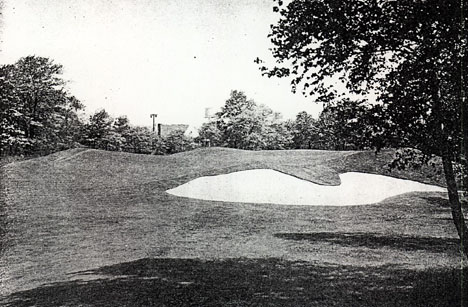
The 15th at Winged Foot features arguably the worst fairway contouring job, leftover from the Meeks 2004 U.S. Amateur setup. Not wide enough to bring the creek into play down the left side or to let a player actually choose an angle to come in from, at least the narrowness doesn't take away from another stellar green complex.

Open up the image to read Tilly's proud take on the hole. 

Huggan Previews Open

After reviewing previous U.S. Open's held at Winged Foot, John Huggan writes in Scotland on Sunday:

There is little doubt that WFW is one of America's finest - and at times when the USGA does not have a say in the speed of the greens, the width of the fairways and the length of the rough - one of the fairest tests. It is a proper golf course, with a closing stretch of demanding par-4s that we hope will be allowed to provide a fitting climax to the championship.

"As the various holes came to life, they were of a sturdy breed," wrote Tillinghast of the design process. "The contouring of the greens places great premium on the placement of the drives, but never is there the necessity of facing a prodigious carry of the sink-or-swim sort. It is only when the next shot must be played with rifle accuracy that brings the realisation that the drive must be placed."

Forgive my cynicism, but that is one aspect of this great course that will likely be lost during this coming week. As usual, the blue bloods in the blue blazers won't want red numbers on 'their' golf course and in 'their' precious championship. So, just as they were at Pinehurst last year, many of the premium spots for drives will be covered in golf's most boring hazard, long grass.

If the USGA can be trusted to do anything, it is that they will endeavour to eliminate any semblance of strategy or thought or flair from the US Open equation. What else? Oh yes, there will be little or no fun to be had, either.

An extremely knowledgeable spy of my close acquaintance has already been to Winged Foot, and had this to say about the course: "It's the hardest thing you've ever seen. I don't see how a short-hitter could break 78. Because of the severity of the slopes on the greens, it's much harder than Baltusrol was for last year's PGA Championship.

"If you hit a shot even one-yard past pin-high, you have virtually no chance to get the ball up and in. I don't think there will be more than two people under par by the end. In fact, it would not shock me if four 71s was enough to win."

NY Times: Hartough "Rembrandt of the back nine"

Project a golf photo onto a canvas, paint over it and you're a Rembrandt according to the paper of record. Yikes.

This is beautiful:

"There is a sense in Linda's work that God is in the landscape," said Jay Williams, curator of the Morris Museum of Art in Augusta, Ga. "If you look at a lot of the paintings, she often uses raking light — she places the light source at an angle. The play of the shadows on the landscape tells the eye a lot about the complexity of the surface. She accentuates the kinesthetic aspect of the terrain, which allows you to read her paintings in a very physical way."