Golfdom Podcast
/My chat with Golfdom editor Larry Aylward about this year's Masters...here's the link (the embedded player was causing technical problems.) Gabcast! Shackelford on Augusta #1

It’s back!
Twenty years later Tatra Press has kindly allowed me to bring back Grounds For Golf now that golf architecture is of more interest to the masses. A new Introduction looks at what’s driven the interest growth and two new chapters I had a blast adding (plus a few edits to keep things up-to-date).
The Amazon purchase page for the book arriving June 15, 2026.

My chat with Golfdom editor Larry Aylward about this year's Masters...here's the link (the embedded player was causing technical problems.) Gabcast! Shackelford on Augusta #1
There are golf museums in other prominent corners of the world, but none comes to life like Augusta National. And it's open to the public only one week a year.
This is why Arnold Palmer will probably step to the first tee Thursday morning for a ceremonial tee shot that will provide as much of a thrill as whoever drains the winning putt come Sunday evening.
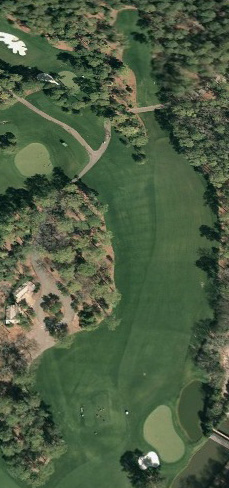
Reader Andrew suggested on another post that we check out Google Earth's Augusta National images for an eye-opening look at the recent changes. The Google photos appear to have been taken in 2005 before last year's horrific new grove on No. 11 debuted, but after the decision had been made to force tee shots down the left side. (I still say this is the easier side to approach the green since you are hitting over and away from the worst trouble...)
Anyway, here are the now and then views courtesy of Google Earth and Golf Digest's recently posted photos:

 In recent years we've been subjected to plenty of stories praising the tree planting, rough and other shenanigans at Augusta National. Now that Hootie's gone, it will be interesting to see if any scribblers try to tell us that the new "premium on accuracy" is all that it's been cracked up to be. Remember, for the last few years we've heard that we need to see the course fast and firm to judge whether the lengthening, tacky tree planting or ridiculous rough could be considered an improvement.
The lengthening perhaps, but that the soft conditions exposed that the course lacked elasticity, leading to additions to the 11th and 15th tees this year (again, that should have been anticipated by the architect).
But more important is the notion that there has been so much criticism of the changes. As Geoff Ogilvy noted in John Huggan's Sunday piece:
...for 60 years not a bad word was said about the place and for the last five a lot of very important people have been very critical.
Does this onslaught (and the likelihood that we'll read few pieces praising the rough and trees) speak to just how awful the changes have been?
Or is it more of a statement about how much Hootie Johnson was feared and disliked?
Or a bit of both?
Yes, hard to believe that Mayor Deke is upset, since this same story has been done about 15 times in the last decade.
But for some reason the current Golf Magazine piece rolled out for its readership of 6 million--yes, that's what the story says--carries some weight.
Golf Magazine is taking a swing at the city of Augusta, and it has some folks teed off.
"It gives a very misleading impression of our city," said Mayor Deke Copenhaver.
Mayor Deke Copenhaver is disgusted by the article, which calls the Garden City "a bargain-basement mosaic of strip malls, strip joints and unassuming houses."
"It's very inaccurate," Copenhaver said.
The article also calls Augusta and the National worlds apart, but says it's only "a short walk from Amen Corner to a Bud Light and beef jerky at the corner store."

(click to see the strip malls)I know, where would anyone get that idea?
The problem with that article is that lots of people will see it. Golf Magazine has more than six million readers.
What, per decade?
 Melena Ryzik will probably be getting some mail from The Brand Lady or one of her lieutenants after this NY Times piece on lesbian spring break, better known as Kraft Nabisco week. Wait, I mean, Dinah Shore weekend. Got to get my brands straight.
Welcome to Dinah Shore Weekend, or, as it’s better known, lesbian spring break, which concludes today. An annual pilgrimage for more than three decades, it has attracted thousands of adult women to this mountain-ringed Southern California desert town, which becomes a destination for lesbians looking to party, socialize and hook up.
The name comes from the Kraft Nabisco Championship (formerly the Dinah Shore Golf Championship), the first stop on the Ladies Professional Golfers Association tour, which happens concurrently a few miles away.
In the years B.E. (Before Ellen DeGeneres), the Dinah was the province of mostly polo-shirted women seeking a low-key weekend getaway. Now, in the years A.L. (After “The L Word”), it has been transformed into a fashionable bacchanal, nearly a week long, with celebrity guests like Carmen Electra and Joan Jett, large pool parties and dozens of corporate sponsors, who vie for the attention of a community that is suddenly much more visible, and visibly wealthy. It’s Girls Gone Wild for Girls (and Marketing)
Golf Digest's Bob Carney defends the latest course ranking on their editor's blog. Can't wait to see what he has to say for himself when Kenny G falls from the top spot in the next music ranking.
The Brand Lady did a wonderful job with those softballs lobbed by those 18-to-34-year-old demo drawers Verne Lundquist and Judy Rankin during today's Dinah Shore final round. Me thinks the LPGA Commish has been working overtime with her brand coach, but she did stray into foreign territory this week and thanks to LPGA Fan, we get some juicy insights from Ms. Bivens.
From Janet Cromley's LA Times story on women hitting the ball longer (or not):
But they can get closer with improved mechanics and technique, says LPGA Commissioner Carolyn Bivens. "Frankly," says Bivens, "the women have to be more fit than the men and their mechanics have to be better. A guy can mis-hit a ball and mis-hit it farther."
To hit the ball farther, the women are focusing not only on upper body strength but also leg and core strength, with balance as the ultimate goal. "You've got to have technique and balance to pull off the long shots," says Bivens.
That's the closest you're going to get out of me for an April Fool's Day shtick.
Actually, John Huggan uses his Scotsman On Yet Another Dreary Sunday Scotland On Sunday column for a nice trashing of the dismal course changes, but with so many new fresh insights thanks mostly to guys named Ogilvy/Ogilvie.
In what is nothing less than a direct and disrespectful contravention of Mackenzie's and Jones' original and delightful philosophy, the Augusta National that will this week host the world's best golfers resembles nothing more than just another one-dimensional country club. Aerial photographs published in the April issue of Golf Digest graphically portray the tragedy that is the modern Augusta National. In place of what were once spacious and tightly cut fairways, rough has been grown and trees have been planted. What was once the most democratic of courses - one that allowed every standard of player to figure out his own way of playing each hole - has become a golfing Zimbabwe, a misguided dictatorship that has all but eliminated freedom of thought and expression.
Ah, we're just warming up.
Where once professionals as diverse as, say, Tom Kite and Seve Ballesteros - the scientist and the artist - could compete on equal terms at Augusta by playing almost every hole in ways that had almost nothing in common, today every player stands on almost every tee attempting to answer the same question and, in turn, hit the same shot.
In other words, virtually every semblance of strategy has been removed.
Today, the paucity of the landing areas, rather than the player, decides how each hole will be played. At Augusta, the spirit of St Andrews is no more.
"I couldn't understand why, at the Masters last year, [former chairman] Hootie Johnson said that he wasn't sure that Augusta National should be fun," says US Open champion Geoff Ogilvy. "That was a very strange thing to say! He is just not right."
Now now Geoff, you forgot. It was all about Hootie. And fun for Hootie was protecting his pride with a high winning score. It's okay, you were a rookie last year.
"Augusta has a lot to answer for, getting the whole world obsessed with really fast greens," contends Ogilvy, who grew up within walking distance of Royal Melbourne. "They have lost a lot of pin positions with that policy. I bet they used to have a lot more variety.
"I would like to see Augusta's greens - even if only for one year - maybe two feet slower. Then they could use some of the front pins that have basically been eliminated. And you wouldn't need the rough. I think everyone would be comfortable with getting rid of it. It's just not necessary. The course is all about the greens. You don't even need the trees. If you put the pin in the right place there is only one good spot on the fairway.
See, that's just way too much to understand for an architect of T...oh we won't go there. Been there, done that.
"I think Augusta is paradise, but the whole golf world tries to follow their lead too much. And all the recent changes certainly haven't been improving the place. I mean, for 60 years not a bad word was said about the place and for the last five a lot of very important people have been very critical. Which is a shame. That course isn't a national treasure, it's a world treasure. It needs to be preserved. And I hope it will be from now on; they'll get it right."
That's a great point, so great I'm going to bring it up again in tomorrow. Why interrupt the fun?
"It's like if you have a beautiful woman, but after her 20th or 30th plastic surgery she doesn't look as good," quips American professional Joe Ogilvie, neatly summing up the feelings of many.
Hmmm...that's a keeper!
Oh, now isn't this fun. Yet another post for tomorrow too.
Most damning is the news that Ogilvy, a big strong boy and a major champion to boot, is seriously considering laying up short and left of the par-3 fourth green, so ridiculously penal does he consider the punishment for even the narrowest miss at this much-lengthened hole.
"I think the 4th is going to be a two-shot hole for me this year," he says. "From short left it is a relatively easy up-and-down; the only pin that is hard is the one way back right. The chip to the front is easy as you can use the slope.
"It's just too risky a tee-shot to go for. If they put the tee where they did last year and the wind gets to swirling, you will see guys hitting it on to the 5th tee or into that stuff on the right. Even the front bunker is not great; it is hard to spin it out of that sand. So the lay-up to the front left is a legitimate play. Even if the ball rolls back a bit it isn't too bad. You can get to every pin except that top right one. So there is a case for it."
Hey, Mike Clayton and I had a blast talking about all of the great long par-3's in golf really become far more interesting as short 4s. Somehow, I don't think that's what Jones and MacKenzie had in mind here. But just think, if Ogilvy plays it like that, then he'll actually get to play No. 6 at Winged Foot as it was intended!
"Two important aspects of modern golf have gone in completely the wrong direction," says the Australian. "Most things are fine. Greens are generally better, for example. But the whole point of the game has been lost.
"Ben Hogan said it best. His thing was that you don't measure a good drive by how far it goes; you analyse its quality by its position relative to the next target. That doesn't exist in golf any more.
"The angle of attack and the shape of the shot mean nothing nowadays. It is 'can you hit it through the goalposts' on every hole. And so the game becomes a one-dimensional test of execution, time after time."
Those humming noises you hear in the background? Both Mackenzie and Jones spinning wildly in their graves.
So nice to see Nick Faldo talking to the British press, this time to James Corrigan in advance of his first Masters in the booth:
"I've always said exactly what I thought, but if I do that at Augusta, only one thing will happen - I'll be out," he said, smiling as he thought of the expulsions that have befallen the loose-lipped in the past. "I'll be walking on eggshells and have my guidelines right next me: they're not 'fans', they're 'patrons'; it's not 'rough', it's 'first cut'. Actually, I may not say anything, I may just do sign language. Only joking. I'm sure Augusta will cut me some slack on my first year."
I don't know how many homes Charter Communications reaches with its cable systems, but apparently they are planning to drop The Golf Channel based on this GC front page plea form.
Anyone know what part of the country Charter covers?
 Sports Illustrated featured two classic only-SI-can-do-it features that made weeding through the usual mishagoss of player profile stuff worth the effort. If you love baseball, don't miss Tom Verducci's piece on umpiring for a day, and if you love golf, definitely check out John Garrity's Tiger 2.0 cover story.
Highlights from the Garrity piece:
But here is Tiger, elbows on the table, working me like a cold-call broker. His business goal, he says, is to get to "a place where my family can be financially secure."
Sheesh, and I thought J.D. Drew talking about job security for his family was a tad much after he opted out of 3 years and $33 million!
His course-design work will be "a partnership between me and the owner of the property; I'm trying to provide a product they'll be happy with." His brilliantly successful endorsement deal with Nike, a multiyear contract recently renewed for a reported $100 million plus, is about "providing products that consumers will enjoy." He sums up: "We are in the providing business."
I wonder, for an instant, if Tiger is trying to sell me a fixed-rate annuity.
Beautifully stated.
There is understandable curiosity about Tiger's foray into course design. Typically, a champion golfer either partners with an established golf architect—Arnold Palmer with Ed Seay, for example, or Ben Crenshaw with Bill Coore—or hires a staff of practiced landscape engineers and architects a la Jack Nicklaus, whose design company has produced 310 courses in 30 countries. Tiger would seem to be leaning toward the latter model (he took advantage of Nicklaus's generous offer to let Bell visit his North Palm Beach offices to study the golf course operation), but he turns vague when asked who will actually read the topographical maps and produce the construction drawings.
In L.A., Tiger had assured me, "I will not be hiring some guy to design a golf course. I'll be hands on and involved in it." He was more forthcoming about his design philosophy. "My tastes are toward the old and traditional. I'm a big fan of the Aussie-built courses in Melbourne, the sand-belt courses. I'm also a tremendous fan of some of the courses in our Northeast."
"I'm not one who thoroughly enjoys playing point B to point C to point D golf," he continued. "The courses I like are the ones where you have the option to play different shots. I enjoy working the ball on the ground and using different avenues." "Like Royal Liverpool?" I asked, naming the English course on which Tiger won the 2006 British Open using a 19th-century arsenal of low, scooting tee shots (played almost exclusively with irons and fairway metals) and ground-hugging approaches.
He smiled at the memory. "Liverpool this year and St. Andrews in 2000 are the only times I've seen the fairways faster than the greens. You hit a putt from the fairway, it was running one speed. It got to the green, the putt slowed down." His smile broadened. "That's not like most golf courses, but that's what I like to see. It fits my eye."
Now, Nicklaus has been criticized for building holes that fit his game. Will Tiger be questioned for building designs that fit his eye?
Does anyone know when Nicklaus made these comments? From an unbylined report from South Africa's Pretoria News:
Nicklaus played a social round at Augusta recently and came off the course disgusted with its new length.
"I played the members' tees. I can't play the back tees anymore," he told reporters. "Every tee I stood on I saw 73 to 91 yards before the back tee.
"The members tees at Augusta used to be 18 or 27 yards in front, which was a normal distance. It's so far now it is ridiculous, but every golf course is that way."
Language barrier would be an understatement. I was lost in the labyrinth of rising and falling inflections that inhabit the Korean language.
Of course, Ahn had a translator, who happened to be her agent, Vicki Lee.
Ahn was asked about changes in her attitude on the golf course. She fought for two minutes to explain herself.
Then came the predictable five-second translation: "She has fun. She is a little more lighthearted."
 From Ron Sirak's Golf World profile of new Masters Chairman Billy Payne:
The course changes under Johnson--criticized by, among others Arnold Palmer and Jack Nicklaus, who are members and winners of a combined 10 Masters--get Payne's approval. "I believe they were necessary," he says. "This course should never be reduced to driver-pitching wedge as it was becoming." He adds, however, a rolled-back Masters ball is still possible if another distance explosion occurs.
A follow-up for Wednesday's press conference: Do you believe the "second cut" and added trees are integral to preventing the course from being reduced to a driver-wedge design?
I know, I know...he won't say.
Geoff Shackelford is a Senior Writer for Golfweek magazine, a weekly contributor to Golf Channel's Morning




Copyright © 2022, Geoff Shackelford. All rights reserved.