
Masters Photo Caption Fun, Vol. 2
/This ought to be fun...from golf.com:


It’s back!
Twenty years later Tatra Press has kindly allowed me to bring back Grounds For Golf now that golf architecture is of more interest to the masses. A new Introduction looks at what’s driven the interest growth and two new chapters I had a blast adding (plus a few edits to keep things up-to-date).
The Amazon purchase page for the book arriving June 15, 2026.

This ought to be fun...from golf.com:
 Billy Payne faces the all-star cast of softball-hurling scribblers and inkslingers for Wednesday's annual chairman Q&A. While he won't flip his lid like Hootie was prone to do, Payne should at least have to earn his pay. Oh wait, he's not paid. Well, they should still ask him a few questions beyond the expected (will you restore exempt status for PGA Tour event winners, will Arnold Palmer be the honorary starter, when are you going to 18-hole TV coverage every year, yada, yada, yada...).
Here are mine. Please feel free to add yours below in the comments section.
 Scott Michaux profiles Nick Faldo's debut in the Masters booth:
"I mean, I actually love Augusta," he said. "Gosh, it's a Picasso. It's a bloomin' Rembrandt. It's a Mona, isn't it? I took friends who are not golfers last year who've never been and said, 'It's like a work of art, isn't it?' And they said, 'You're right. It's absolutely unbelievable. What a place.'
"Yes, you could get a bit harsh at the odd hole or this and that, but crumbs if you don't like the odd tree."
Ultimately, CBS and Faldo both understand what he brings to the booth: the perspective of a three-time Masters champion. They crave his insights on the course and his empathy for what the competitors are going through.
"We have Phil Simms at the Super Bowl," Barrow said of the former New York Giants quarterback turned CBS analyst. "Phil Simms knows what it's like to go down that tunnel. He knows what it's like to be a part of that game. He knows what it's like to win the Super Bowl. That's what Nick brings to the Masters."
Let's hope he brings a LOT more to the booth than Phil Simms!
 Well you know it's a slow day when the scribblers are grilling Geoff Ogilvy over the gold shoes he's going to be wearing, Golfweek's on-site blog covers just how little was happening and AP sends out a story on Gary Player's quest to get American's in shape.
But hey, a CBS free lance tech guy tried to rob a bank, so it wasn't entirely dull.
Worth your time is Steve Elling's take on why the Masters is the easiest major to win. Even if you don't entirely agree with you, the story might give you some good thoughts on who to pick this week, not that any of you engage in that illicit gambling.
** David Westin writes about the possible winning score and the likelihood that a double-digit under par tally is likely out of the question. Praise the Lord!
John Huggan provides the excuses for the European drought in majors, while Scott Smith blogs about Ron Kapriske's April Golf Digest piece on the possiblity that the Masters theme song may become available commercially.
This is for the scribblers and everyone else not attending the Champions Dinner: Brenner-Zwikel PR's Brian Robin, a familiar face at several major tournaments, makes his Jeopardy debut tonight, April 3rd. Check your local listings!
I remember walking Augusta in October of 2003 and noticing that not only would the new trees between 15 and 17 look silly and trample all over Jones and MacKenzie's vision, but based on the planting locations, it appeared that no one considered what would happen when the trees actually...grew!
Well, here we are four years and Lord knows how many man-hours spent handwatering them, and the pines have grown.
Imagine what they'll be like in another four years.
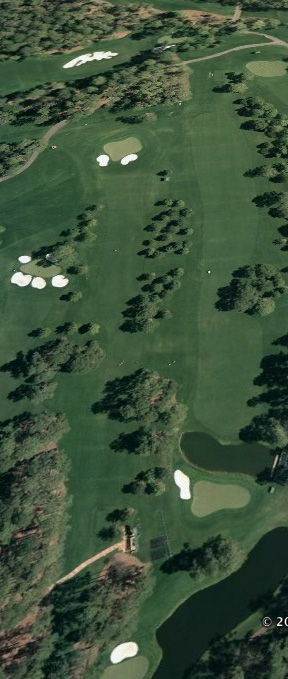

 To the readers in Australia, tell us where it should be played if Royal Melbourne is not the course...
"The players giving Tiger his competition are just as good as those who Jack faced in terms of pure talent, but they don't have the heart, the guts, the tenacity, maybe even the sense of pride that the [Tom] Watsons and [Lee] Trevinos had."
Why, one wonders, would such things be lacking?
"It has to do with money," Barkow continues, "although no one likes to say that. But today's players are so rich they don't have the real need for money the previous generation had, and are also so incredibly pampered and spoiled from the day they took up the game that they don't know how to respond to the dominant player. Watson, Trevino et al, gave Jack a good go and took him a few times head-to-head. I can't see anyone out there today giving Tiger that sort of competition. They don't need to."
Get your MBA bingo boards out. From the PGA Tour:
FOR IMMEDIATE RELEASE
April 2, 2007
 Who didn't Billy Payne talk to leading up to this year's Masters?
First, Tim Carroll in the Wall Street Journal poses some great questions to the new chairman (thanks to reader John for the link).
THE WALL STREET JOURNAL: Is it fair that your predecessor, Hootie Johnson, is going to be known forever as the man who wouldn't let women into Augusta National?
MR. PAYNE: No, I don't think so. I'm thinking he's going to be remembered principally as a man who took on the very significant challenges to our wonderful golf course caused by the advances in distance that were a consequence of some advances in technology. He took some very bold steps in order to ensure that our course kept its competitive nature, notwithstanding the fact that the average driving distance since the founding of our tournament is up some 70 yards.
Notice Mr. Payne never says anything about the guys being better athletes. Get this man the talking points!
WSJ: One of the changes outside Augusta National is technology. For a long time, it was the ball. Augusta National threatened to impose a tournament ball, something that Ohio did for some of its statewide events. Lately, the USGA and the Royal and Ancient Golf Club of St. Andrews seem to be focusing on club-face grooves. Do you feel as if you're in some sort of nuclear arms race against the ball and club makers? Is an Augusta ball still a possibility? How about Augusta clubs?
MR. PAYNE: We will take whatever steps are necessary to ensure the competitiveness of our golf course against the challenges of these great and very talented players and against equipment changes which allow them to hit the ball farther and to spin the ball more. As a consequence, I think we remain diligent as we measure and look at those kinds of increases and those kinds of challenges to our course. But last year, as you recall, one of the tour's longest hitters was the winner [Phil Mickelson], and a close second was one of the tour's shortest hitters in Tim Clark. So we felt that that was demonstrative that the course was a fair challenge to players of all lengths. So, we think we got it about right now....
We are encouraged by the fact that the regulatory governing bodies, both the Tour and the USGA and R&A, are themselves looking at ways to either diminish the increases in length and/or to affect the spin of the ball. All of which has an indirect consequence of making folks not want to just hit it as far as they can whether or not it goes into the rough.
So again I ask. If the guys are spinning it more out of the rough than the fairway, as the USGA is claiming, then why not eliminate the rough?
Loved this question from Carroll:
WSJ: Another change this year is that Fred Ridley, a longtime USGA official, is setting up the golf course for the first time. In the past, Sunday hole locations have seemed to be in spots where amazing things could happen. Take the 16th hole: There were two holes-in-one in 2004 and Tiger Woods's jaw-dropping chip-in for birdie two years ago when he used the green's ridge as a backboard. The USGA seems to have different thoughts on how to set up a golf course. As viewers, can we expect to see the Sunday fireworks continue?
MR. PAYNE: It would be fair to say that the imprimatur you will see imprinted on the golf course, the final Sunday and especially on the second nine, will be as you have seen it traditionally at Augusta. We hope [the setup] will allow those fireworks that you refer to continue. Because that's what people want to see. I think that's the way the players prefer it as well.
In the LA Times, Thomas Bonk profiles Payne and offers this:
Payne said Johnson could not have done a better job.
"He is a dear friend of mine and I would rate his performance a 10. I thought he faced the issue of technology threatening our course and dealt with it decisively, properly and in the best interests of our tournament.
"Equally as important, he was much aware of the importance of Augusta National and the preservations of our traditions and its place in the game of golf."
A 10? I know, I know, he has to say this stuff.
The work on the course for this year is complete, with only minor changes, including adding to the front of the 11th and 15th tees and changing the cut line on the right side of the 11th fairway.
"Hopefully, for the duration of my turn, we would not need to resort to any substantive changes," Payne said.
"Given the way the relative field competed … absent continued technological advances, it seems to me we should have it right for quite a while. I will caveat that by saying we don't take any option off the table when it comes to preserving the integrity of this course."
I like that caveat, assuming Payne recognizes that the rough and tree planting are impacting the integrity of the Jones/MacKenzie vision.
My chat with Golfdom editor Larry Aylward about this year's Masters...here's the link (the embedded player was causing technical problems.) Gabcast! Shackelford on Augusta #1
There are golf museums in other prominent corners of the world, but none comes to life like Augusta National. And it's open to the public only one week a year.
This is why Arnold Palmer will probably step to the first tee Thursday morning for a ceremonial tee shot that will provide as much of a thrill as whoever drains the winning putt come Sunday evening.
Reader Andrew suggested on another post that we check out Google Earth's Augusta National images for an eye-opening look at the recent changes. The Google photos appear to have been taken in 2005 before last year's horrific new grove on No. 11 debuted, but after the decision had been made to force tee shots down the left side. (I still say this is the easier side to approach the green since you are hitting over and away from the worst trouble...)
Anyway, here are the now and then views courtesy of Google Earth and Golf Digest's recently posted photos:

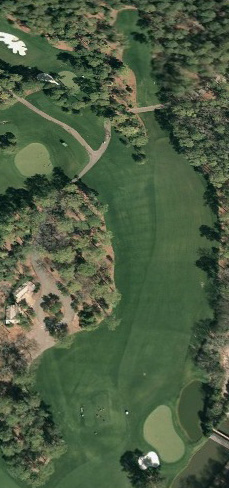
 In recent years we've been subjected to plenty of stories praising the tree planting, rough and other shenanigans at Augusta National. Now that Hootie's gone, it will be interesting to see if any scribblers try to tell us that the new "premium on accuracy" is all that it's been cracked up to be. Remember, for the last few years we've heard that we need to see the course fast and firm to judge whether the lengthening, tacky tree planting or ridiculous rough could be considered an improvement.
The lengthening perhaps, but that the soft conditions exposed that the course lacked elasticity, leading to additions to the 11th and 15th tees this year (again, that should have been anticipated by the architect).
But more important is the notion that there has been so much criticism of the changes. As Geoff Ogilvy noted in John Huggan's Sunday piece:
...for 60 years not a bad word was said about the place and for the last five a lot of very important people have been very critical.
Does this onslaught (and the likelihood that we'll read few pieces praising the rough and trees) speak to just how awful the changes have been?
Or is it more of a statement about how much Hootie Johnson was feared and disliked?
Or a bit of both?
Geoff Shackelford is a Senior Writer for Golfweek magazine, a weekly contributor to Golf Channel's Morning








Copyright © 2022, Geoff Shackelford. All rights reserved.


