Walker Cup Captain's Picks

The U.S. Amateur finalist and British Amateur Champion were passed up for younger players...

FOWLER AND STANLEY COMPLETE USA TEAM
FOR WALKER CUP MATCH AT ROYAL COUNTY DOWN IN IRELAND
 
Far Hills, N.J. (Aug. 27) – Rickie Fowler, 18, of Murrieta, Calif., and Kyle Stanley, 19, of Gig Harbor, Wash., have been selected to complete the 10-man squad that will represent the United States of America for the 2007 Walker Cup Match. The Match is scheduled for Sept. 8-9 at Royal County Down Golf Club in Newcastle, Northern Ireland.  
 
Chosen by the International Team Selection Committee of the United States Golf Association, the squad will face an amateur team representing Great Britain and Ireland.
 
The USGA had earlier announced eight members of the team. They are: Billy Horschel, 20, of Grant, Fla.; Dustin Johnson, 23, of Myrtle Beach, S.C.; and Chris Kirk, 22, of Woodstock, Ga.
 
Also previously named were 2007 U.S. Amateur and U.S. Amateur Public Links champion Colt Knost, 22, of Dallas, Texas; Trip Kuehne, 35, of Irving, Texas; Jamie Lovemark, 19, of Rancho Santa Fe, Calif.; Jonathan Moore, 22, of Vancouver, Wash.; and Webb Simpson, 21, of Raleigh, N.C. All but Kuehne are collegians or recent graduates, who are playing on their first Walker Cup team.
 
The alternates to the team, in rank order, are Michael Thompson, 22, of Tucson, Ariz.; Drew  Weaver, 20, of High Point, N.C., and Alex Prugh, 22, of Spokane, Wash.
 
The Walker Cup Match consists of 16 singles and eight foursomes (alternate shot) matches. The USA reclaimed the Cup with a one-point victory at Chicago (Ill.) Golf Club in 2005. Great Britain and Ireland’s team had won the three previous Matches, in 1999, 2001 and 2003, twice by scores of 15-9 and by 12½ -11½ in 2003. The USA leads the series overall, 32-7-1.
 
Fowler won the 2007 Sunnehanna Amateur in Johnstown, Pa., by one stroke, finishing at 8-under-par 272 for his four rounds. He followed with a win at the 2007 Players Amateur in Bluffton, S.C., where he was 24 under par for 72 holes. He also was a quarterfinalist at the 2006 U.S. Amateur.
 
At the Sunnehanna, he was in the 60s for three of the four rounds. At the Players, his four rounds in the 60s included a 63 and 64.
 
He won the individual title at the 2007 Southern California High School Championship and the 2006 California State High School Championship. He is currently in his first year at Oklahoma State University.
 
Stanley won the 2006 Southern Amateur in Birmingham, Ala., as part of a resume that includes five top-10 finishes in highly regarded amateur events over the past two summers. In winning the Southern Amateur, he posted a 9-under-par total of 275 for 72 holes to win by a single stroke. He reached the second round of match play at the 2007 U.S. Amateur.
 
He was individual runner-up at the 2007 NCAA Championship, where he had a 65 in the third round. He was invited to play in the PGA Tour’s 2007 Arnold Palmer Invitational in Orlando, Fla.
 
Stanley, a sophomore year at Clemson University, will be playing in his first Walker Cup Match.
George “Buddy” Marucci, 55, of Villanova, Pa., who played on the USA Walker Cup teams of 1995 and 1997 and was runner-up to Tiger Woods at the 1995 U.S. Amateur, will serve as team captain.
 
“I couldn’t be more pleased to lead this Walker Cup squad to Ireland,” said Marucci. “It is an honor to be involved with this competition and these fine young men who will represent the USA. I appreciate the commitment on the part of our players who were chosen and those who were considered.”

Anyone who follows amateur golf closely care to weigh in? On paper, it seems odd to pass up the first American to win the British Amateur in ages when you will be playing links golf. 


U.S. Amateur Final Stories

506-t.gifI think outgoing USGA President Walter Driver--exhausted from a week hammering away at his Blackberry while being shuttled around Olympic Club (it's tough to type in that damp air)--really needs to look into a TV career. Did you see how Jimmy Roberts set him up for the winner's on-air trophy presentation, "and now here to present the trophy to Colt Knost, USGA President Walter Driver."

And in that uncanny Hord Hardin way of bungling the television spotlight, Driver then introduced himself. "I'm Walter Driver and I'm president of the USGA."

Slick! I'm telling you, this man was made to be on television. 

Meanwhile they had a wild final match and Beth Murrison sums up Colt Knost's win.Sun_KnostInside1.jpg

Ken Klavon's "Here's To All The Non-Believers" was not targeted at those astounded that Knost could walk 37 holes at Olympic Club without an oxygen tank, but instead is a look at this late starter's unlikely rise to the top of amateur golf.

Alex Miceli looks at the incredibly gracious runner up, Michael Thompson. And the official site publishes some beautiful photos from John Mummert. I can't wait to see how they look blown up in Golf Jour...oops.

"We're trying to make the course more available to more people."

Thanks to readers John and Scott for this Frank Eltman story on the trend of municipal and public courses mandating cart use.

Nassau County officials argued that Eisenhower Red is so popular that carts are necessary to keep up the pace of play. They contend that anyone who wants to walk can still use the county's two adjacent 18-hole courses at the park named in honor of one of the country's best-known presidential duffers.

Of course, the added income from golfers paying up to $29 each to rent a cart won't hurt the bottom line in a county that only several years ago teetered on the brink of bankruptcy.

"We're not doing it for the money," Deputy County Executive Peter Gerbasi said after the policy went into effect. "We're trying to make the course more available to more people."
I'm assuming he is claiming that either (A) carts will help keep the course in business or (B) carts will speed up play and therefore allow more people to play?

Either way...frightening.

And I thought I was the only one driven to self publishing... 

Dan Zurla, a retiree from Port Orange, Fla., wrote a self-published book, called, "A Civil Right: The Freedom to Walk a Public Golf Course," and has filed lawsuits with little success against the municipalities of Daytona Beach, Ormond Beach and Port Orange, which have mandatory cart policies.

He argues that his constitutional right to liberty has been infringed by policies that prevent him from walking the links. He wrote an opinion piece that appeared in Sports Illustrated last year, supporting the rights of walkers.

"Requiring golf carts changes the basic nature of the game and deprives people of their liberty to choose," he said. "Governments cannot make walking illegal on public land without a good reason."

Steve Stricker's Emotional Win Overshadowed By Steve Allan's Early FedEx Cup Exit

Just remember, they weren't going to eliminate anyone after this first event until Tom Pernice sounded off last year to John Hawkins (I'd link it, but I think it's a goner). The tension it added was palpable, well at least the few times I flipped over from the U.S. Amateur.

Meanwhile, Rich Beem avoided elimination with his fine play, earning a spot in Deutsche Bank and reportedly forcing tournament officials to order an emergency print run of tickets,

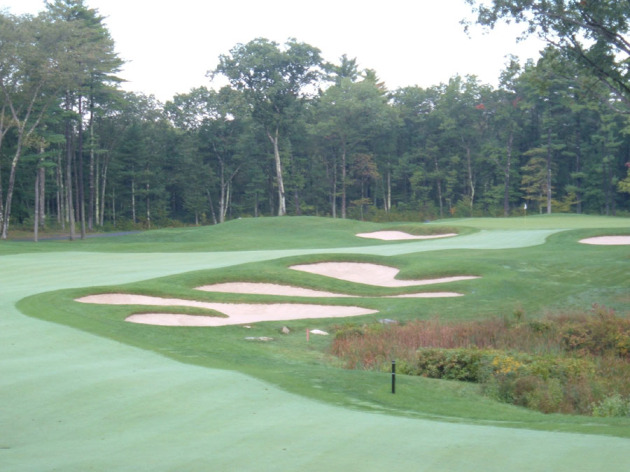
TPC Boston Before/After 4th Hole

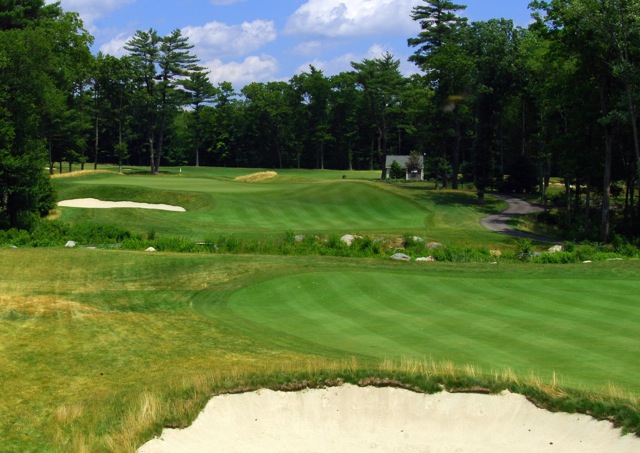
This is the one TPC Boston hole that Hanse-Faxon-Wagner reworked most, shortening the 425-yard par-4 by over 100 yards to create a risk-reward, driveable short par-4. The new view facing players is seen in the below "after" photo.

I'll be able to say more about how the options work when I get out there and see it next week.
 TPCBoston4thbefore.jpg

TPCBoston4thteeafter.jpg 

"Money games seem to have gone the way of the niblick and stymie."

Thanks to reader John for catching Jim McCabe's excellent overview of practice round gambling in pro golf:

"It's different out here. It's way too serious," said Brett Quigley, who isn't against tossing down his own money to back his game, except his colleagues seem to prefer the company of swing coaches, sports psychol ogists, and agents as they walk the fairways in practice rounds. A spirited Nassau? Not enough of his peers seem to go for that sort of thing anymore, "at least, not like when I was watching Dana grow up."

That would be his uncle, Dana Quigley, who at 60 is old enough to remember when money games during practice rounds were standard.

"I'm sure guys would still want to do it, but the fact is, they're all in their private planes, going home between tournaments, so they don't travel together," said Dana Quigley. "It's too bad, but there's no one around to have money games with."

Certainly not like the days when players such as Doug Ford and Bob Goalby were part of the traveling PGA Tour show.

"We had to play the money games," said Ford, a two-time major champion. "We made our money in the practice rounds."

To illustrate his contention, Ford recalled a practice round at the 1957 Masters when a colleague challenged him. Accepting the game and the stakes, Ford pocketed a sum of money that nearly matched what he made later in the week when he captured the coveted green jacket ($8,750).

OK, that pales in comparison to the gaudy sums that Mickelson and Huston took from Daly, but Goalby offers reminders of inflation and perspective.

"You'd probably have to play a $100 Nassau to match the $5 and $10 Nassaus we played for," said Goalby. "The only difference is, we didn't have the sort of money that these fellows do today, so the pressure was probably greater back then, because we couldn't afford to lose what little money we had."

Still, Goalby doesn't begrudge today's players for their treasures.

"They're so much better than we were, it's unbelievable," said the 1968 Masters champ. "They drive the ball better, they putt it better, they practice more."

But Goalby offers a disclaimer.

"But I think we had a better time playing golf in our day," he said. "We definitely had better times in our practice rounds. I'm sure of that."


U.S. Amateur Final Set

506-t.gifI was wrong when I posted that Colt Knost wants to be the next Tom Scherrer. He wants to be the next Chris Patton. Holy guacamole is he, well, uhhh...let's just say I hope they pad that U.S. Walker Cup budget so Buddy Marucci can meet Colt's dietary needs.

Ryan Herrington blogs about Colt's so-called Masters dilemma, and Colt says no matter what there is no chance he's remaining an amateur to the U.S. Open should he win Sunday.

Meanwhile there is this unbylined game story on Saturday's matches, while Dave Shedloski also looks at Knost, Ken Klavon writes about the other finalist Michael Thompson and Alex Miceli posts notes.

And Yet More FedEx Cup Reviews

fedexcuplogo.jpgNot since Tiger turned 30 have the scribes found such an easy column, only in this case, they're actually interesting to read. Chris Lewis lists various reasons to question the playoff concept but loves that it has revealed an "unparalleled surfeit of tour pro honesty."

Meanwhile John Huggan says the FedEx Cup...

...is merely the latest attempt by commissioner Tim Finchem to set a place for himself at golf's top table, where sit the Masters, run by the Augusta National Golf Club; the US Open (United States Golf Association), the Open (Royal & Ancient Golf Club), the USPGA (PGA of America) and the Ryder Cup (PGA of America and European Tour). The world's biggest and richest circuit, the PGA Tour, has long been driven crazy by its almost total lack of influence over any of the game's five most important and lucrative events.

Which is why the Presidents Cup matches, a glorified exhibition between a 12-man team from the US and another drawn from anywhere and everywhere except Europe, exists. Ticked-off Tim wants to be the centre of attention.

Sadly for his sizeable ego, however, the Fed-Ex Cup has just about the same level of (in)credibility as does the transparently tacky PC, a biennial affair that is but a pale imitation of the Ryder Cup.

Also check out Huggan's column for his review of Scott Macpherson's new book on The Old Course. 

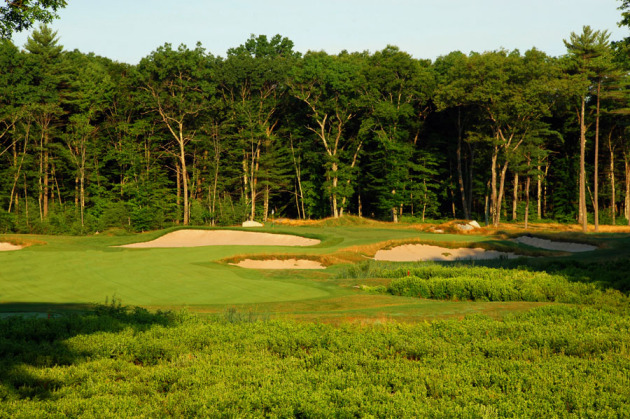
TPC Boston Before/After 8th Hole

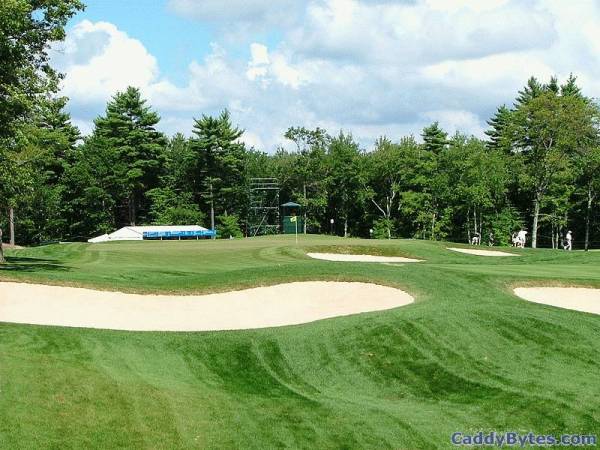
The TPC Boston's 213 yard par-3 8th appears to not have provided the Hanse-Faxon-Wagner team much to work with, but the bunker has less of that lovely Rees quality to it in the after shot (below). I also like the little bumpy ridge cut out short right that eliminates some of the modern shaping look and probably helps the player see into the right bunker better.

TPCBoston__before3.jpg 

TPCBoston8thafter.jpg 


U.S. Amateur Saturday and Other Olympic Club Observations

506-t.gifI'm a little behind because the matches are underway, but for those tuning Saturday at 1 on NBC, a few stories will acquaint you with the final four.

Beth Murrison has the Friday game story summing up the day's play with a nice overview of the semifinalists.  Art Spander writes about Jhonattan Vegas, whose impressive game I got to see some of Friday. There's also Dave Shedloski on Colt Knost and Stuart Hall on Michael Thompson. 230136-992923-thumbnail.jpg
A big gallery follows the Vegas-Pan match Friday (click to enlarge)

As for the event, it was my first U.S. Amateur and if you've never been, it's one of the great spectating experiences in golf. Very few ropes dot the property and you get the chance to roam a great golf course watching elite golfers. Until you see it, you forget how unique it is to get so close to such high quality play in today's game. 230136-992909-thumbnail.jpg
(click for a word from USGA sponsors)

As for Olympic, it remains one of my very favorite places in golf thanks to the atmosphere, singular design and fond memories from playing USF's collegiate event there. I was a both thrilled and disappointed in how the course looks. On the sensational side is the extensive tree removal work since the U.S. Junior Amateur that has left mostly Monterey Cypress and some pines. Vistas have been opened and the Cypress look more impressive than ever. The view from the clubhouse of No. 3 green is particularly eye-catching.

230136-992905-thumbnail.jpg
View from behind No. 8 (click to enlarge)
The fairways and greens looked to be in fine playing condition, but outside the main playing areas, the course looks worn out. And there is a difference between looking natural and rugged, and appearing beat up.

Here it was the U.S. Amateur, with very limited galleries and it looked like Tuesday after a PGA Tour event. The many fescue native areas that looked so good during the U.S. Junior Amateur now look less appealing, with too many non-native weeds and a less than satisfying appearance.

Bunkers were recently resodded so it's hard to say how the sod will settle, but right now the bunkers have lost some of their gracefully aged look. Give them time and play and I suspect they'll settle back into their classic antique look. 230136-992914-thumbnail.jpg
New tee on No. 3 stretches it to 247 (click to enlarge)

Several new tees were in play since my last visit, and while the third and fourth were conceptually fine, the execution was uninspired and in the case of the third, they appeared to have been done very close to the Amateur. Two new modern and even less inspired practice greens right below No. 3 don't exactly add much ambiance either. I have a feeling this overall feel may be the reason Olympic has slipped a bit in some of the recent course rankings.

And just to be the broken record I am, the fairway widths were incredibly depressing. On a course where the slopes and trees are such a prominent part of the design, the confining widths just seem to keep errant balls in play instead of taking missed shots to greater trouble. When firm and a lot wider, Olympic is infinitely more interesting to play or watch. I would contend that when it is firm enough, as it was Friday, it is far more difficult the wider it gets. I have played it when it's wider and it was exhausting! In a good way.

230136-992934-thumbnail.jpg
Rough around and behind No. 6. What a contrast to Southern Hills (click to enlarge)
Two narrow fairway examples come to mind: No. 2, with it's beautiful helping slope to the right and steep fall off to the left was reduced to a meaningless sliver, while No. 6, at a paltry 22 yards wide and featuring the lone fairway bunker, offers nothing but rough over that bunker, even though a player should want to hug the hazard and the left side to get at right side hole locations (and tee shots missed left trying to secure this angle find serious trouble).

Of course it would help if the guys weren't hitting wedges into a 440-yard hole, but that's an issue for another department in Far Hills. I hope that by the 2012 U.S. Open some of the fairways are tweaked.

Still, for overall tournament golf atmosphere, I don't think there are many better places than The Olympic Club. 230136-992937-thumbnail.jpg
One of the game's great scenes, No. 18 at Olympic Club (click to enlarge image)


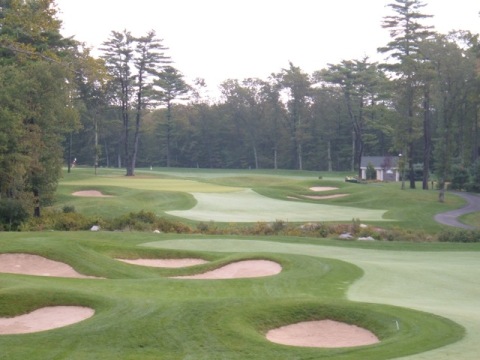
More TPC Boston: 16th Before and After

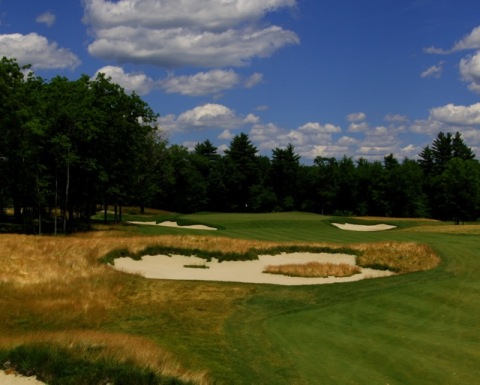
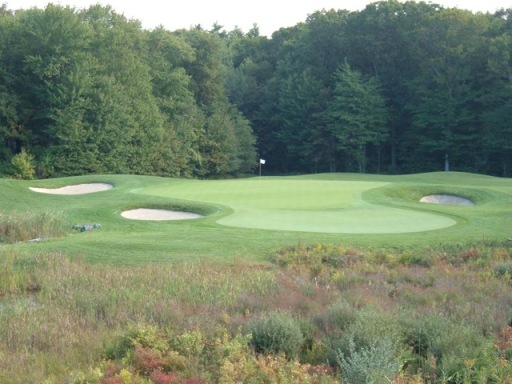
I believe this is a new green by Hanse/Wagner/Faxon at the TPC Boston, with the par-3 shortened and the green given more of a peninsula effect that should make Sunday hole locations fun.

Before and after, with the old green site sitting where you see the reddish fescue grass:

TPCBoston16Before.jpg 

TPCBoston16after.jpg