In golf construction art and utility meet; both are absolutely vital; one is utterly ruined without the other. GEORGE THOMAS

It’s back!
Twenty years later Tatra Press has kindly allowed me to bring back Grounds For Golf now that golf architecture is of more interest to the masses. A new Introduction looks at what’s driven the interest growth and two new chapters I had a blast adding (plus a few edits to keep things up-to-date).
The Amazon purchase page for the book arriving June 15, 2026.
Westchester Options
/Sam Weiman posts an interesting update on the Westchester-PGA Tour standoff, including the slim possibility that the Barclay's may return there in 2008.
That contract had Westchester on the receiving end of $3.6 million from the tour—$800,000 for already hosting the Barclays last summer, and then another $2.8 million over the next five years.The value of that agreement alone suggests Westchester feels it deserves more than $1 million to let the tour walk away.
"The two-network average showed an increase of 111%, or 4.0 compared with 1.9."
/Thanks to reader Hugh for emailing this Thomas Bonk piece picked up in The Age, but run originally in today's L.A. Times. These numbers may cause dangerous health effects in tournament directors who never see Tiger Woods:
According to research that traced Woods' effect on television ratings in 2007, tournaments in which he finished in the top five had a 171% increase in CBS' ratings over those in which he did not play or wasn't in contention.
The ratings were 4.6 compared with 1.7.
In similar tournaments on NBC, the ratings increase was 59%, or 3.5 compared with 2.2.
The two-network average showed an increase of 111%, or 4.0 compared with 1.9.
Greetings From San Diego, Vol. 2
/ A glorious day at Torrey Pines with few clouds, temperatures in the low 60s and lots of giddy anticipation for...the 11 and 3 pm mandatory player meetings to discuss the new drug policy. I saw the Commish walk by and only fear that the players were subjected to lengthy presentations by golf's first $5 million suit.
Still, I managed to have some nice chats with several veteran players about topics of interest related to stories I'm working on. It's always refreshing to know that for every guy who is just happy to be there playing for $6 million, the Bob Tway's, Joe Durrant's, Geoff Ogilvy's and Duffy Waldorf's give the game a lot of thought.
However, that meant I missed Jason Day's sitdown with the scribblers but would imagine he was not quite so audacious in his stated aspirations.
The combination of the football playoffs going dark this weekend and the strong field had many on site wondering if this would be a more appropriate place to start the PGA Tour season. Not sure what you do with Hawaii and the Hope, but that was the vibe on the putting green.
I know your day has been made so much better by that spellbinding speculation.
"If you want to mess with these guys you've got to create options."
/I missed Mark O'Meara's sit-down with the assembled scribes at Torrey Pines today, but loved this from the transcript:
Q. A lot has changed in the last ten years. It's become a power game now. Do you wish that you could go back or guys could learn maneuvering the ball, hitting the ball different directions? It's kind of a lost art out here.
MARK O'MEARA: It is. That's why it's kind of fun certainly to watch what Tiger has done, the way -- he has the power; that's not an issue. But the cool thing about Tiger Woods is he can hit an 8-iron 87 yards if he wants to. I think a lot of the other young players that are brought up in this modern era of power and distance, you have to hit the ball far to really compete nowadays. The creativity standpoint, that's kind of gone away, the fact that the equipment and the ball don't curve as much.
Would I like to see that change? As long as the equipment is legal, I have no problem with it. But I do agree with that. I think when I play with a player that plays some creative shots, that impresses me more than just somebody who's powerful and beats away.
You know, the conditions have kind of led into that. Everybody talks about how far everybody is hitting, and they think that's ruining the game. So they think, okay, to fix that we're just going to make the golf courses longer. But I'm not so sure that really fixes it because when you look at the game and you look at some of the most creative holes or the most talked-about holes in golf are usually the shortest ones. So it's kind of ironic that, okay, you can go play a 497- to 512-yard par-4, but it's pretty much bombs away.
Okay, the guys who are powerful are going to have a huge advantage over the average length players, and power players should have somewhat of an advantage. But I think if you want to mess with these guys you've got to create options. You've got to force them to think a little bit. There's more fear on a player's face when he's standing on the 12th tee at Augusta than there might be standing on the 12th tee at the South Course at Torrey Pines.
Where's Marty Hackel When You Need Him...Wait, That Is Marty Hackel Edition
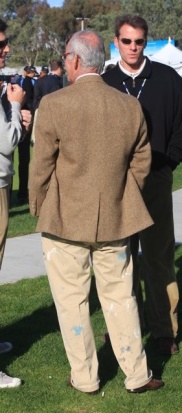
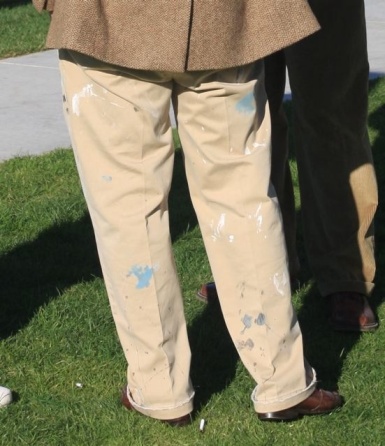
/They must not be paying enough at Golf Digest because it was disheartening to witness the always dapperly-dressed architecture and style aficionado Marty Hackel sporting a pair of (cuffed? Marty?) khakis that he picked up at the Jackson Pollack estate sale.
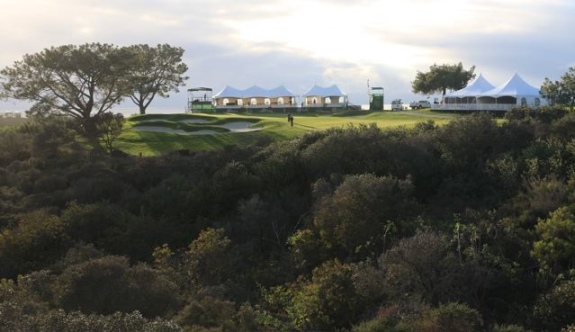
Images From Torrey Pines: 14th Green
/The par-4 14th may be the best and worst change in the new look Torrey Pines. Best with the tree removal and embrace of the canyon, and worst because the canyon use could have been even better. The bunkers that look airlifted onto the landscape left protect balls from heading into the hazard, a feature I dread. Click to enlarge the image.

(Click on image to enlarge)
Images From Torrey Pines: 13th Green
/There are mixed feelings about this one. I love that balls with too much spin might come back down off of #13 green at Torrey Pines South. And superintendent Candice Combs is wise to protect this collection area...of sorts, with netting and ropes. But something also is just not right when there's a need to cover an area to prevent a sea of divots. In this case, the weak turf in the approach, which appears to be the product of lousy soil, seems to be making it too easy for balls to spin off the green, down the hill and to this ledge.

Images From Torrey Pines: 16th Tee
/This is a view from the tee that will be used during June's U.S. Open, but not during Buick play this week. It's great to see the sage scrub canyon, unfortunately the bunkers are still those copy and pasted clunkers from Bethpage Black.
Phil Would Rather Stay In Bed Than Face Scribblers
/And I was so looking forward to hearing his take on Kelly Tilghman.
Masters Extending Its Brand To Streets Of Pattaya Beach
/Doug Ferguson reports on the captivating news that Liang Wen-Chong of China, Prayad Marksaeng of Thailand and Jeev Milka Singh of India are extending the Masters brand. Do I smell a knickname for the Masters chairman? A counterpart to The Brand Lady?
"These three individuals are successful, accomplished and talented golfers deserving of a Masters invitation," Payne said. "This is also another component in our objective of growing the game of golf worldwide utilizing the Masters brand. We think the interest in golf in each country will heighten when these players compete in the Masters."
“One thing I just don’t think we got right was the first cut of the primary rough"
/Thanks to reader ken-one-putt for catching this on Torrey Pines in Brian Hewitt's recent notes column:
What people won’t readily see on television, but the players will learn, is the firmness Davis means to insure for June. “The greens typically run from 9 ½ to 10 ½ (on the Stimpmeter),” Davis said. “My guess is we’ll be closer to 13. That’s a speed those greens have never been at before.”
For the Buick Invitational, Torrey Pines South will play 7,568 yards to a par of 72. That yardage will be roughly the same for the U.S. Open but the USGA has converted the par-5 sixth to a long par 4 which will make for an 18-hole par of 71.
“That hole had no sexiness as a par 5,” Davis said of No. 6.
The 18th hole, a relatively short par 5, will remain a par 5 despite a lively debate among USGA officials. Course architect Rees Jones, who did the re-design at Torrey Pines, wanted No. 18 converted to a par 4. Davis wanted a par 5 so he could manipulate the tee box lengths on a daily basis to account for weather conditions and challenge the medium-to-long hitters to go for the green in two all four days.
And this was very interesting because A) I wonder how many times he fell asleep watching and (B) his statement about the first cut being too severe is so refreshing from a USGA official:
One of the things Davis did during the holidays was break out the tapes and watch every minute of all four days of the television broadcasts of last year’s U.S. Open at Oakmont.
“One thing I just don’t think we got right was the first cut of the primary rough,” he said. “It was just too penal.”
That will change at Torrey Pines. The winning score at each of the last two U.S. Opens was 5 over par. Davis told me he has no problem if 10 under is the winning score in June.
Oh but Rees will!
"You can't grow an avid golfer in a quarter"
/ A couple of interesting columns have rolled in from the PGA Show and focusing on the rosy economic picture recently painted by some of the game's leaders.
Thanks to reader John for John Paul Newport's look, which included this:
So why the undercurrent of pessimism about the golf industry? Joe Steranka, chief executive of the PGA of America, which sponsors the show, suggests that the industry's outlook became a bit skewed starting in the 1990s. Many well-known golf businesses were gobbled up by investor-owned companies, which focused on short-term earnings.
"You can't grow an avid golfer in a quarter," he said. "For a while there, I think some in the industry lost sight of what the game needed for its long-term good."
And...
The possible looming recession may have only a minor effect on golf, argues Mr. King at TaylorMade. For one thing, more and more baby boomers are entering their prime golf-playing years. "The fact is that when people can't afford bigger vacations or fancier cars, they still make smaller purchases for recreation," he said. "Sometimes it means they even play more golf than they did when times were better."
Brad Klein at Golfweek wasn't quite so keen on the numbers presented...
Macro-economic studies like this serve a useful industry function in that they help generate public attention and set the stage for legislative lobbying efforts and behind-the-scenes policy bargaining. That’s precisely one purpose of this report. It will certainly be part of a widespread golf industry show and tell effort in Washington on April 16, National Golf Day. Similar, state-by-state studies have also been completed for Iowa, Louisiana, Michigan, Minnesota, Ohio and Virginia. They can help steer public policy toward pro-golf, pro-tourism efforts, and they can be powerful tools for impressing legislators and policy-makers when it comes time to decide upon water allocation, land use, tax rates and zoning provisions.
This was interesting and a point I haven't seen written about before:
Perhaps the biggest issue facing the golf industry, which went unmentioned in the report or in the news conference accompanying its release, is the vast dependence of maintenance crews and clubhouse operations on immigrant labor for staffing. If the golf industry can effectively lobby for immigration reform to assure a steady supply of legal workers, that would be a major legislative achievement.
And it's hard to disagree with this:
But some of the numbers here in this report seem inflated, with suspect counting rules that create an unduly rosy picture. For example, the $28 billion in golf-facility operations includes weddings, banquets and all food and beverage operations. Why all of this should be attributed to golf is a legitimate question, because folks would be having meals and banquets somewhere, and it’s not as if golf created that expenditure.
More questionable is the exaggerated activity attributed to real estate: $14.97 billion in 2005, accounted in terms of 63,840 homes constructed at a cost of $11.6 billion ($181,704 apiece, plus 28 percent premium of additional value ($50,877 per home), which the report explains as “the amount a buyer is willing to pay for a home or property located on a golf course or within a golf course community.”
But why does golf get credit for all of those homes? Only 20 percent to 25 percent of homeowners at golf communities buy there for the game and play golf at the facility;
Greetings From San Diego, Vol. 1
/ Arrived today at Torrey Pines where a light, cool drizzle gave way to a beautiful afternoon so that pro-am number nine could finish in all their glory. I walked the back nine, and because it's so bloody cold you can't go outside and have nothing better to do, some food for consideration...
The good...
The U.S. Open hosting South Course is in fine condition. The greens look especially good considering the beating they are taking with all of the Pro-Am play. The rough is benign for the most part, and the fairway widths generous by today's standards (24-31 yards for the holes I paced off, most were 28 on the number...). In other words, expect a fun tournament with some decent scoring and excitement.
The really good...
Tree removal. Lots of it and plenty of trimming too. It's no coincidence that one Tour official told me this is the best he's seen the course in nine years. There are several stunning views that have been opened up, and the Torrey pine's are actually the predominant tree. Considering this is the only place in the world you can see them in abundance, it's a nice touch.
Also, the reworked 18th fairway landing area is much better. It's a generous 31 yards and very inviting for guys to hit driver, which will encourage many to go for the green in two. I hope it stays close to this configuration for the Open.
The really, really good...
The Lodge at Torrey Pines. Other than the poor soul who has to dress up like a Scottish bagpiper to greet front door guests, the place is stunning in every respect. If you love Greene and Greene craftsman architecture, the replication of their details makes it a modern day architectural marvel. Especially compared to...
The bad...
The lack of any intelligent purpose to the holes other than hitting it high and straight is beyond belief. It's just a shame considering how much potential there was to embrace the canyons and take advantage of the nice natural ground. Prior to the renovation there were several hole locations that rewarded drives placed on certain sides of the fairways. I don't see that in the current South course.
The ugly...
The shaping. Not only are the bunkers soulless, the tie-in work around the greens is awkward and abrupt. It also appears that poor topsoil was used to elevate the greens because many approaches are thin.
All in all the place is at least feeling like a U.S. Open venue. The scale is grand and the views lovely. And yet it could be so much more interesting strategically, particularly in utilizing the natural features.
Images to follow...
Bob Hope Photo Caption Fun
/Courtesy of GolfDigest.com's weekend photo slideshow...what's Jim Weathers whispering in Long John's ear?