Finchem Declares Rap Music Interesting; Rebranding Hits Snag When Talk Turns To Value Modules

I get a medal don't I for sitting through alll of Tim Finchem's "roundtable" with Rosaforte, Dorman and Lerner?

roundtable_450.jpgYou may recall that what started out as an attempt to soften Finchem's image turned into a dress alike contest (Dorman was DQ'd for the khaki and Rosaforte for that bluebloodish navy under-mock), turned into an over-40 softball session covering Finchem's childhood, golf game and musical interests.

Everything was fine until Lerner asked something serious. Finchem forgot he was on television instead of in a sponsor's meeting.

To save you the trouble of sitting through the entire thing, here's a transcript. And no, I did not make this up... 

In the marketplace there are three value streams that flow to a title sponsor. One is the value, what we call the branding exercise, which is the entitlement to the tournament. The value of the commercial inventory that's presented to that sponsor. And half of that inventory is rolled into other tournaments. You may and probably do see Sony advertising at Buick and San Diego. That's the value of the package, the television platform. That's why when we put an event on like a World Golf Championship it raises the value of the overall platform. It's not just that week.
The second value stream is business to business out here on the property. Week in and week out that value is significant and unique in many ways. There's hardly anything else that compares to a business to business experience than a pro am experience  on the PGA Tour for a business enterprise. You just can't name it. You can give men or women tickets to sporting events, or to go see a show and it doesn't compare to this out there.
The third thing is that companies can align themselves with charitable causes which impact what we call the qualitative brand impact or the qualitative nature of their brand. And more and more companies are paying attention to that in today's world. They want to be associated with a sport like this and they want to be associated with the charitable benefits that are generated.
The companies that take advantage of all three of those streams, and you need to take advantage of all them. You have to have good creative in your advertising, you have to be smart on how you use the business to business and you have to work hard on the PR value of the charitable, they're with us a long time. If you have a company that comes in and just wants to put their name on a tournament and run some ads, they're not around very long. Or just wants to get a lot out of the pro-am not thinking about how to use the creative to reach our demographic, which is the most powerful demographic in all of sport, they're not going to be around. The ones that take advantage of all three are going to be around. To your example, Sony has worked hard to take advantage of all three and they get real value at the price point that they're at. If they didn't, given the energy that these companies put into evaluating expenditures, if they didn't, we wouldn't be making these transactions.

There was also a mention of value modulations later on, in case that was on your bingo buzzword board. 

080214finchem_gwindex.jpgRosaforte wrote about the cuts discussion portion at GolfDigest.com:

Finchem had the numbers to back this up in an interview he did on Golf Channel, citing an average of 12 times a year when the players who survived the cut totaled in the mid-eighties, and it took five hours and 20 minutes to complete a round. What sent this to the Policy Board for a vote last November was that it happened twice late in the Fall Series.

"It's not the way we want to present the product," Finchem said.

And...

As for the player who matters most, you can see why Tiger Woods would not want to see the rule changed back. Since he's regularly in one of the last three groups on the weekend, he's one of the guys caught waiting on tee boxes. And it's not fair to the golf viewer when the network signs off for contractual reasons, sometimes with the leader on the course. But what is fair to a guy like Jay Williamson, who was only four strokes out of the top-10 when he was sent home early at the Buick Invitational?

So is he product too? 
Greetings From Los Angeles, Mop-Up Edition

greetingsfromLA.jpegI'm still working on that 10th hole analysis (I know, you can't wait) but in the meantime, there were a few fun items worth noting about Sunday's Northern Trust Open.

Chris Lewis puts Phil Mickelson's win in perspective and also wonders about the hand placement during Amy's.philandamy_2.jpg

Bob Smiley recounts the hilarious exchange between Jim Nantz and Northern Trust CEO Rick Waddell.

John Strege's Golf World game story is also posted already.

And finally, Peter Yoon in the LA Times and Larry Dorman in the New York Times profile Phyllis Wade, who worked her 60th straight Los Angeles Open and who I've gotten to know thanks to her diligent work copying and clipping every article written about the event. Every year I get a nice envelope full of all the clippings.

17volunteer.1.190.jpgMy favorite moment of the week came Sunday morning when a Golf Channel pre-game show ran a feature on Phyllis. The press room got quiet and 30 or so people were glued, and when the feature ended a huge ovation broke out.


"Heavyhanded edicts"

John Hawkins does a nice job encapsulating the growing displeasure amongst PGA Tour players with the job Commissioner Tim Finchem is doing and the possibility that it might lead to some sort of player union. Having just talked to several players about various topics, it's amazing how many continue to bring up their displeasure with the Golf Channel's 15-year deal.

Finchem's 2006 decision to form a long-term partnership with the Golf Channel was the first of several big moves that had numerous veterans scratching their heads. Some wondered why he'd done what he did, who had a say and how much player input was involved in the process. Enter the FedEx Cup, a competitive restructuring that began with players talking about a shorter season but soon morphed into a "tourified" commercial enterprise.

When Woods, Phil Mickelson and Ernie Els all skipped a FedEx Cup playoff event last summer, a message had been sent. In particular, Mickelson was rankled by what he perceived as the tour's inability to listen and was frustrated enough to bring it up in a televised interview immediately after beating Woods in Boston.

"There can be some heavyhanded edicts," admits Browne, who has served on both the policy board and PAC. "I think a lot of guys want to be involved [politically] in something where we all have such a huge stake. Given the direction the tour has gone [in determining recent policy], there obviously has been some conversation [about forming a liaison]. We'll see what comes of it."

I really think they'd all forgive and move on if they watched the Golf Channel roundtable and listened to Finchem talk about his favorite Eagles song. 

Greetings From Los Angeles, Final Thoughts Edition

greetingsfromLA.jpegWhile the 2008 edition couldn't top last year's classic in the thrills department, Riviera was the winner again thanks in part to wild weather, the best course conditioning I've ever seen (credit goes to Matt Morton and his hard-working crew), along with a stellar field that struggled despite decent scoring conditions over the weekend. If nothing else, the week proved Geoff Ogilvy's insistence that no rough and firm greens can give the best a great test.230136-1350787-thumbnail.jpg
Stuart Appleby approaches No. 1 Sunday (click to enlarge)

Larry Dorman in his New York Times game story saw the 10th hole as a key turning point, and while Jeff Quinney was pleased with his par salvage there, it really was a deflating way to start the back nine. When I get a chance to catch my breath I'll post some fun stuff on the 10th hole, including the ShotLink data. 

Doug Ferguson focuses on Mickelson's odd transformation at Riviera, where he went from not really liking the place to embracing it's subtleties with help from Amy Alcott.230136-1350751-thumbnail.jpg
Mickelson approaches the 3rd (click to enlarge)

You can check out Mickelson's post round exchange with the scribblers here where he talks about Amy as well as an interesting equipment adjustment that he credited.

230136-1350763-thumbnail.jpg
Phil was not checking where he stood on the FedEx Cup points list (Click to enlarge)
The predicted leaderboard issues thankfully never materialized since it was a two-man show, but the PGA Tour has a serious problem on their hands with the new board content (visually they are fantastic and a huge improvement).

Every time I tried to get scores today, I was met with a litany of ads, thank you's and worst of all, Fed Ex Cup points. If you want to do that stuff early in the week, fine, but not during the final round.

230136-1350793-thumbnail.jpg
No. 16 Sunday (click to enlarge)
Finally, I've decided that the best job in golf belongs to the dude who runs around the course carrying David Feherty's monitor. While Peter Kostis goes with the strap on, Feherty is accompanied by the lucky soul who gets to hear an endless stream of one-liners and sarcastic jabs at the telecast. I would repeat the parts I overheard, but why endanger that lucky soul's chances of hearing Feherty unplugged? 230136-1350780-thumbnail.jpg
Sunday's final round hole location on No. 10 (click to enlarge)


Late/Early At Riviera

With the cut made Saturday morning, Peter Yoon of the LA Times was finally able to compute the scoring average differences between late/early and early/late players and came up with this killer stat that sums up just how brutal the conditions were...for some.

Players who had tee times on Thursday morning and Friday afternoon enjoyed less windy conditions both days and it showed in the statistics.

Those players averaged 71.28 on Thursday morning and 70.68 on Friday afternoon. The other half of the field averaged 73.51 on Thursday afternoon and 73.78 on Friday morning -- a total difference of 5.33 strokes.

"The wind was gusting and swirling enough that you were really out there guessing as much as you were feeling like you were making good decisions on club choices," said D.J. Trahan, who played the more difficult times the first two days and then shot a third-round 66, the best round Saturday.

Greetings From Los Angeles: All Change Is Not Progress Edition

greetingsfromLA.jpegThe golf was fairly lackluster today thanks in part to another shift in the weather that brought heavy air. Combine that with some tough hole locations and a surprising forward tee location on 14 which made the boys think, and that probably contributed to the lack of low scoring. I've had a preview of Sunday's setup and it should let someone go low and maybe catch up, but right now it looks like a two man race between Phil Mickelson and Jeff Quinney.

I was present for Quinney's ace, which was a bit of a surprise for everyone. After he hit the shot he didn't seem too aware that it might trickle down to the hole. Because the cup was cut on the front right, the large gallery could not see it trickling down until the last moment.  230136-1348252-thumbnail.jpg
Quinney collects his ace (click to enlarge)

230136-1348256-thumbnail.jpg
No. 18 Saturday minus the traditional manned leaderboard (click to enlarge)
Should someone go low Sunday, it will be interesting to see if the leaders actually know it. While Northern Trust has done a nice job injecting some class and much needed spending into the event, there has been one poorly planned change involving leaderboards. The longtime manual board that has been a fixture at the 18th green (as well as another between the 8th and 15th holes) has been scrapped in favor of a seating area for Riviera owner Noboru Watanabe. That seating area has gone unused so far this week, but either way there is still room for a manual scoreboard.

This board was vital for a few reasons. One, it gave leaders coming to 18 an idea where they stood. It also let the fans who traditionally gather there a way to track and react to what the leaders are doing.

Sure, there's one of the new electronic boards on 18, but while they look superb, the content is horrendous. The main leaders scoring list is rarely up long enough before player bios and group information appear. I really don't need to know that Robert Allenby enjoys fishing in his spare time.  230136-1348260-thumbnail.jpg
Not so vital information on the new scoreboards (click to enlarge)

Less visible but equally as bad was the removal of Bob Lowe's classic hand-drawn scoreboard in the press room, replaced by a new, hard to read and less informative plastic board.

230136-1348264-thumbnail.jpg
Scribblers Miss The Old Hand Drawn Scoreboard (click to enlarge)
The guess among the scribblers is that these changes were influenced by the PGA Tour's Championship Management division, which has a well known disdain for the old style manual scoring systems (and for all we know, renting some of this stuff to the Northern Trust Open folks).

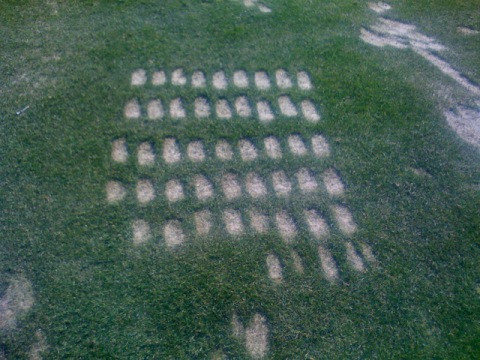
And finally, for obsessive compulsive types, Tom Pernice's driving range divots from the week... 

2008NorTrustPerniceDivot.jpg 

"What's happened, Doug, is the golf ball is going farther."

I thought this was a good question from Doug Ferguson after Saturday's third round at Riviera, but because Phil Mickelson was anxious to get on Mickelson Airship 1, he poo-pooed the question a bit.

Still, at least he says it's the ball...

Q. Curious on 10, if conditions notwithstanding, it seems like 3-wood is the choice for most of the power hitters. When did that become the case? Has it ever been driver, and have you noticed over the years driver no longer being a choice?

PHIL MICKELSON: What's happened, Doug, is the golf ball is going farther. So when we used to hit drivers, we now are hitting 3-woods. (Laughter).


"They've changed it a little bit, but they haven't ruined it"

John Strege points out Scott Verplank's disappointment with some of the changes at Riviera, which this year included bizarre add-ons to the 11th and 17th that were not carried out very gracefully. It's not a good sign when PGA Tour pros can tell... 

"They've changed it a little bit, but they haven't ruined it," said Scott Verplank who, heading into the final round, stands tied for fourth in the Northern Trust Open, six shots behind leader Phil Mickelson.

"They haven't ruined it" smacks of damning it with faint praise. Several greens have been expanded by architect Tom Fazio and his design associate Tom Marzolf, though not necessarily as a counter to their tending to shrink over time. They've been expanded in places where there has never been green before, contrary to architect George Thomas' original design.

"I haven't been all that impressed with some of the changes," Verplank said, "but the golf course is so great. As long as you don't do anything too major, it's a brilliant place. They changed some of the greens a little bit, and it seemed to be a little bit out of character with Riviera, but it's still great. Every great golf course goes through stages of changing it and tinkering with it and all that. It would be pretty hard to mess this one up too much."

It should be noted the Tour is not using the new wing locations on the 17th and only used the front spots on No. 11 (I'm sparing your photos...it's more of the same incongruous stuff as they've done in the past). 

Greetings From Los Angeles, Slow Play Edition

greetingsfromLA.jpegWhy try to convey just how royally hosed the late/morning tee times were when I can have Phil Mickelson do it for me:

The early/late tee times had a huge advantage this week. A lot of the times, most of the weeks, it doesn't make too much of a difference but every now and then, there will be an advantage on one wave, and we certainly had that. I mean, all of the scores that are any good, 90 percent of them are from the early/late wave. We avoided wind yesterday morning. It died down this afternoon. Just we got very lucky.
The conditions made late/early starter Fred Couples' -2 performance that much more amazing. And speaking of Freddie, John Strege writes that the two-time winner at Riviera plans to keep coming back as long as they'll have him. Judging by the paltry crowds and the huge proportion following Fred, they'll invite him back until he's using a walker.

Okay, now that we have the pleasantries out of the way, let's talk about slow play and the narcissists who apparently think they are the only golfers on the planet. Namely, Ben Crane and Mike Weir.

 
230136-1346821-thumbnail.jpg
Looking for Weir's ball (click to enlarge)
Let's start with Weir, who rudely held back Geoff Ogilvy and Shaun Micheel with all of his twitching and false starts. On the par-5 11th, Weir drives it in the trees and lays up beautifully in the 12-inch kikuyu barranca. He asks the marshal where the ball entered and the volunteer points to where he swore it entered. Well, just as the five minute marked wrapped up, Ogilvy finds the ball about 7 or so yards away. Weir simply turns and scowls at the marshal. Classy touch Mike!

Weir then spends the next 3 minutes considering his options before finally taking an unplayable drop. From that point on the group was a hole behind and eventually put on the clock on No. 13. So Weir picks up the pace right? No, he never seemed to make much of an attempt to speed up as long as I was watching.  He does not ever play ready golf, instead starting his pre-shot research and routine only when it's his turn.

The low point came on No. 15 when Ogilvy asked if he could hit out of turn because Weir was mysteriously lollygagging down the fairway even as they remained on the clock and a hole behind.  230136-1346832-thumbnail.jpg
The warm weather brings out the best in L.A. (click to enlarge)


Then there's Ben Crane, paired with two other slow pokes in Trevor Immelman and Sergio Garcia. After holding up everyone behind him and reportedly having already been put on the club 3(!) times in 36-holes even though there are 24 groups spread over 18 holes (kinda hard to fall a hole behind!), Crane was standing in the TV scrum area outside the scoring room. When one of the players in the group behind him entered the hallway, he saw Crane and looked right at him and said, "Hurry the $@%# up!" Crane didn't hear him (of course).

Later on the locker room the f-bombs were flying like it was sailors night out, with Crane's name flying off the walls of Riviera's locker room.

Now, Golf Digest's Tim Rosaforte asks in a blog post if "144 players too many for a West Coast tour stop -- or are these guys just too slow?"

In talking to the rules staff, they say yes, the field needs to be reduced.

However, I responded with two points.

One, the course has been lengthened and the 10th, 11th and 17th are all reachable now, adding many of the logjams or timely walks that never existed. And two, cutting the field means you'll likely cut the spots that go to local qualifiers who add a unique flavor to the event. So before they go calling for a 132 player field, perhaps a stronger pace of play policy should be tried before ending an important local tradition. 

Greetings From Los Angeles, Vol. 3, 2008 Edition

greetingsfromLA.jpegI didn't see any of the first round telecast from Riviera so I'm not sure if they were able to convey just how strong the gusts were. It was a cruel fate for the afternoon times who drew swirling, cold Santa Ana wind gusts (with more apparently forecast for the morning play). There is no way to describe how good Geoff Ogilvy's late 69, Dustin Johnson's 3-under through 15 total and in progress rounds by Kevin Sutherland and Chez Reavie were considering the extreme conditions.230136-1344456-thumbnail.jpg
Geoff Ogilvy plays into No. 7 (click to enlarge)

I tagged along for 11 holes of Ogilvy's round and his game appeared quite sharp. More alarming was the play230136-1344451-thumbnail.jpg
Mike Weir and caddy (click to enlarge)
of partner Mike Weir, a two-time winner at Riviera who I've watched many times over the years. However, I had not actually followed him recently and while I love the look of his Stack and Tilt swing, everything that happens right up to pulling the trigger is painful to watch. His caddy is constantly asking marshal's to move and his Monty-like ability to hear all sounds leads to constant restarting of his pre-shot routine. Weir won't even pull his driver on obvious driver holes until his caddy rests the bag down next to the teeing position.

230136-1344499-thumbnail.jpg
Jim Furyk Plays Into No. 1 (click to enlarge)
And they wonder why it was well over 5 hours in the afternoon for the field to finish. Well, most of the field.

As usual the tenth hole proved to be a joy. Playing downwind most of the day 3-wood was often the option for many players. A quick look at ShotLink showed that laying up was a mistake today thanks in part to the green firmness.230136-1344459-thumbnail.jpg
Shane Bertsch approaches No. 10 from a poor angle (click to enlarge)

Though I'm still kicking myself for missing Tom Pernice's hole out for double bogey. Shucks! Apparently he went back and forth between No. 10's greenside bunkers, which was easy to do today with the back left hole location and firm, fast greens.


"I felt the brunt of the tour when they're trying to squash you. I felt like Brian McNamee.''

I finally got around to Doug Ferguson's always entertaining weekly notes column, this week featuring a fun lead item on Rory's long lost cousin, Jonathan Kaye, who weighed in on several topics, starting with drug testing and eventually, his lengthy suspension.

"I don't see a need for it. I don't think anyone is on steroids,'' he said. ``They're opening themselves up for a stringer, especially if we don't have a players' union, or a universal voice where we can be heard, instead of being squashed by a dictator.''

That would be PGA Tour commissioner Tim Finchem, with whom Kaye has crossed frequently.

His most notorious incident, which led to a four-month suspension, came in Kingsmill in 2001 when a security guard asked to see Kaye's tour badge. According to several published accounts, Kaye returned to his car and displayed the badge below the belt.

"I got the largest suspension ever on tour ... for what?'' he said. "I lose my job, and I lose my sponsorship. I felt the brunt of the tour when they're trying to squash you. I felt like Brian McNamee.''

He also doesn't like the new cut policy, and when told the Players Advisory Council would be meeting Tuesday at Riviera, that didn't seem to allay his concerns.

"There's not one person on the PAC that I voted for,'' Kaye said.