In golf construction art and utility meet; both are absolutely vital; one is utterly ruined without the other. GEORGE THOMAS
It’s back!
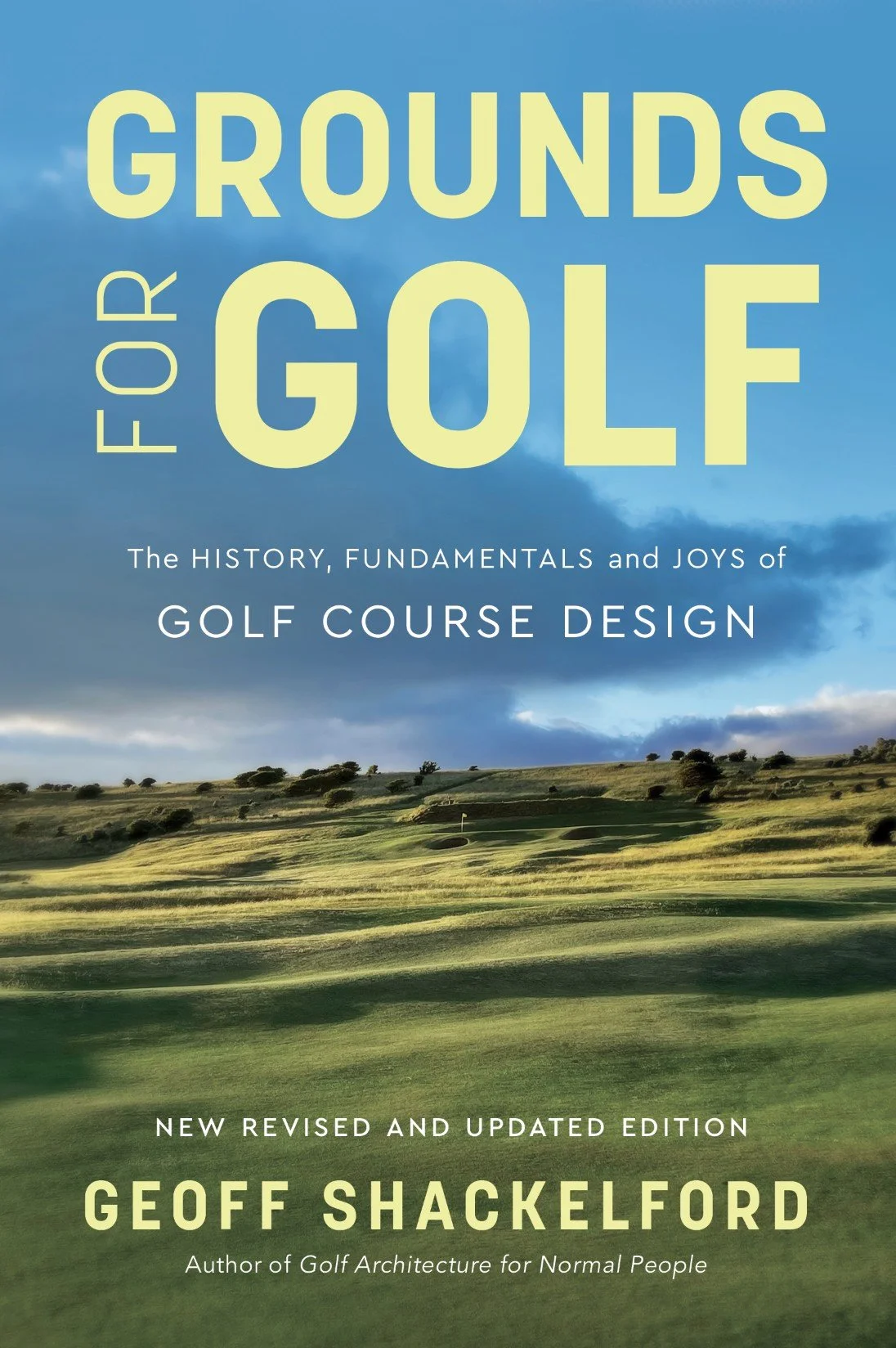
Twenty years later Tatra Press has kindly allowed me to bring back Grounds For Golf now that golf architecture is of more interest to the masses. A new Introduction looks at what’s driven the interest growth and two new chapters I had a blast adding (plus a few edits to keep things up-to-date).
The Amazon purchase page for the book arriving June 15, 2026.
"It's all still there."
/Ron Green Jr. visits with Ben Crenshaw during the Pinehurst No. 2 rehab.
"You may get a great lie or be up against a pine cone or against wire grass," Crenshaw says. "You wonder why Ross was so enamored with what he saw. It's just sandy, impoverished soil but it's ideal for golf."
The fairways are wide and follow the original lines created by Ross. More than half the sprinkler heads have been removed at No.2, leaving the restored natural areas to take what the weather gives them.
There is an art to bringing back the natural look of No.2. Crenshaw stands in a sandy area, recently cleared and now being cultivated. He talks about the fun of placing clumps of wiregrass so that there's no pattern to it, spreading them like the wind might, and the options that will evolve over time when weather and fallen pine needles fill in off the fairways.
Green also talks on this video about what he's seeing, allowing us to get a glimpse of the work behind him.
"He is one loose cannon."
/What happens in Vegas...ends up in the newspaper!
Thanks to reader NRH for Norm's Las Vegas Journal-Review item on Anthony Kim continuing his image rehab at the Bellagio during this week's tour stop.
"He is one loose cannon," said a dealer, who said Kim may have set a personal record for F-bombs while playing high-stakes craps over the weekend.
Maybe it was the heartbreak of not securing a European Tour card for 2011?
"To play two links courses in succession just might too much for some players."
/"As part of the suit, the plaintiffs filled a notice of mechanic’s lien against the resort hotel."
/"Just seven years ago, 11 Tour events were sponsored by automotive companies, or more than one in three Tour events with a title sponsor."
/"How do you keep your boys down on the farm, now that they've seen Moline?"
/"The golf industry was not included as part of the national stimulus package, but just about everyone else was."
/Tiger Back To Dodging Softballs And Battling Presser Insomnia
/RIP Hiroshi Tango: At Least He Was Playing Ready Golf
/Departing GC Exec: Golf Needs To Spice Things Up
/"Do you believe what just happened out there? I have a job again."
/Classic finish to today's Frys.com event today, classic post round remarks by champion Rocco (as always) and classic call by Oosterhuis in advance of Rocco's fourth (!?) hole-out of the week.
The video does not include epic shots by Alex Prugh, Bo Van Pelt and Rickie Fowler driving the green at the same hole.
Olympia Fields Lands 2015 U.S. Am; Confirms USGA Has A Very Short Memory
/
Bradley Klein delivers the news of a USGA return to a place thought to be off the radar for a major event. I doubt this is a setup for a return U.S. Open, despite the widespread and frankly, relentless clamoring for a 2023 Open return to celebrate the 20th anniversary of Jim Furyk's unforgettable triumph over the North Course.
This is probably more of a gift to an executive committee member for time well-served, not that there's anything wrong with that:
The 2015 Amateur will be contested on both the North Course and the South Course, with both courses sharing responsibilities for the 36-hole stroke play qualifier. It has yet to be determined which of the 18-hole layouts will be home to the match play segment of the championship.
Olympia Fields, founded in 1913, at one point included four courses, but gradually sold off some of its land. Its North Course, designed by Willie Park Jr. in 1922, has been home to the Western Open (1933, 1968, 1971), the PGA Championship (1925, 1961), the U.S. Open (1928, 2003), and the U.S. Senior Open (1997).The South Course evolved into its current configuration from a 1916 design by Tom Bendelow and was the subject of a major overall and partial re-routing by architect Steve Smyers in 2007-08. Smyers has been a member of the USGA Executive Committee since 2006 – the only professional course architect ever to have served in that capacity.
“And frankly, all they do is market slow play.”
/In Gene Yasuda's look at the dire state of the golf industry, industry consultant Stuart Lindsay suggested that the PGA Tour deserves great blame for slow play.