In golf construction art and utility meet; both are absolutely vital; one is utterly ruined without the other. GEORGE THOMAS
It’s back!
Twenty years later Tatra Press has kindly allowed me to bring back Grounds For Golf now that golf architecture is of more interest to the masses. A new Introduction looks at what’s driven the interest growth and two new chapters I had a blast adding (plus a few edits to keep things up-to-date).
The Amazon purchase page for the book arriving June 15, 2026.
Tuesday's U.S. Open Interview Schedule
/"Hogan and Woods a lot alike"
/Gene Wojciechowski took his life into his own hands and posed the above thought to Hogan fan supreme Dan Jenkins over Carshon's Deli chocolate pie.
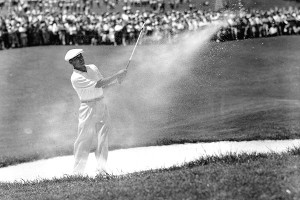
Jenkins' eyes narrowed and for a moment I thought he was going to stab me with my car sun visor. Remember, this week's U.S. Open is the 60th of Jenkins' brilliant sportswriting career and his 218th major. And it is being played on sacred ground: Merion Golf Club, where Hogan won the 1950 U.S. Open, just 16 months after nearly losing his life in a car crash.
There was a painful pause, nearly as long as it takes Kevin Na to line up a putt, before Jenkins finally said, "How so?"
Wojciechowski's comparison is pretty good, even Dan might...might have to admit.
They each completely retooled their golf swings and then totally committed themselves to those changes.
They understood that the secret, as Hogan once said, "was in the dirt." Translation: Practice until your callouses had callouses.
They had little or no respect for players who didn't work hard.
They were aware of their critics, detractors and doubters, remembered every word, and used the criticism as motivation.
They were essentially loners: loyal to a select few; careful, guarded to most everyone else.
Tiger sat down with Wojciechowski for ESPN's Sunday Night Conversation:
Davis: “I would contend that if you saw Merion firm for four straight days versus soft for four straight days, you may see an 18-to 20-shot difference in the winning score.”
/Bill Pennington considers Merion's place in the technology debate this week for an NY Times story and it includes this eye-opening quote from the USGA's Mike Davis.
Particularly because it was probably said before the recent downpours that have hit Merion on the U.S. Open eve.
“I would contend that if you saw Merion firm for four straight days versus soft for four straight days, you may see an 18- to 20-shot difference in the winning score,” Davis said. “But we can’t control the weather.”
Radar as of 9:15 ET Monday night.It's dreary to read about it, but the Monday coverage obviously focused on weather issues. Dave Shedloski with this GolfDigest.com roundup also included the USGA's plan to not use lift, clean and place at this time.
But there was also a huge cell hitting Merion Monday night (pictured right).
Timothy Carroll also included this quote from Davis in his roundup:
Mike Davis, executive director of the USGA, expressed confidence despite the near-biblical rains and the dire forecast for Thursday. “The course drains beautifully,” he said at a previously unscheduled news conference. He noted that the course is played over rolling hills with few, if any, flat parts where standing water would be an issue.
Scott: "I try and entertain people on the golf course, not on talk shows.”
/Jason Sobel writes about Adam Scott's visit to the media center Monday at Merion where he didn't get any questions about anchoring, but did talk about post-Masters win fame.
This was a good line:
“I kind of had a plan in place. I like to have a plan for most things so I don't get blindsided by stuff,” you explain. “I really enjoy playing in front of everyone. But I felt that's all I needed to do. I try and entertain people on the golf course, not on talk shows.”
Restored Merion To Be Restored After '13 U.S. Open!
/The USGA Member Clubhouse hosted an engaging, standing-room only roundtable Monday afternoon as persistent spring rains pelted the tent just off of the USGA's main "Spectator Square." Hosted by Jimmy Roberts, the hour-long discussion featured guests Curtis Strange, Merion historian/member John Capers, USGA Executive Director Mike Davis, architect Tom Fazio and '13 U.S. Open General Chairman Rick Ill.
The program kicked off a series of daily events in the clubhouse that include a Rich Lerner interview of Ray Floyd (Tuesday), a 2009 Walker Cup reunion Wednesday with Rickie Fowler (among others), Billy Casper Thursday and tantalizingly, a Thursday chat called the "USGA's Position On Technology And Golf Equipment" featuring Championship Chair Tom O'Toole and Managing Director of Equipment Standards John Spitzer.
But the real bombshell in the Merion conversation was dropped by Ill, who revealed after a discussion of Merion's decade long restoration (tree removal, bunker work, etc...) that following the 2013 U.S. Open, several of the "restored" bunkers--which were actually shifted to pinch landing areas on holes like 2, 15, 16--will be restored to their previous positions.
Also of note was Fazio's prediction that after this week, the world of golf will be having a "very different" debate about the ball because of his belief that Merion will show that a course under 7,000 yards is plenty relevant in today's game. Relevant, that is, until the restored landing area bunkers are unrestored.
Rain Renders Merion's "Red" Parking Lot Out Of Service
/Sergio Begins The Re(?)conciliation Process With Tiger
/Els: "You're not going to see a firm U.S. Open this year, I'm sorry."
/Q&A With Dan Jenkins, Vol. 6: Merion
/The U.S. Open's return to Merion marks Tweeter Supreme and mutiple-award winning writer Dan Jenkins' 60th U.S. Open, a milestone he marked in the June Golf Digest with his favorite players, courses, holes and even constructive criticism through the years. And for the sixth straight year, he answers my softballs in anticipation of America's national championship.
Previous U.S. Open Q&A's can be read in order, here, here, here, here and here.
GS: Big return to Merion, judging by your comments in the June Golf Digest, this is a favorite US Open venue of yours? How so?
DJ: I guess I like Merion a lot because of these things. History, "Merion lightning" (the greens). flag baskets, quarry holes. It's one of my three favorite courses to play and look at, the other two being Pine Valley and Cypress Point.
GS: Your man Hogan sealed his comeback at Merion. Was it his greatest performance?
DJ: Merion wasn't Hogan's best golf, just his timeliest and most historic. His best golf came in the last round at Oakland Hills in '51, and all week long at Oakmont in '53. Study his career and you find his game at its best when his obstacles were the toughest.
GS: Did you ever talk to Hogan about Merion, the 1-iron or the Hy Peskin shot?
DJ: I do wish I'd been at Merion in '50---I didn't start covering the majors until '51---but I talked to him about it many times over the years. It wasn't a 1-iron, by the way. It was a 2-iron. That's what he always told me. Once in later years he even said it was a 3-iron. To get more of this you'll have to read my "journalism memoir" that's coming out from Doubleday sometime around the first of the year. The Mystery of the Stolen One-Iron at Merion is part of two long chapters on Ben.
GS: Does the book contain any words of wisdom about the state of journalism and the media industry in this time of "transition"?
DJ: Of course it does. But nothing to put in a scrapbook.
GS: Sergio, your sometimes Twitter alter ego, will be setting foot on American soil for the first time since his fried chicken remark. Will you be brokering peace settlement talks between he and Tiger and Tiger and Sergio and your ownself?
DJ: Knowing me, Geoff, surely you know I don't much care about Tiger or his feuds, even those with Sergio, except for the comedy involved. I love it that people ask me about Tiger all the time. I really don't know what I'm expected to say. I do say he's the greatest putter I've ever seen, and the greatest reader of greens. But ask me to place him somewhere in golf history, and I still have him behind a lot of players who did more for the game at the time of their peak years, those gentlemen being, not in any particular order, Hogan, Snead, Byron, Jones, Hagen, Arnold, Jack, Gary, and even Demaret, Trevino, and Seve. But of course I'm a geezer.
GS: Is the journalism book it in that mysterious phase where the publisher accepts it and then spends a year sitting on it? What's it called?
DJ: I was dragged kicking and screaming to the title of my book that the publisher has insisted on: HIS OWNSELF----A Semi-Memoir. I was thinking A Farewell to Arms had a ring to it.
See you at Merion.
McGrath's NY Times Cabot Links Travel Story
/Charles McGrath's NY Times Travel story on golf at Cabot Links and elsewhere in the vicinity is one of the best travel stories I've read in a long time and is an absolute must read if you are considering a trip to Cabot. Not only are the observations and tips superv, but the overall presentation by the NY Times nearly makes up for the utterly ridiculous "Golfers are working out these days" cover story they posted earlier this week.
To match McGrath's insights, photographer Piotr Redlinski's images flesh out the presentation and he includes a video diary item as well with interviews of people like Cabot developer Ben Cowan-Dewar.
Besides the super information, this package is another one to add to the list of examples showing how the NY Times really getting this whole digital world thingy.
Philly Inquirer Lifts Paywall Restrictions For U.S. Open Week
/Jim Romenesko reports and explains that the venerable paper's strong U.S. Open web page and multimedia effort convinced the beancounters to lift paywall restrictions while millions turn their attention to Philadelphia golf this week.
As always, I love to take in the local coverage for events like this so give them a look and reward the Inquirer for unlocking their host city coverage.
Harris English Wins; Phil's Wedges Steal The Show
/"No harm, no fowl."
/Fun moment during the FedEx St. Jude Classic finale when a duck moved Robert Karlsson's ball on the 11th green.
There was a later incident with Stefani and a mother duck on 18 that will hopefully go up on YouTube too.
Not surprisingly, TPC Southwind is a multiple-award winning Audubon cooperative course.
Merion's Amazing Archives
/Jeff Silverman, guest on this week's State of the Game Podcast, filed a fantastic story (complimented by Dom Furore images) on Merion's history archives and current caretaker, John Capers, in this week's Golf World.
But since that's not online, you can check out David Shefter's story about the USGA's intial involvement in making it "arguably the most extensive archives of any golf club in the country." In particular, the work of (now independent) consultant, Andy Mutch, who has since undertaken a similar project for Pine Valley.
The first thing Mutch did was to create a database. He ordered archival storage supplies and began to identify key items. He also asked the club to relocate its boardroom, a self-contained room with minimal sunlight – a near perfect environment for storing historical artifacts. The room’s windows could be blacked out, and it had enough space to store the memorabilia.
“Frankly, they needed a better boardroom,” said Mutch.
Every suggestion was met with positive affirmation from the club.
“My feeling is if you hire a consultant … you are wasting your money if you don’t get out of their way,” said Belsinger.