The World Golf Championship concept brings an international together four times a year, including the PGA Tour's lone match play event, so it's hard to criticize a concept forcing the best players in the world to show up.
 HSBC pours a lot of money in golf, generates discussion about the industry of golf with its business forum, and wants to see the game expanded beyond its current borders, so it seems unfair to blame a company going above and beyond the normal sponsors.
And top players did show up in Shanghai at the end of a year when they've been asked to play even more weeks than normal, so there is no way they can be criticized.
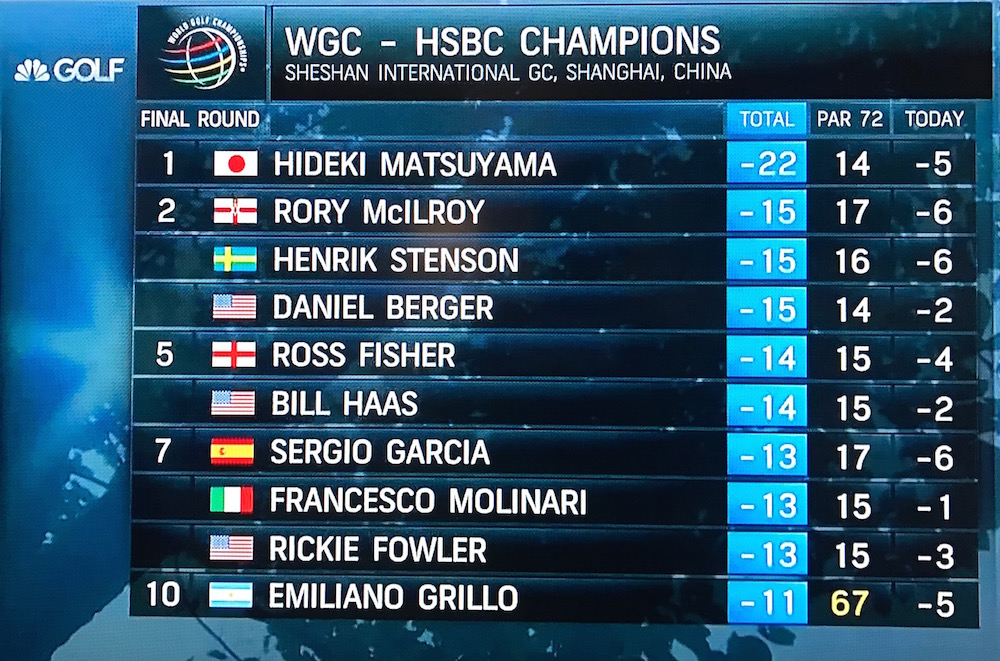
Yet in trying to watch the WGC-HSBC Champions, won in resounding fashion by Hideki Matsuyama for his third PGA Tour win, there may be no finer example of the oversaturated product that is elite professional golf. A limited field, no-cut rankings and cash extravaganza watched by few people in person or on television is the product of...too much "product."
The recent analysis suggesting oversaturation and over-extension of the NFL and Premier League should serve as a reminder that unless a pro golf tournament this time of year has something fresh and entertaining to offer the fan base, it should not be played. Too many events are serving the needs of players, executives and sponsors, and needlessly denying the fans a chance to be entertained.
Consider this week's 72-hole, no-cut WGC-HSBC. To say it was lifeless would be an insult to life. The competing Sanderson Farms PGA Tour stop in Mississippi offered a more compelling event because the players, who genuinely need these dollars and points to retain their tour status before the next re-shuffle, appeared more engaged. The event exuded a certain small-town charm lacking in Shanghai. (Left-hander Cody Gribble won and added his name to the list of emerging young players.)
And it's not as if alternatives are unavailable.
This week's collegiate East Lake Cup, while obviously a made-for-TV event highlighting top Division I teams, at least promises to entertain thanks to the team match play format. What if the WGC-HSBC did something similar, offering two or three days of stroke play to determine an individual winner and to make some seedings. But instead of binding players as a team by their country, allowing them to play for a corporate alliance?
Might we stand a better chance of watching and being entertained by seeing Team Nike featuring Rory McIlroy, Paul Casey and Jhonattan Vegas, taking on Team Srixon with Hideki Matsuyama, Russell Knox and J.B. Holmes.
Team Callaway's Henrik Stenson, Patrick Reed and Thomas Pieters could take on Team Taylor Made's Dustin Johnson, Sergio Garcia and Daniel Berger in another early tournament match? And why relegate it to manufacturers? If the RBC-endorsees are going to get appearance fees elsewhere on the schedule, let them field a team based on having enough players high enough in the world ranking.
Some sort of twist on existing formats are presumably squelched in the name of FedExCup points and world ranking points prioritization, which reminds us once again: too often professional golf tournaments are played at the pleasure of the golfers, executives and sponsors, and not for the fans.
Is it any wonder so few were paying attention this week, even with a leaderboard like this?