
Tiger On His Return: "It's been long enough."

Tiger Woods delivered his usual huge media turnout and intrigue while launching the reborn Genesis Open at Riviera. With his tournament operations folks running the show and the Woods Foundation benefitting from the tournament, Tiger seems full engaged in raising the profile of an event that has languished since the hometown hero last played in 2006.
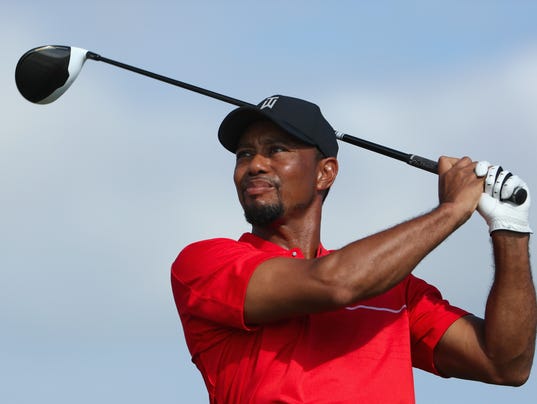
From the accounts of those on-site, key takeaway lines revolved around his desire to get back playing after too long off, along with his admission of concern about a stacked start.

As I wrote for Golfweek.com, the common sense admission of vulnerability is actually a positive sign that will only win him more fans and sympathy should rust slow down his return to the top.

Steve DiMeglio's story notes Tiger's desire to get back at it after too long away from the game.

Ryan Lavner at GolfChannel.com noted highlights from the press conference, including this on Tiger's concern about so much golf out of the chute.

“My body is in a pretty good state where I feel like I can handle that workload,” he said Monday at media day for the Genesis Open, which his foundation now hosts, “but I’ve still got to go out there and do it.”

Bob Harig at ESPN.com noted Tiger's obvious ease in returning to a tournament we weren't sure he'd ever play again and the role he envisions for rejuvenating the LA stop.

"To come full circle and have an opportunity to run this event is really special moment in my life,'' said Woods, who will make the tournament one of three in four weeks that he is playing to start 2017.

A couple of other key moments from the press conference included the continuation, with Charles Sifford's name attached, of the annual special exemption to a minority golfer.

Tiger discussed that and his role in shaping the tournament.

Q. Tiger, question about the tournament operation, things like the Sifford exemption.

How much do you get involved in that? Would you get involved in helping pick the person who gets exempt, or in this first year do you kind of step back and see how things unfold and then give your thoughts?

TIGER WOODS: No, I'm part of all of it. I've been involved with running golf tournaments and my foundation for a very long time, since '99. So we've been doing it a very long time. So part of the operations and my staff, I'm very close with them, I trust them implicitly. But obviously I have my finger on some of the things that I want to have happen and how we can make this experience here at Riviera and with Genesis, how we can make it better for not only the players but for all the people that come out and are part of this event.

The Scotty Cameron fan club will enjoy this:

Q. Tiger, can you describe what it feels like to have the putter back in the bag that you have had so much success with over the years?

TIGER WOODS: Yeah, well, it felt good there at the Hero in the Bahamas. I made a few putts there, made a few birdies and, yeah, you can hit the ball close but you've still got to hole the putts. I made quite a few putts that week. Over the years, I mean, Scotty has probably built me over a hundred putters trying to replicate this one. It just doesn't. For some reason this one just stands out. I think it's -- I mean, Bob Charles putted with his putter for 50 years, that Bulls Eye. Mark McNulty putted the same thing with his Bulls Eye forever, Jack with his George Low. I mean, for some reason you can find other putters, you may put it on the side or penalty box for a little bit, but for some reason it just keeps coming back.

For those who prefer to read in Tweets, the GCTigerTracker was busy today.

Here is Golf Central's condensed report from the event.

There were many other good bits from the day and I got a one-on-one with him that I'll share more of as we get closer to the Genesis.

Meanwhile, European bookmaker BookMaker.eu is pushing some attention-getting prices that suggest a lack of bullishness (or need for attention!). Tiger's prospects, given his attitude, body language, energy and play at the Hero World Challenge, would have me jumping at a few of these...

Will Tiger Woods finish in the top 10 at the 2017 Farmers Insurance Open?

Yes +350
No -500

How many birdies will Tiger Woods record during the 2017 Farmers Insurance Open?

OVER 6.5 (-110)
UNDER 6.5 (-120)

How many bogeys or worse will Tiger Woods record during the 2017 Farmers Insurance Open?

OVER 8.5 (-115)
UNDER 8.5 (-115)

Tiger Woods finishing position at 2017 Farmers Insurance Open

1st (+3000)
2nd-10th (+1500)
11th-19th (+900)
20th-30th (+550)
31st-40th (+400)
41st-50th (+350)
51st or worse (-120)

Former PGA Prez: "PGA Championship in May? No way"

Former PGA of America president Ted Bishop pens an item for the Morning Read questioning the possible PGA Championship move to May?

Given Bishop's intimate working knowledge of the current PGA of America way of thinking, his insights are particularly impactful. If this were match play, Bishop sees PGA Tour Commissioner Jay Monahan winning this one 5&4 over the PGA of America's Pete Bevacqua.

Bishop suggests agronomy as the main concern, especially in the greater New York area.

Worse yet, May virtually eliminates some of the classic PGA Championship venues such as Hazeltine, Medinah, Whistling Straits and Baltusrol. Because of climatic conditions, the PGA Championship map would shrink if the event were to move to May or earlier. 

Early spring jeopardizes even Valhalla in Louisville, Ky., a site owned by the PGA and one that Bevacqua seemingly has shunned. In 2012, the PGA spent $5.5 million in course renovations and delivered a memorable ’14 championship won by Rory McIlroy as darkness fell. There is nothing on the docket for Valhalla. It will be the first time since 1996 that the PGA has gone longer than four years in playing a PGA, Ryder Cup or Senior PGA at its own facility. Louisville is renowned for the Kentucky Derby in early May, so where does the PGA Championship fit in the corporate picture later in the month at Louisville? It fits nowhere.

As for the PGA of America's motive in listening to the PGA Tour on this, Bishop speculates...

Maybe it makes sense for Monahan to cough up the PGA’s purse of $10 million per year to cement his FedEx deal for the future. It still would be a bad deal for the PGA, which can own the August sports calendar for three out of every four years.

Don't Tell President Trump: China Orders 111 Golf Courses Closed

Stranger things have caused trade battles and even wars. I'm glad the president is busy in meetings today!

Anyway...in the exhausting, boring but predictably goofy saga that has been the dream of golf in China, the Communist Party is cracking down...again.

AP's Nomaan Merchant reports on the order of 111 courses ordered closed "to conserve water and land" while Party members have been reminded not to play golf. Again.

The state-run Xinhua News Agency said Sunday the courses were closed for improperly using groundwater, arable land or protected land within nature reserves. It said authorities have imposed restrictions on 65 more courses.

China banned the development of new golf courses in 2004, when it had fewer than 200. Since that time, the number of courses more than tripled to 683 before the new crackdown, Xinhua said.

Whew!? There Won't Be Any 59s At Torrey Pines

We've been enjoying much-needed rains here in Southern California, much to the chagrin of media members hoping to get a crack at Riviera Monday. Tiger Woods will be there to kick of his foundation's operation of the Genesis Open and hoped-for rejuvenation of a historic PGA Tour stop.

Woods then heads to San Diego for the Farmers Insurance Open where rough has been high in recent years, and, according to this John Strege item at GolfDigest.com, is on steroids again. Mowers hit the thick stuff last Thursday but almost surely haven't been able to hit the overseeded ryegrass.

While I'm no fan of rough like that and fear it'll send some of the starpower home early, the tall thick stuff may arrive at a good time. Though I sit back with popcorn and a Coke watching the lamenting of 59s due to unregulated equipment, the conversation invariably misses some key points in the distance debate. Which is why this week's Torrey Pines reset, normally something to lament on Rees Jones' lamentable anti-strategic golf renovation, may land at the right time.

Not that I ever discourage questioning how the USGA and R&A have let this happen, but for this to be constructive to all, we have to offer solutions instead of bemoaning displays of skill.

We know this:

--Instruction and Trackman have made players better at repeating swings, repairing flaws and fitting equipment.

--Conditioning of courses has never been better, impacting scoring (though the suggestion that tighter mowing heights leads to more roll was nicely debunked).

--Equipment has never been better made or more effective for all skill levels, giving the players instruments to attack courses like never before.

--Course setup has become more fluid, democratic and interesting in recent years, leading to some thrilling moments and less par-protection.

--Players and caddies have rangefinders and other tools to better understand courses.

A 59 is still a magical score, especially on a par-72 course (13 birdies by Hadwin!). Lamenting these rounds hurts the cause of those pushing for a competition ball since a 59 is an incredible athletic achievement aided by human progress on many fronts.

Loyal longtime readers who know how long I've been venting about this know that the only genuine solution is a ball that better fits select courses. Because the governing bodies are not going to tell manufacturers to stop innovating and even when they do, the companies are too good at what they do. Players are not going to get less skilled and superintendents, caddies and instructors are not going to be getting worse at their jobs.

A ball that simply allows course architecture to ask a few more questions of players--in the form of longer approach shots to greens and more drivers off the tees--would do wonders for the pro game. Furthermore, I suspect elite players would actually enjoy employing such a ball at select classics--assuming they are real competitors and not placing themselves above the game. Such an introduction should also usher in a larger ball that goes longer and helps beginning and senior players enjoy the game more.

I point this out because harvesting rough, while helping to tamp down the current infighting and grousing over great achievements, does little to advance the best long term cause. Keep that in mind this week!

Video: Amateur Makes Careerbuilder Hole-In-One

Mercifully for David Colby, the NBC/Golf Channel crew was recording so he could see his ball go in the hole after not watching. He's playing No. 17 at the PGA West Stadium course in the Careerbuilder Challenge final round:

Hadwin (59): “I was thinking about it. I knew exactly where I was."

Golfweek's Dan Kilbridge with some of the fun comments from Adam Hadwin following his 59 at La Quinta Country Club. Hadwin takes a one stroke leading over Dominic Bozzelli into Sunday's Careerbuilder Challenge final round.

Hadwin's 13-birdie, no bogey round was played in a zone of sorts, but Hadwin knew what he was doing. His quote is fun:

“Everybody talks about kind of they were in a zone and I think that’s what happened out there,” Hadwin said. “I was thinking about it. I knew exactly where I was. I knew exactly what I needed to do. It just didn’t seem to matter.”

The 29-year-old Canadian knew he had a decent chance after a birdie on No. 11, which began a streak of five straight birdies on the back nine and followed a stretch of six straight on the front.

“After hole 11, I said to my caddie (Joe Cruz), ‘We need four more,” Hadwin said. “I’m not sure he knew what to respond to me at that point, because he knew I was playing well and he knew that clearly I was thinking about it. But we just went about our business and kept making putts.”

Kevin Casey with other notes from the day and another great quote from Hadwin about shaking over the final putt.

Mike Johnson with the clubs Hadwin used to shoot the 9th sub-60 score in PGA Tour history.

The final up and down for 59:

IOC Expresses Concern Over 2020 Olympic Golf Venue

The Guardian's Justin McCurry reports that while the IOC has "reportedly expressed concern" and has contacted the International Golf Federation over Kasumigaseki's male-only and no-Sunday play membership policy.

The club's GM told McCurry that they are prepared to review their policies if asked by the IOC. However, a non-profit launched last year to "modernize" the game in Japan is calling for the event to move.

The Japan Golf Council, a non-profit organisation launched last year with the aim of modernising the game, is lobbying to have the tournament moved from Kasumigaseki to Wakasu Golf Links, a public course near Tokyo Bay. Wakasu was initially proposed as the 2020 golf venue, but was replaced by Kasumigaseki in early 2013, several months before Tokyo was chosen to host the Games.

The council’s vice chair, Yutaka Morohoshi, said staging the golf competition at Kasumigaseki made no sense given its distance from Tokyo, and the availability of an alternative course that could be used by members of the public after the Olympics had ended.

“The Olympics is all about legacy, but we won’t have that if the golf tournament is played at a private club,” Morohoshi told the Guardian. “The ban on women at Kasumigaseki is certainly a problem. It runs contrary to what the IOC stands for in spirit.”

Established in 1990, Wakasu was designed by Ayako Okamoto and is 6881 yards with a tiny 20-stall, 200-yard deep driving range. Judging by the aerial, it's a fantastic location severely landlocked and design deficient to handle the competition.

Whicker On Scoring, Distance And A Changing Game

Mark Whicker talked to players at the Careerbuilder Challenge about Justin Thomas' record scoring in Hawaii and what the increase in 59s all means for the game.

Many things stood out, so I'm just clipping the most intriguing. The entire piece is worth your time.

From Jason Dufner:

“Larry Nelson won the U.S. Open at Oakmont (in 1993),” Dufner said. “He told me that on the first hole, he’d hit four-iron into the green. Last year I hit pitching wedge three days, sand wedge the other day.”

William McGirt has many great insights about distance and Trackman.

In 1998, John Daly led the tour by averaging 298 yards. Last year, there were 27 pros who topped 300. This year, Smylie Kaufman leads with an impossible average drive of 322.

Any course with mundane par-5s is helpless. Luke List is already 50-under-par on the long holes this season.

“People will say the golf ball doesn’t go any farther, but they’re wrong,” McGirt said. “The drivers can’t get hotter. The ball is the only common denominator with all the shots.

“They’ve basically taken an old two-piece, hard-brick ball and made it spin. That benefits the bombers. They can get to the core and compress it better than anyone. I can’t do that, but I have a ball I know I can control.”

Oh boy, blaming the ball. That'll get you sleeping with Luca Brazi and the fishes!

But as I noted this week on Golf Central (below), Trackman is now an underrated element in the overall improvement of player skill and distance.

“It detects a flaw before it gets out of control,” McGirt said. “If your swing is a degree and a half steeper than it should be, you can fix it before it becomes four degrees. You look at it and scratch your head and say it looks the same, but it’s not. Video doesn’t pick everything up.

“Because of this, I don’t have to have my teacher (John Tillery) with me all the time. I can hit 40 shots and e-mail them, and he can pull the numbers and say, here’s what the problem is. But some guys get caught up in it. They might start playing numbers instead of playing golf.”

John Feinstein and I discussed this very topic on Golf Central, including the Trackman component in today's improved scoring.

NYT: Sam Saunders Reflects On His Grandfather

The New York Times' Karen Crouse catches up with Sam Saunders, who had a dreadful fall when he lost both of his grandfathers while also having to withdraw from the Web.com Tour Playoffs to care for his ill child, Ace.

But Saunders is back playing the Web.com Tour and able to reflect with great strength about what must be such a tough topic: his unexpected last call with grandfather Arnold Palmer.

The entire story is excellent and worth your time, but this stood out:

He was caring for Ace on Sept. 25 when Kelly reminded him to check in with Palmer, who was in a hospital in Pittsburgh preparing for surgery.

Saunders knew his grandfather would appreciate hearing from him. Since the death in 2003 of Mark McCormack — Palmer’s friend and business manager, who slipped into a coma after going into cardiac arrest while having minor surgery at a dermatologist’s office — Palmer had stubbornly resisted any medical procedure that required anesthesia, including hip replacement.

“For a guy who seemed so tough, he was scared of that,” Saunders said.

Palmer answered on the first ring, and their brief conversation sounded no alarms with Saunders, who said he was caught completely off guard when his father called a few hours later to relay the news that Palmer, 87, had died.

Palmer's "Sweetest Win Ever" Came At The Hope

Really fun deep dive read here from Jim McCabe, in a special to PGATour.com, writing about Arnold Palmer's final PGA Tour win.

It came at a special Bob Hope Classic that brought Jack Nicklaus to the desert and one that Palmer would call "the sweetest ever."

A teaser:

Palmer and Nicklaus were together on the tournament’s eve to break ground on a golf course project they were co-designing (now Ironwood Country Club), but they were miles apart in Round 1 at Indian Wells.

In the Los Angeles Times, the great Jim Murray called Palmer and Nicklaus “the prime minister and emperor of golf,” but it didn’t appear as if they were competitors any more, at least not until Palmer outscored Nicklaus, 66-70, in the second round at Tamarisk Country Club.   
     
That left Nicklaus at 134, three ahead of Palmer and a Monday qualifier named Allen Miller. Joked Miller: “What are all those unknowns doing up there with me?”   
     
“The Hope” was competing for space in the L.A. Times with the legendary Steve Prefontaine, who beat Marty Liquori in the mile at the Times Indoor Games.

50 Years Ago This Week A Club Pro Won On The PGA Tour

Granted, he was the legendary Tom Nieporte of Winged Foot, but as Tom Cunneff writes for Golf.com, he is believed to be the last legitimate sweater-folder to beat the flatbellies.

Cunneff writes of the 1967 Bob Hope Classic:

After all, Nieporte wasn’t even a tour pro when he won the Hope at age 37. He was the head pro at Piping Rock Golf Club on Long Island when he outplayed the likes of Palmer, Nicklaus, and Floyd at La Quinta Country Club. After opening with a 76 that left him 10 shots off the lead, Nieporte carded three 68s to trail defending champ Doug Sanders by one shot heading into the fifth and final round. With an estimated 30,000 spectators on hand enjoying a perfect day in the desert, Sanders was still a stroke ahead after nine, but Nieporte’s 25-foot birdie putt on 11 pulled him even. Another birdie on 18 from 12 feet gave him a one-shot lead at 11 under par. Playing a hole behind Nieporte, Sanders had a chance to tie him on 18 and force a playoff, but his long birdie attempt just missed.