In golf construction art and utility meet; both are absolutely vital; one is utterly ruined without the other. GEORGE THOMAS
It’s back!
Twenty years later Tatra Press has kindly allowed me to bring back Grounds For Golf now that golf architecture is of more interest to the masses. A new Introduction looks at what’s driven the interest growth and two new chapters I had a blast adding (plus a few edits to keep things up-to-date).
Alasdair Reidreports for The Times that a shot clock will be part of next June's Austrian Open, replete with group referees, 40 second limits and one-shot penalties.
Reid says European Tour tournament committee member David Howell supports the idea but is concerned that we won't see great recovery shots if this became a regular practice. However, Howell says the committee signed off because the event in question can have its field size reduced.
“We’ve discussed it and agreed it should take place,” Howell said. “Among the committee, we think it’s worthwhile trialling that week in those specific circumstances. The field is not the strongest so it can be shortened without doing anyone too much harm. That allows the opportunity to get around quickly, so that’s why it is that week.”
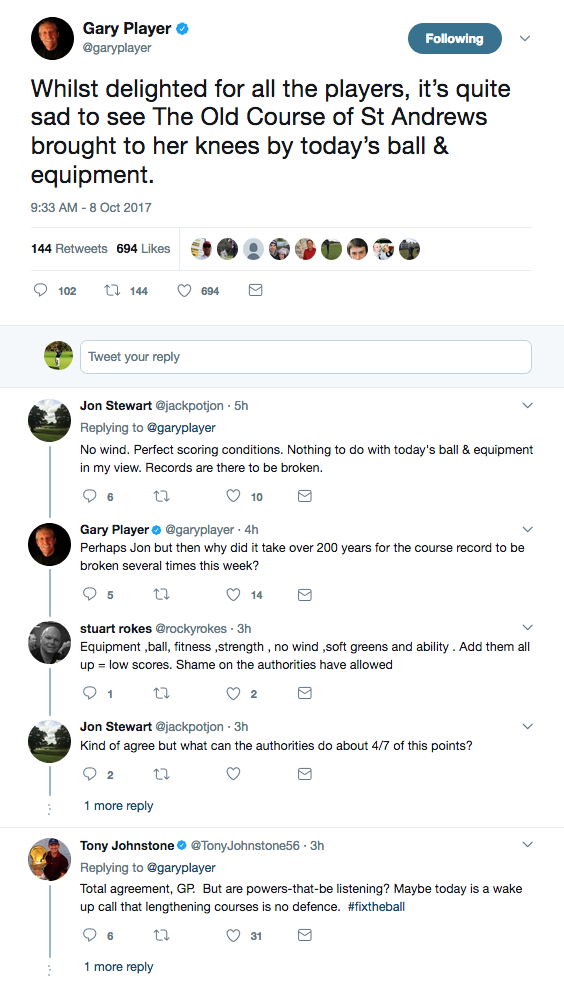
There will be the usual hysteria after a record falls that something must be done and while I always find that shortsighted and slightly disrespectful to the players involved--but let the hysteria begin!
Ross Fisher had an amazing shot at 59 during the Alfred Dunhill final round over the Old Course, in spite of a glacial round pace caused in part by the pro-am format. But a last hole three-putt from the Valley of Sin left him with 61 and a new record. Victor Dubuisson was on a 59 watch a few groups ahead of Fisher, but settled for 63.
“But to go out and shoot a score like that, with no bogeys, I just saw the lines and was hitting good putts and they were going in and I didn’t want it to end.
“At the home of golf, I wanted to try and give that putt on the last a try for 59 and it just came up a bit shy and then unfortunately I didn’t hit a great (birdie) putt, so unfortunately had to settle for a 61 – but I would definitely have taken it.”
A post shared by European Tour (@europeantour) on Oct 8, 2017 at 10:40am PDT
Why should we be hysterical when the distance situation at classic courses has been an issue for nearly two decades ago, with huge leaps since the governing bodies drew a line in the sand (2003)?
Because course records get attention, especially when it's the Home of Golf and especially on a course not using some of the absurd Open Championship tees employed by the R&A to mask distance leaps.
While most of us know modern course conditioning combines with today's instruction technology and brain power, should lead to records falling. And that's just fine. But couple that with players rarely hitting a long iron due to courses being overwhelmed, and these accomplishments should be warning signs that the importance of certain skills has been diminished to the point that such a record may need an asterisk.
“Carnoustie course record holder – it sounds good doesn’t it? It was a good day’s work by any standards,” Fleetwood said. “When you consider all the great players who have played here, in Opens and in this tournament, it is very special to have the lowest score ever recorded on this course. Yeah, I hit it in some places where you probably won’t be able to get able to hitting it when the Open comes back here next year, but I’m still very proud.”
“It was poor from me to not know the rules of a game I’ve played since I was two. I take full responsibility. People say it’s bad luck but it’s not bad luck because I should have replayed the shot and could have made four. But I didn’t and it became nine, and that became me missing my card. I’ve only got myself to blame. I’m not annoyed with anyone else.”
The best wishes of his peers have not assisted much either; and neither has their collective ignorance. I asked 10 different pros at the Dunhill Links if they were aware of that particular rule and all admitted they were not.
You may recall that post-U.S. Amateur(s) it was suggested theUSGA revisit the insistence on a winner retaining amateur status to enjoy their U.S. Open exemption.
While the newly announced perk by USGA President Diana Murphy is little different and we want the Opens to remain "open," news of exemptions for Mid-Am and Junior winners seems like a positive development from this week's U.S. Mid-Amateur.
During Thursday’s evening reception for the 264 players competing in this year’s U.S. Mid-Am, which begins on Saturday at Capital City Club in Atlanta, USGA president Diana Murphy announced that the winner will receive an exemption into next year’s U.S. Open.
Similarly, the winner of the U.S. Women’s Mid-Amateur next month at Champions Golf Club in Houston will get into next year’s U.S. Women’s Open. Additionally, the winners of the U.S. Junior Amateur and U.S. Girls’ Junior this past summer, Noah Goodwin and Erica Shepherd, will get exemptions into their respective Opens as well.
While some might see this as chipping away at qualifying spots for the U.S. Open and U.S. Women's Open--because it is--the move seems like a smart way to validate the importance of other national championships. Given that these winners get to the Sectional stage and many have qualified for the Opens anyway, it will give the events and amateur golf just a bit more of a boost.
A recent push to narrow the fairways marginally has seen the grounds staff convert seven of the layout’s 50 acres of shortgrass to rough. The idea is to create more strategic twist and turn to the fairways consistent with Flynn’s plan and to bring more fairway bunkers closer to the line of play. Fairway widths are still on the relatively generous side for U.S. Open, 28-34 yards in the championship landing areas. But their delineation pays close attention to the lay of the land and the role of airway bunkers.
Her post was validated by International player Anirban Lahiri and is yet another warning sign that there may need to be limits on crowd size and alcohol sales when the Ryder Cup comes to Bethpage in 2024.
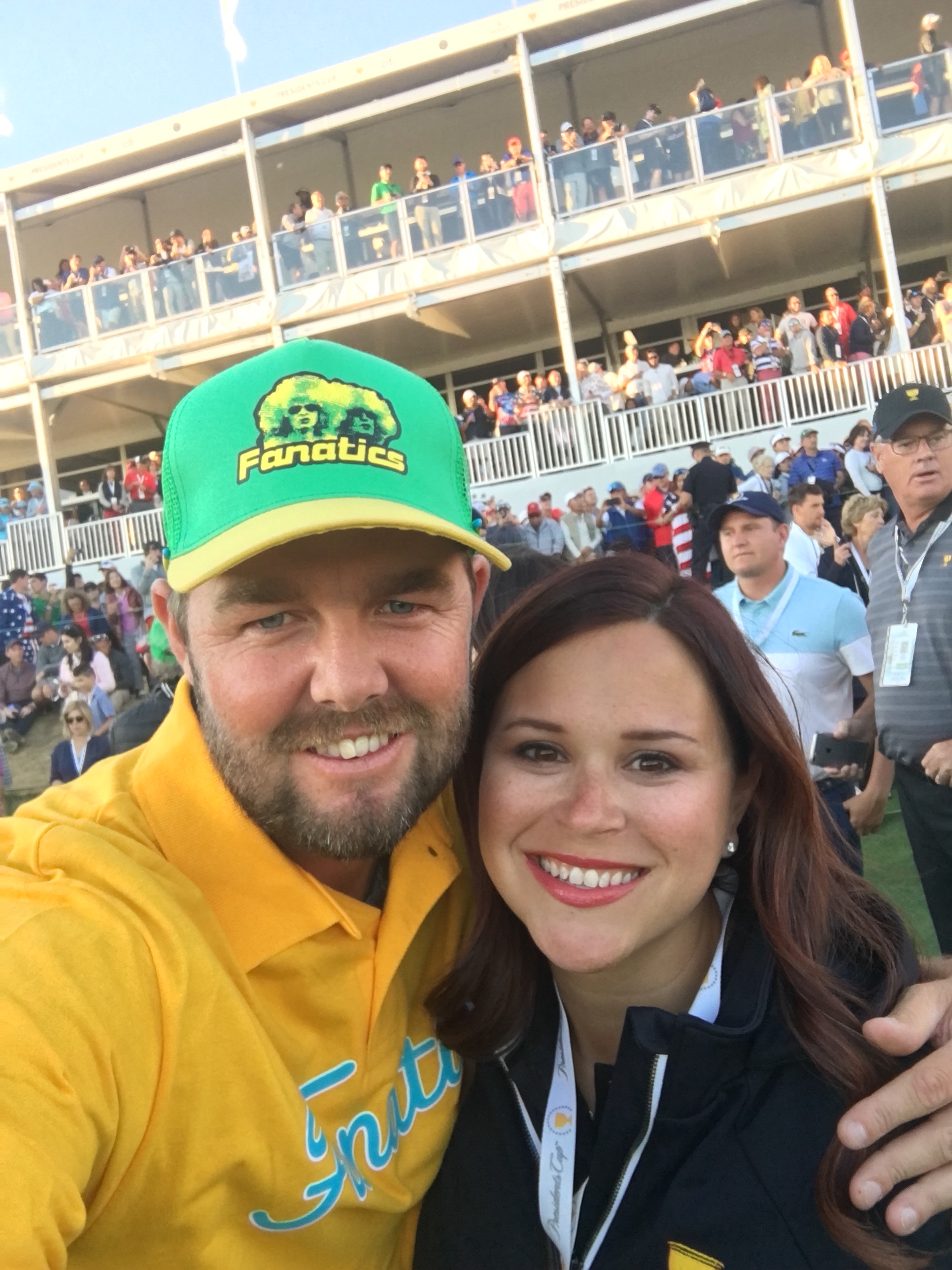
There were many times last week that I thought about what the kids were seeing. The crowds booing for good shots and cheering for missed putts. The drinking at 7am? Screaming “Big Easy” to Ernie Els and begging for his autograph and then yelling at his players. Heckling a wife for her beauty and then her husband for his play. I was thankful my boys weren’t there to see the way people were treating their daddy. Their hero. My parents could simply turn the television off.
Leishman also takes issue with some of the language used by players in describing what they wanted to do to the International team, and also calls out analysts for excessive language invoking massacres and other ugly scenes for a simple golf exhibition.
House and I meet face-to-face live on tape from San Diego's Petco Park, home again Callaway's The Links. We discuss the season, the Links at Petco and interview No Laying Up's Chris Solomon.
This year's iteration of the course within the stadium was the best routing yet, taking golfers (until next Tuesday) up, down and around one of baseball's very best stadiums. Gil Hanse lent ideas to Callaway's Nate Adelman and while some of Hanse's proposed bunkers will need to be restored in 2049 when they try to reproduce the course, it was still the most challenging yet.
But unlike the copycats, Callaway's The Links is set apart by the signage, the score-keeping caddies, the video screen production, the new Callaway clubs and balls, and the many giveaways.
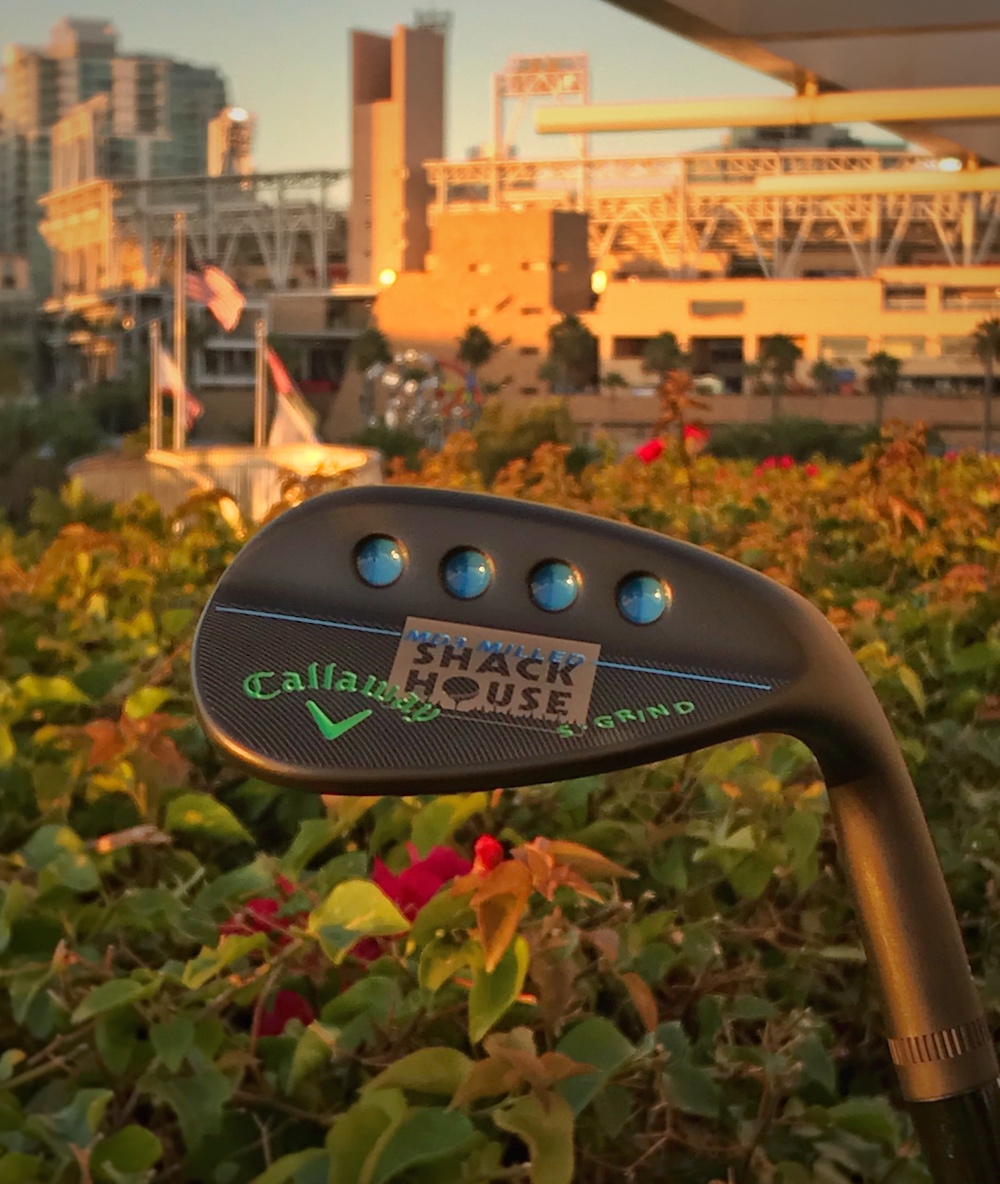
Speaking of those, on this week's season-ending ShackHouse we are auctioning a special one of a kind set of wedges created by Anthony Taranto, who hand stamps and sandblasts wedges for Callaway's Tour staff and celebrities around the world. The cause: Golf Fights Cancer.
All three wedges are sandblasted and hand painted and stamped (one of them pictured here). They also have one of a kind black and green KBS Tour Limited shafts with Superstroke black grips. Go to Callaway Customswhere you can bid until October 11th for this very special set.
Rex Hoggard explains for GolfChannel.com how the PGA Tour's new blood testing will impact the players and perceptions of the sport.
Hoggard says most players he spoke to felt the time had arrived for this more complete program, an amazing shift compared to a decade ago when Tim Finchem was resisting testing and players generally declared golfers clean and therefore not needing testing of any kind.
This was interesting:
“Why can’t we do hair samples, because then you can actually trace further back?” asked Casey, who is also an amateur cyclist. “There are certain drugs that are flushed out of the system within a day or two days, hair actually holds that drug in the follicle longer.”
Golf’s return to the Olympics last year will ensure the game remains vigilant when it comes to testing and officials haven’t ruled out new tests as the science and doping evolves. But for now, the circuit is content with the new testing methods. “There is a lot of alternative testing methods, including hair, but the efficiency of these tests is really not at a level that would warrant use in a sport anti-doping program at this time,” Levinson said. “Urine is the most effective method of detecting most of the substances we are looking for.”
One of the more insightful caddies in golf, John Wood was on Matt Kuchar's bag at the 2017 Open Championship, guiding the veteran to an epic performance.
Since we only have a few hours left before the new PGA Tour season ends, Dan Kilbridge's Golfweekpiece on Wood may amount to one of the few key season recaps. But it's a good one given Kuchar's play and Jordan Spieth's victory, which, if I had to choose, gets my vote for tournament of the year over Sergio winning the Masters.
This was fun from Wood on the 13th hole delay Kuchar faced as Spieth attempted to take an unplayable lie drop.
Kuchar and Wood waited nearly 20 minutes while Spieth and his caddie, Michael Greller, located Spieth’s errant tee shot and tried to figure out how to drop and play on. A big screen left of the fairway gave Wood a vague idea what was going on as they waited. He doesn’t recall any specific conversations during that time. Kuchar probably talked about his kids. Wood might have discussed a book he was reading. A bit of normalcy amid the chaos.
“At a certain point we just started laughing,” Wood said. “That’s all you could do. You’re going, ‘This is a funny situation. I’ve never been in something like this.’ … (Kuchar) didn’t get frustrated by it. He just kept calm, and we were sitting back there telling stories and laughing. That was the best way we could handle it, really.”
Victor Ocasio of Newsday reports dreadful news: Engineers Country Club members have voted to sell the historic course to developer RXR. The company intends to get approval for development that would eliminate the Herbert Strong and Devereux Emmet design.
Besides being a sensational course (reviewed here by GCA's Ran Morrissett), it's been a vital part of golf history with its 2 or 20 hole and other bold features. The course has enjoyed restoration efforts by Gil Hanse and Tripp Davis. Apparently, however, the membership has other priorities beyond stewardship of an important early American design.
On Monday, members of Engineers Country Club, which owns the 18-hole championship golf course, voted overwhelmingly in favor of the proposed purchase by Uniondale-based RXR, said Cliff Saffron, president of the club.
The developer proposed buying the course and building a luxury residential project on a portion of the property. A price was not disclosed.
Of the club’s 84 equity members — those who are entitled to a vote — 81 participated in the voting, with 77 in favor and 4 against the RXR proposal, Saffron said. The club has more than 200 members.
Doug Ferguson's extensive AP notes column this week confirms the PGA Tour will return to Washington DC in 2018, but still not at Congressional as planned contractually.
According to PGA Tour Commissioner Jay Monahan, the move to exit that deal was designed to help leave negotiating flexibility.
Why opt out with such certainty of playing in 2018? Monahan said there is no guarantee the National will be played in 2019 and beyond. Being tied to a golf course - even one as storied as Congressional - might limit any negotiations.
''Let's say we didn't renew with Quicken and there was another sponsor and they had a different objective. They wanted to be at a different golf course, a different part of town. They wanted to do something different,'' Monahan said. ''You can't be wed to one golf course that might limit your ability to get a deal done.''
The tournament remains in contact with Quicken Loans, and there are conversations with other potential sponsors.
The Woods Foundation is still expected to be involved.
Geoff Shackelford is a Senior Writer for Golfweek magazine, a weekly contributor to Golf Channel's Morning Drive, is co-host of The Ringer's ShackHouse is the author of eleven books.