
Tiger After Bahamas Practice: "Life is so much better"

ESPN.com's Bob Harig quotes Tiger Woods as saying he's one happy camper living with a pain-free back.
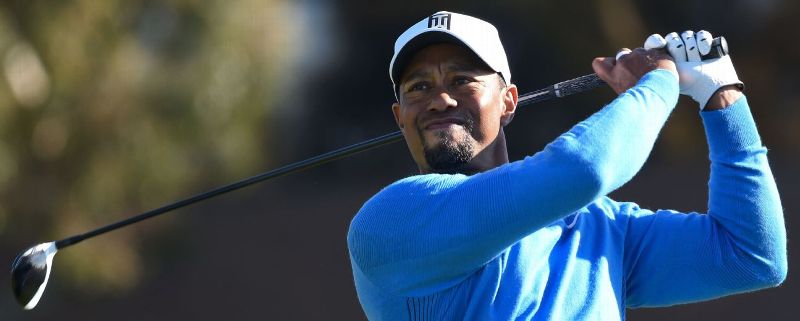
As Woods prepares to come back again at the Hero World Challenge, his comments about the joys of living pain free suggest there were far reaching effects over the recent years.

"It could be the next step, I just didn't know [when the pain would occur],'' Woods said. "That's tough to live with. And it's been a struggle for years. To finally come out on the good side of it is exciting. I am stiffer. Of course, [his lower back is] fused. But I don't have the pain. Life is so much better.''

Rex Hoggard also included this quote from Woods on his holiday round at Trump National.

“[Johnson is] the No. 1 player in the world. He’s been playing, I haven’t been playing,” Woods said. “It’s nice to compare my game to some of the other guys, like Dustin or Rickie [Fowler] or Rory [McIlroy]. It’s nice to do something like that and compete and have a couple little denominations [a bet] we’re playing for. I like seeing where I’m at.”

The SI/golf.com gang weighed their excitement level over Tiger's return this week. A few highlights:

Michael Bamberger, senior writer, Sports Illustrated: Such extreme options! Fantastic, I guess. By which I mean he plays four rounds, doesn't hurt himself, shows that the game still brings him some pleasure, hits good shots, goes 72 holes without a yip.

John Wood, caddie for Matt Kuchar (@johnwould): I'll lean toward the fantastic. The three things I would love to see is a pain-free golf swing, a lot of drivers off the tee and, like Michael said, joy. I hope he looks like a junior golfer out there sometimes, with a smile and having fun. I think that'll be a good starting point.

Alan Shipnuck, senior writer, Sports Illustrated (@AlanShipnuck): It's fantastic that he's back. The words of Faxon and, before that, Fowler, have helped stoke the anticipation but they're not helpful for Tiger. The expectations — his and ours — should be very, very low. It's gonna be fun to watch him play golf again and, for now, that's all that matters. One more point: I think the rehab stint was more important for Tiger than we can know. The DUI report made clear how out of control his prescription drug use had become. Tough to play golf like that. If his mind is clear and his body flushed-out from all of those toxins, that could make this comeback much different from all the previous, aborted ones.

As his first practice round in the Bahamas played out, there appeared to be lurkers in the dunes capturing swing video:


Mercifully Tiger posted a clean view of his swing:
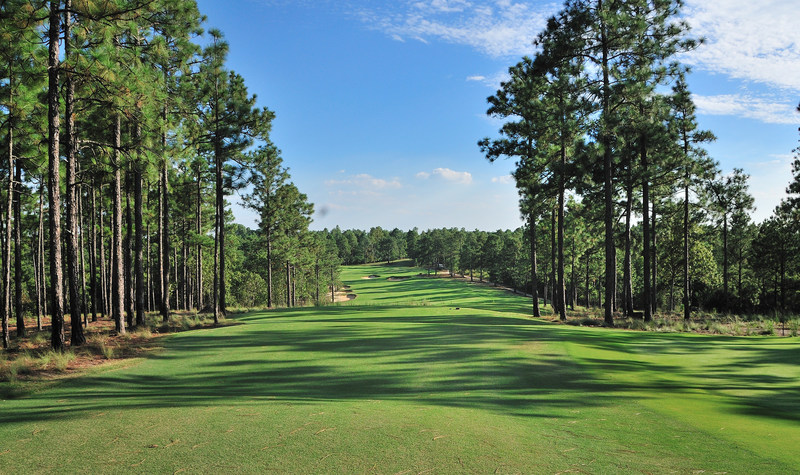


#Repost @tgrliveevents ・・・ Welcome to the 2017 #heroworldchallenge

A post shared by Tiger Woods (@tigerwoods) on Nov 26, 2017 at 12:51pm PST


Video You'll Want To See: Longest Usable Golf Club Strikes A Ball

Jugglin Josh Horton is a man of many talents, but advancing a golf ball with a 30 foot long driver gives new meaning to big stick!**


President Trump Tees It Up With Tiger, DJ And Someone Else

Oh how quickly they forget!

Having 280 characters at his disposal still didn't encourage the President to get a mention in of the fourth today:

Brad Faron!:

The President is a Taylor Made man!

We did get some Tiger swing video too...

Shark Talks Weakness Of Today's Players Inside 150, Why The Masters Can Make Players Use Anything They'd Like

We forget that when Greg Norman is not hawking golf carts and posting shirtless Instagram images, he can be a keen observer of the game.

In an interview with an unbylined Gant News writer filing for the CNN affiliate, Norman touches on Patrick Reed knowing so little about his clubs, LPGA players being more accurate with their drivers and many other topics.

But the two getting my attention involved what he sees as a big change in the prowess of today's players with a wedge approach (inside, gulp, 150 yards).

“If you look at today’s top players, their distance control inside 150 yards with a wedge is quite amazingly poor,” he said.

“These guys are 20ft short, 30ft left, 20ft long, their distance control is not consistent. It could just be the way they play — when it works, it works and when it doesn’t, it doesn’t.

“In our era, every time you’d put a pitching wedge in your hand, if you didn’t think you’d get the ball inside 10ft every time, or seven out of 10 times, you weren’t having any control over your golf game.”

I do see this in watching many of today's players compared to Norman's era and wonder what the exact cause is that makes Phil Mickelson and Zach Johnson such standouts in this distance.

On the topic of distance, Norman agrees with others that this is about sustainability and Augusta National could be the solution.

“I remember the eighth hole at Augusta was nearly impossible to reach in two and now these guys are hitting irons in there,” said Norman who finished second three times at The Masters, perhaps most notably in 1996 when he blew a six-shot lead and Nick Faldo took the green jacket.

“Augusta can’t lengthen itself anymore but the tech is going to allow these players to keep hitting it longer year after year.

“If they sent out an invitation to the players and said ‘you’re going to use a gutter percha ball and a hickory shafted golf club, go get them worked out, practice before you get there, the best player will still win that week.

“The best players have that ability to make that adjustment no matter what they’re using.”

Pinehurst's Dormie Club Bought, Faces Upgrades

The Pinehurst area's Dormie Club, a Bill Coore-Ben Crenshaw design on extraordinary ground but sidetracked by unfinished features, financial woes and an ownership change, has been purchased by a golf course network of the same name. Plans call for Dormie Club to eventually revert to a private model as part of the Dormie Network.

It all sounds promising and, at the very least, gets the course away from the current ownership group best known for extremely high-priced golf course construction that has operated it with favorable-enough reviews.

For Immediate Release:

LINCOLN, Nebraska (November 22, 2017) — Dormie Club in Pinehurst, North Carolina has been purchased by Nebraska-based golf investment company Hainoa, LLC, making it the latest addition to the Dormie Network—a network of destination golf clubs. Under new ownership, the renowned Coore-Crenshaw club will see a number of immediate renovations and upgrades (including the construction of a new clubhouse, halfway house, and on-site lodging accommodations) as it gradually returns to its original status as a private course.

Dormie Club is a short drive from the Village of Pinehurst, an area widely known as the Home of American Golf. Though not far removed from area conveniences, the club’s size and layout seclude its golfers from roadways and residential real estate, providing an unadulterated pure golf experience.


The highly anticipated 2010 opening of Dormie Club was met by rave reviews, including a No. 3 ranking in Golfweek’s list of best new courses. Designed by Bill Coore and two-time Masters champion Ben Crenshaw—who form one of the most renowned golf course architecture teams in the world—the 18-hole course features 110-foot elevation changes, three natural lakes, and an aesthetic that draws inspiration from the Scottish Highlands. “Dormie Club stretches across a massive 1,020-acre expanse of absolutely stunning land,” says Dormie Club’s Membership Director Mike Phillips. “It features a mix of pine trees and hardwoods and the beautiful 55-acre Coles Mill Lake that dates back to the early 1900s.”

Its Old World-design includes a number of reachable par fours, wind tunnels, bunkers positioned to stimulate creative strategy, and a 241-yard reverse Redan par three. The course features Bermuda fairways and tees with bent grass greens; it has five sets of tees and measures up to 6,883 yards with a rating of 73.7 and a slope of 138. It is currently ranked No.3 among the best courses you can play in North Carolina by both Golf Magazine and Golfweek and the 12th best course in North Carolina by Golf Digest. 

Straying from its original concept, Dormie Club extended play to non-members almost immediately after opening and today remains a public course. As part of the Dormie Network, it will transition immediately from public to semi-private and eventually to private status with invitation-only membership by 2020. 

Now under the management of Landscapes Unlimited, LLC, Dormie Club will see a number of critical course enhancements, as well as several large-scale renovations and improvements. Plans to construct a full-service clubhouse and halfway house are already underway. Landscapes Unlimited will also oversee the addition of lodging accommodations, including on-site cottages and executive suites. 

“Dormie Club is a truly exceptional club that was conceptualized as and designed to be a high-end private course,” explains Zach Peed of Dormie Network. “Our vision is to make it one of the finest pure golf destination courses in the region.” 

With the acquisition, Dormie Club joins the ranks of Briggs Ranch Golf Club in San Antonio, Texas; ArborLinks in Nebraska City, Nebraska; and Ballyhack Golf Club in Roanoke, Virginia as part of the Dormie Network. Corporate and national memberships include access to and full member privileges at all courses within the network—each of which is currently ranked among the top 10 in its respective state.

“Dormie Club is a renowned course,” says Peed. “It’s already a tremendous value to our current and future members, but the club’s incredible potential and the vision we have for what it can be make it an ideal addition to the Dormie Network.” 

Golfweek Wrap: 2017 In Amateur Golf

We were priviliged to have the U.S. Amateur(s) and Walker Cup come to California and all three produced historic weeks with unforgettable moments.

I was blessed to get to cover the U.S. Amateur at Riviera and Walker Cup at Los Angeles Country Club for Golfweek and reflect on where 2017 fits among the great years in amateur golf.

Shark Instagram Files: The Living Brand's "Feeling Horny"

Verizon is paying him for years to come to upset the apple cart, shatter the cast iron with fancy golf cart speakers and...read the caption, if you must.

Feeling horny today!!!

A post shared by Greg Norman (@shark_gregnorman) on Nov 21, 2017 at 9:44am PST

Jarrod Lyle Update: Working Television This Week, Stem Cell Transplant Next Month, A Book In Works

Mark Hayes catches up with Jarrod Lyle at this week's Australian Open, and the pro golfer battling cancer for the third time is working the event for Australia's Channel 7 (and therefore we should hear him on Golf Channel) before receiving a stem cell transplant in December.

From Hayes' story for Golf Australia:

“I’m great now, feeling really good actually,” said Lyle, who will spend time this week as an analyst of Channel 7’s coverage of the national championship.

“But I’ve got a big month coming. I’m back into hospital for some really heavy-duty treatment that’s really going to determine how things pan out for me.

“It’s pretty hard work at the moment, but that’s the reality of the situation. It’s very serious and I’m going to have to fight … thankfully I have the three girls as inspiration and I’ll do whatever I can to get back out and be a father and a husband and live as a family afterwards.”

A video interview with Lyle:

Video: Chief Executive Pelley On State Of The European Tour

Nothing groundbreaking is revealed in this sitdown with Golf Channel's Todd Lewis, but after watching it I think you have to give European Tour Chief Executive Keith Pelley credit for doing a lot to re-position the European Tour.

Now, some of the ideas might be excessive and the Rolex Series' long-term ramifications unclear, but he has people talking about the tour and viewing it as a true rival to the PGA Tour.

Ogilvy On Pro Golf: "We’ve completely outgrown the stadiums."

Add Geoff Ogilvy (again) to the onslaught calling for professionals to be regulated.The timing now, however, adds to the sense the game's best thinkers have finally conceded something needs to change.

Martin Blake, reporting from the Australian Open, on Ogilvy's comments in response to recent remarks of the USGA Executive Director.

“Major league baseball in America they use wooden bats, and everywhere else in baseball they use aluminium bats,’’ he said. “And when the major leaguers use aluminium bats they don’t even have to touch it and it completely destroys their stadiums. It’s just comedy.

“That’s kind of what’s happened to us at least with the drivers of these big hitters. We’ve completely outgrown the stadiums. So do you rebuild every stadium in the world? That’s expensive. Or make the ball go shorter? It seems relatively simple from that perspective.’’