Wally Uihlein Shifts To The Get-Off-My-Lawn Phase Of His Career: USGA Has No Evidence Of Escalating Costs

In a letter to the editor, Acushnet CEO Wally Uihlein railed against the USGA claims of cost increases in golf due to distance advances. Be careful what you wish for Wally!

Dylan Dethier at Golf.com reports on the response to Brian Costa's story Saturday.

"Is there any evidence to support this canard…the trickle down cost argument?” Uihlein wrote. “Where is the evidence to support the argument that golf course operating costs nationwide are being escalated due to advances in equipment technology?"

Let's see, off the top of my head there are studies underway on multiple fronts, golf course operators who can point to increased insurance costs due to safety issues and the simple common sense wave realizing the absurdity of an expanding footprint.

"The only people that seem to be grappling with advances in technology and physical fitness are the short-sighted golf course developers and the supporting golf course architectural community who built too many golf courses where the notion of a 'championship golf course' was brought on line primarily to sell real estate," he wrote.

Easy there Wally, short-sighted developers sell golf balls too.

And his jab at Bridgestone did not note the irony of his letter's intent, which would be a similar commercial motive, no?

"Given Bridgestone’s very small worldwide market share and paltry presence in professional golf, it would seem logical they would have a commercial motive making the case for a reduced distance golf ball," Uihlein wrote.

BTW watched this the other night and really is a special film. Warning, bad language! Racially insensitive comments!

Lexi Thompson Is A Million Dollars Richer Tonight, Mercifully

We know golf is cruel but few have experienced a year like Lexi Thompson, who dealt with an ugly rules infraction at the ANA Inspiration and costing her a major. Then her mother battled cancer and, with the season ending CME Group Tour Championship in her sights, Thompson missed one of the shorter putts you'll ever see. And she wasn't close.

But there is great news! She won the season-long Race To the CME Globe in spite of the miss and world No. 5 Ariya Jutanagarn capitalized with a clutch last hole birdie for the tournament win. As Beth Ann Nichols notes in her Golfweek game story, the LPGA season ended as it essentially started: with Thompson heartbreak.

Bill Fields, filing for ESPN.com, sets up the scene:

Thompson went to No. 18 leading by one and was on the green of the 425-yard par 4 in regulation. From 60 feet after reading the putt with caddie Kevin McAlpine, she lagged beautifully, cozying her ball two feet left of the hole. So little was left that if Thompson hadn't been worried about stepping in the lines of fellow competitors Austin Ernst and Jessica Korda, she said she would have putted instead of marking.

When it was time, to finish off a tournament and end a trying season in style, there was no reason to call McAlpine over for his opinion. "I just mentioned to her, 'You've got it,' and my job's done," said McAlpine, who didn't watch what happened next.

And it's best.

Kevin Casey at Golfweek with the roundup of Tweets and other Thompson comments after the ghastly miss. Kids, cover your eyes, this is not a stroke to emulate:

Because the event was telecast on ABC, there do not appear to be any packaged highlights available for embed or reference. So Lexi has that going for her. And $1 million well earned after a long, but consistently good 2017 season.

USGA's Davis: Distance Explosion Impact Has Been "Horrible"

In what's increasingly smelling, sounding and feeling like a buildup to a serious product-driven discussion about how to deal with the distance chase, the Wall Street Journal's Brian Costa talks to several about where we are headed.

The Saturday WSJ piece (thanks reader JB) is titled "Golf Weighs Big Shift To Reduced-Distance Golf Balls" and says golf's governing bodies are discussing "different balls for different levels of the game."

This is similar to something the USGA's Mike Davis floated in March and now Costa reports:

“I don’t care how far Tiger Woods hits it,” Davis said. “The reality is this is affecting all golfers and affecting them in a bad way. All it’s doing is increasing the cost of the game.”

For those of you more recent readers, you may not know it, but these may be the strongest comments yet from a governing body figure related to the distance explosion's impact.

The concept Davis is floating would leave it to other groups, from the PGA Tour all the way down to private clubs, to decide which category of balls is permitted on any given course. It could also create new options on the lower end of the sport.

“What if we said to get more little kids into the game, we’re going to come up with a conforming golf ball that’s the size of a tennis ball, to help them hit it up in the air?” Davis said. “We are really trying to think outside the box.”

One question to be answered is which groups would mandate the use of reduced-distance balls. PGA Tour commissioner Jay Monahan declined to comment. Until someone requires golfers to use something other than the best-performing balls they can find, manufacturers will have little reason to bring reduced-distance balls to market.

Unless of course their favorite pros are playing them to play courses as they were meant to be played.

But as Davis notes, there are potential options to that also help kids, beginners or seniors potentially enjoy the game more as part of this solution.

“You can’t say you don’t care about distance, because guess what? These courses are expanding and are predicted to continue to expand,” Davis said. “The impact it has had has been horrible.”

Every party involved has some incentive not to force the issue. If the governing bodies tried to mandate a more restrictive ball for all golfers, they would face a massive fight from equipment companies. Those companies thrive by making a hard game easier, not harder. The PGA Tour relies on eye-popping distance numbers to highlight the skill and athleticism of its stars, which isn’t always apparent to the naked eye.

Brian Mahoney, head of the New York-based Metropolitan Golf Association, said elite amateur events like the ones his group organizes would be receptive to a reduced-distance ball. But for the idea to be more than an option presented by the governing bodies, some influential club would need to be the first to adopt it.

Costa floats the concept of a Masters ball and Fred Ridley's recent statement that they would prefer not to go that route. Which is why the mandate to play such a ball will come from a classic that is dealing with safety issues and other questions about its integrity brought on by the distance chase.

As to the timing of this, the comments of Davis follow March's first mention of variable distance balls, Martin Slumbers bringing up the distance "movements" at The Open, Tiger's pointed comments to Coach Geno and Bridgestone's CEO endorsing a tournament ball.

Why Spieth Is Returning To Australia Again

Jim Tucker talks to Jordan Spieth instructor and Australian Cameron McCormick about why his pupil is returning again to this week's Australian Open golf.

In a nutshell, Spieth has taken to the area as a great place to kick off his season and enjoy the land Down under while pursuing a title with a fantastic history.

“The tournament is not getting a top player on a holiday because we’re talking about a kid who loves golf history.

“With those names, Jack Nicklaus, Gary Player, Arnold Palmer, Greg Norman and others, on the trophy it’s definitely not just another event for Jordan. He doesn’t come here for second.”

McCormick gave an insight into Spieth lapping up Australia away from the spotlight with restaurant visits on Sydney Harbour, tackling a rip at Bondi Beach and slipping away for some bucket list golf.

“I’ve got to say the funniest afternoon on the 2015 trip was Jordan and (caddie) Michael (Greller) bodysurfing at Bondi and being shocked at the extent of the rip when slightly outside the flags,” McCormick said with a chuckle.

McCormick will also be on the bag as regular Spieth looper Michael Greller celebrates a new addition to his life:

Spieth's title defense starts Thursday (Wednesday in the U.S.) at The Australian Golf Club with Golf Channel coverage commencing at 8 pm ET.

Bridgestone CEO: Standardize The Ball For Pros

We'll ignore all of the business motives momentarily and just take in the first-ever CEO suggestion of a tournament ball in golf.

The comment came during a Golf.com interview with Ryan Asselta where Bridgestone CEO Angel Ilagan said the time has come.

"As it relates to the Tour...there needs to be something to standardize [the ball] because the guys are hitting it way too long," Ilagen says.

This marks the first time the chief executive of a ball company has called for a dialed-back ball. 

And he offered this:

"I think there is an option to have a ball that is played on Tour, and a ball that is played casually," he said, adding that he gives a standardized ball a 50-50 chance of appearing on Tour in the near future.

There is the very reason possibility Bridgestone has made such a ball, perhaps even for the governing bodies to use in their studies and that it could be the basis for a competition ball concept.

That said, the standardized ball concept mentioned by Ilagan would not be relegated to one manufacturer, meaning brands with more market share and golfer loyalty would still be likely leaders in what sales there are for such a ball.

6'9" Leukemia Survivor Thomson Earns European Tour Card With Birdie-Birdie Finish

It's sounds cinematic on many levels, and if you're a Telegraph subscriber you'll undoubtedly get a great read from James Corrigan about 21-year-old Jonathan Thomson.

For those of us not behind the paywall, there is this AP story on the incredibly tall, amazingly courageous golfer. The Englishman endured five years of chemotherapy.

The 21-year-old Thomson was diagnosed with a strain of Acute Lymphoblastic Leukemia at the age of 7, and went into remission after five years of chemotherapy. He represented England in tournaments at youth level and turned pro in September 2016, spending this season on the EuroPro Tour – the third tier of European golf.

Thomson shot 67-72-68-67-71-69 at Q-School to qualify with two strokes to spare.
“I know who will be leading the driving distance stat next year,” said European Tour player Tyrrell Hatton, a good friend of Thomson’s.

Guardian: "Golf sponsors happy to pay but appearance fees can distort sport"

Appearance fees seem like less of an issue than they used to be for the European Tour.

But as The Guardian's Ewan Murray notes in dissecting their current place in the game, still very much on the minds of some and having an impact on schedules or motivation to win the Race To Dubai.

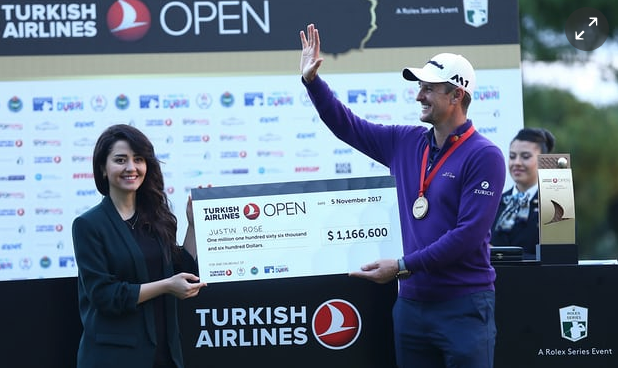
Nonetheless, the situation raises questions. It seems fair to ask what standard of field would participate in Turkey were enticement not given to stellar names. If the answer is that the competition would become the domain of only lower-grade golfers, does that not undermine its Rolex status? There is also an ethical argument regarding why golfers, or any sportspeople of a certain financial level, should be paid simply to appear. In many ways, this surely contradicts the ethos of sport, albeit that such a point could be applied to money’s tight grasp of football, tennis and so many other enterprises.

Grayson Murray Now Respects The Guys Who "Paved My Way" To Play Pro Golf For Money

Now, let's revel in the immediate apology from HOF Point Misser and undoubtedly-freshly-fined PGA Tour player Grayson Murray first, then quibble later.

For those unaware or simply distracted by things that actually matter, Grayson Murray comes from a world where those who make money are good and those who cause the PGA Tour's stil-robust bottom line to show a few red numbers, apparently are not so good. That was the basis for his post-Schwab Cup controversy thoughts, since deleted.

He was scolded by, among others, Curtis Strange, who has won more U.S. Opens that the rounds Mr. Murray has played in the U.S. Open. Given that Mr. Murray also failed to break 80 in either of those rounds, it's clearly he saw some sort of light from Strange's rebuttal Tweet that cited the way-pavers.

However, I must quibble that the current players on the PGA Tour Champions paved a way for Mr. Murray to ply his trade. That honor would actually go to Willie Park Sr./Jr., Allan Robertson and Old Tom/Young Tom Morris, folks I'm willing to bet he's never heard about.

Their fine efforts for professionals were continued, with major injections of freshened paving from Harry Vardon, Ted Ray, J.H. Taylor, Walter Hagen, Gene Sarazen, Ben Hogan, Byron Nelson, Sam Snead, Arnold Palmer, Jack Nicklaus, and should Mr. Murray leave these United States, the likes of Gary Player, Peter Thomson and Seve Ballesteros, among others.

Today's PGA Tour Champions are riding the remnants of a wave initially fueled by some of the aforementioned. They still warrant respect for having devoted their lives to professional golf and doing their best to create a place for the likes of Grayson Murray to make a living, and presumably play a sport he loves, after he turns 50. God helps us all should he ever think of himself as a path-paver.

Is Rahm A Controversial Winner Of The European Tour's ROY?

That's the question posed by Ryan Herrington at Golf World, and while I'm loathe to even argue the merits of an award that is essentially inconsequential, I think it's a worthy post to consider.

And not because Rahm is undeserving as he's an incredible young player who was deserving of a PGA Tour ROY but was not eligible. Nor should we necessarily be rewarding tour provincialism as a pre-requisite for consideration, but as Herrington points out, Dylan Fritteli was a genuine European Tour player with 28 starts to Rahm's 12. Both won one event. The European Tour's press release said Rahm clinched the award Sunday based on money winnings, but why this week's season-ending championship is not included, is unclear.

Herrington writes:

Yes, Rahm played in 12 officials European Tour events in 2017, claiming one win at the Irish Open and four top-10s in 12 starts while earning €2.8 million to put him fourth in the Race to Dubai entering this week’s season finale. However, of the 12 events, eight were either major championship or WGC tournaments that also counted toward his PGA Tour numbers. Is playing only four regular-season events native to the European Tour enough to be deserving of the honor?

At first glance, the answer feels like a definite maybe.

In the past, the Henry Cotton Award was said to come from a committee of European Tour, R&A and Association of Golf Writers and if they are still voting on it, they certainly rewarded a nice year by Rahm. But given all that's going on with efforts to give the European Tour a boost, the lack of reward for the tour's most devoted (and maybe best rookie) seems like an idea worth revisiting.

The Fine Line Between Desperation And Authenticity In Sports

I wrote in the latest Golfweek about the importance for golf to remember the fine line between desperation and authenticity in promotion of the sport.

The confluence of recent events--from Henrik's sore rib caused by the HSBC stunt, to the suddenly iffy future of the NFL, suggests golf needs to sell the values that got the game to age 500 (or so).

For a perfect example of how quickly can sour when desperation takes hold, check out Ben Rothenburg's NY Times story on the ATP Tour trying tweaks to tennis via its NextGen event.

If you like the sport at all, you'll be intrigued by the ideas (pace of play, technology) and less inspired by the motivations (millennial attention spans, etc...). But as with so many of golf's stunts, organizers got carried away and the tennis portion of the experiment was forgotten following a draw party boondoggle.

Instead of drawing chips from a bowl, organizers instructed the young players to select a model who would then reveal a letter, A or B, on her body to determine each player’s group.

The first model selected hiked up her dress and pulled her garter to reveal the letter A. Another instructed a player to remove her glove with his teeth.

The tennis world quickly expressed its disapproval at the crass sexualization of the event. The Hall of Famer Amélie Mauresmo called it a “disgrace,” while the French player Alizé Cornet mocked the regressive start to a showcase of innovations.

“Good job ATPWorldTour,” Cornet wrote on Twitter. “Supposed to be a futurist event right? #backtozero.”

An apology was issued and most didn't even up talking about the tweaks to format that included no line judges, shorter sets and a court presented without the doubles alleys. Desperation won in straight sets.

Initial Findings Confirm Faster Greens Mean Slower Play

While this is a shock to almost no one, we've never had solid statistical evidence that the chase for faster greens slows down play. Anyone who has some of the best putters on the planet mark 18 inch putts when greens are pushing 14 realizes speed forces caution for even the very best.

The USGA and University of Minnesota have teamed up for some very intriguing Science of the Green studies, and while it's early you have to admire their release of findings from a recent green speed/pace study at Poppy Hills. Parker Anderson explains the methodology, the plans for more extensive efforts and it's all worth reading, but of course we'll cut to the chase here:

An increase of one foot in Stimpmeter reading resulted in an increase of 6.39 seconds per green per player.  This one foot increase equates to an increase in total round time of a foursome of 7.67 minutes. In some instances, the increase in time spent per player per green resulted in an increase of as much as 30 minutes per round for a one foot increase in green speed (25 seconds per player per green). Overall, playing experience ratings decreased as green speeds increased. This decrease, although statistically significant, was small.

In conclusion, we found that faster greens equate to longer round times. The strength of this relationship, however, is not as substantial as we had hypothesized.

Perhaps I'm misunderstanding, but I would disagree that the number is insignificant.

On these findings of one foot of speed increase, greens Stimping 9 for a foursome would take 76 seconds less to play a hole than a group dealing with 12 on the Stimpmeter. Over the course of 18 holes that adds up to over 20 minutes. Throw in the added cost, stress and architectural impact, all of which do not improve the game, and the chase for speed continues to make little sense.