Intersecting Stories Help Better Explain Why Comcast Is Downsizing Golf Channel

Last week The Athletic’s Brendan Quinn detailed the rather stunning changes at Golf Channel and the likely blurring of editorial lines as the network is moved to Connecticut, with offices in the PGA Tour’s new expensive new headquarters.

The confounding implosion of Arnold Palmer and Joe Gibbs’ successful vision is coming into better focus after two stories emerged connecting more dots.

Palash Gosh at International Business Times reports on activist investor Nelson Peltz acquiring 7.2 million shares in Golf Channel owner Comcast, as first reported in the Wall Street Journal. Peltz’s Trian Fund now holds 20 million shares and a 0.4% stake in the company, believing the stock is undervalued, looks forward to discussions about improving the company, yada, yada.

The Journal commented that Trian is known for “encouraging changes at companies it targets, such as a breakup or sale of underperforming divisions or moves to improve efficiency and better use capital. It often seeks board representation and tries to avoid public spats, unlike some of its more pugnacious rivals.”

However, Comcast may be difficult for Trian to influence as Brian Roberts, its chairman and chief executive officer, controls about one-third of the stock’s voting rights.

Another Wall Street Journal story on the same day—mitzvah time!—not coincidentally details Comcast and NBC’s plan to essentially wind down several key cable channels they see as an “albatross” and put their focus into “individual franchises” for the Peacock app.

Thanks to reader Todd for Lillian Rizzo and Joe Flint’s story that included this:

The future is also dimming for sports networks like the Golf Channel and NBC Sports Network. Hockey and soccer games are likely to appear more frequently on USA Network and Peacock, the people say.

The move to downsize cable networks comes as the pandemic weighs on NBCUniversal’s business. Movie-theater closures hurt its film operation, its theme parks were closed and TV ad spending fell off. NBC’s second-quarter revenue shrank 25% compared with the same period last year.

When Comcast acquired control of NBCUniversal nearly a decade ago, Chief Executive Brian Roberts cited the cable entertainment networks as a key attraction in the deal.

And now those channels, along with sagging numbers at NBC would seem to be part of Peltz’s desire to see Comcast consider shedding the units via breakup or sale. Budget cuts seem unlikely since, as last weekends bare bone U.S. Open telecast showed, NBC has already trimmed so much.

Sadly, as Quinn noted last week, any outcome of this corporate arm wrestling appears too late for the several hundred who lost jobs. Worse, for viewers who appreciated the vision of Palmer and Gibbs, the damage has already been done.

Danny Lee Apologizes For Shocking 6-Putt Not Seen On U.S. Open Broadcast

As I noted here, NBC carried eight hours of 2020 U.S. Open coverage last Saturday but Danny Lee’s unbelievable 6-putt meltdown did not make the show. Only after an influencer Tweet did the sequence make it on the Sunday morning pre-game show where it was decried as “not a great look.”

Tuesday, Danny Lee admirably pulled out the old Notes app, typed out an apology and posted it to Twitter. He says he has been battling a wrist issue—the reason cited for his WD—and will be taking some time off.

USGA's Mike Davis Stepping Down In 2021, To Start Design Career With Tom Fazio II

Screen Shot 2020-09-22 at 11.21.50 AM.png

GolfDigest.com’s Dave Shedloski reports on Mike Davis’s future plans after the USGA announced their current CEO’s plans to depart by the end of 2021 (full release below).

Shedloski says Davis will pursue his well known passion for architecture, which has been instrumental in the USGA returning to classic venues and a huge inspiration for many restorations. Shedloski writes:

The USGA on Tuesday announced that Davis is stepping down as its chief executive officer, effective at the end of 2021, to embark on a career in golf course design and construction. Davis plans to team up with Tom Fazio II to create a new golf course architecture company, Fazio & Davis Golf Design.

“I’ve absolutely loved the USGA, and I hate the idea of leaving,” said Davis, 55, who became the USGA’s seventh executive director in 2011, succeeding David Fay, a role that segued into that of CEO in 2016. “I’ve grown up around here. I mean, it will have been 32 years by the time I leave, and my work in championships and governance and so on is just ... in some ways, I never thought I’d leave.

“But at the heart of this, I have always loved golf course design. I loved learning, seeing, playing, studying golf courses. I’m closer to 60 than I am 50, and there was almost a sense that if I don’t do this, I’m going to regret it.

Here is the full release from the USGA where it says Davis will assist with the “onboarding” of the next CEO, also known as hiring:

USGA CEO Mike Davis Announces Departure in 2021

Search for new CEO to begin 

LIBERTY CORNER, N.J. (Sept. 22, 2020) – The USGA today announced that CEO Mike Davis will leave the organization by the end of 2021 to pursue a life-long passion for golf course design and construction. 

In the next step of his professional journey, Davis will team with accomplished golf course designer Tom Fazio II in a new business venture, where together they have formed Fazio & Davis Golf Design. 

Davis, who joined the USGA in 1990, became the Association’s seventh executive director in 2011 and its first Chief Executive Officer in 2016. In the CEO role, Davis is responsible for managing all aspects of the association’s day-to-day operations, including its core functions, essential programs and human and financial resources. He serves as a member of several golf-related boards, including the International Golf Federation, World Golf Foundation, World Golf Hall of Fame and Official World Golf Rankings.

“Leading the USGA has been such an honor, and I’m grateful for the many wonderful years I have had with this great organization,” said Davis. “While I am excited for my next chapter, my work here is not done, and I look forward to furthering our mission to better the game over the next 15 months.”

Until his departure, Davis will continue to focus on leading the organization through the impacts of COVID-19, advancing the USGA’s commitment to create Golf House Pinehurst; driving USGA strategy (including, importantly, the outcomes of the Distance Insights project); and on-boarding and supporting his successor to ensure a smooth transition for the next CEO. 

"Mike has been a transformational leader in golf and his actions to move the USGA forward have been numerous and decisive," said USGA President Stu Francis. "These accomplishments include leading global rules modernization, the new World Handicap System, the ongoing Distance Insights project and the creation of the new USGA Foundation. In addition, Mike’s vision helped create four new USGA championships, while at the same time ensuring a renowned lineup of golf courses for all of the USGA’s championships. He has also been a strong advocate for the selection of public golf courses as U.S. Open sites.”

“During his tenure as CEO, Mike has assembled a strong, experienced leadership team, and worked collaboratively with our board to modernize and streamline the internal governance structures of the USGA, which created the space for the management team to lead the way and the Executive Committee to function primarily as a strategic board.”

The USGA Executive Committee will soon initiate a search for the next CEO, with the goal of having a candidate in place prior to the 2021 U.S. Open in June. Davis will support the onboarding of the new CEO over the subsequent months with the intent of formally departing the organization by the end of 2021. 

The 2020 U.S. Open's Overnight Ratings Are Not Good

The rescheduled 2020 U.S. Open provides a rare, and (hopefully) one-off look into what happens when a major championship moves to the fall against the NFL.

The numbers, courtesy of ShowBuzzDaily.com’s Mitch Metcalf, saw Sunday’s final round earn a 1.99 overnight rating, on par with the better “Return to Golf” events but easily a record U.S. Open low.

The previous benchmark for a U.S. Open final round came in 2014 when Martin Kaymer’s runaway win earned a 3.0 on NBC. However, that event was not going up against top-flight NFL matchups on CBS and Fox, where this year’s tournament was crushed by two dynamite games: Cowboys vs. Falcons and Chiefs vs. Chargers.

Against less competition Saturday, the 8-hour third round telecast averaged a 1.92, or 542,000 viewers in the only age group that purportedly shops.

NBC’s weekday coverage drew more decently, with a 1.33 Thursday and a 1.51 Friday.

Golf Channel’s first-year televising U.S. Open action appears have established record overnight lows which will almost certainly improve in 2021 when the event returns to June and a west coast venue.

Three editions of “Live From” surfaced in the top 150 cable shows, with Sunday’s post-final round edition earning a .03/171,000 viewers.

**Paulsen at SportsMediaWatch offered more on the various all-time lows and percentage declines.

Third round action averaged a 1.9 and 3.04 million, also the lowest on record. The previous lows were a 2.2 (2016 and 2017) and 3.20 million (2014). The telecast declined 32% in ratings and 27% in viewership from last year (2.8, 4.20M) and 24% and 19% respectively from 2018 (2.5, 3.77M).

The increase from Saturday’s third round to Sunday’s final round — just 5% — is the smallest on record for the tournament. Last year’s final round increased 57% in ratings and 74% in viewership over the third round.

NBC also averaged a 1.5 and 2.30 million for second round coverage on Friday (both -12%) and a 1.3 (-44%) and 1.96 million (-43%) for opening round action last Thursday. NBC’s weekday windows began in the afternoon, while last year’s comparable FOX telecasts aired mostly in primetime.

Some Reactions To Bryson DeChambeau's U.S. Open Win And What It Means For Golf

Tim Dahlberg of AP considers what Bryson DeChambeau’s win means for state of the game discussions:

The USGA and R&A are so concerned about the impact of long hitting on the game that they issued a report earlier this year that said, in part, that advances in distance off the tee were threatening to ``undermine the core principle that the challenge of golf is about needing to demonstrate a broad range of skills to be successful.’’

Now they may have to update that report. It was done before DeChambeau added 40 pounds during the pandemic break and began swinging at every tee shot like Barry Bonds used to swing at baseballs.

It was impressive to some, worrying to others. The fact is, golf has always evolved, from the days of hickory shafted clubs and gutta percha balls to today’s big headed drivers and balls that fly far and stop fast. But the beatdown DeChambeau gave Winged Foot this week might have been a tipping point in the debate over just how far the evolution of the game is allowed to go.

Michael Clayton writes for Golf Australia about what the key takeaways will be:

The first was that this was a dominant performance and his final round one to remember.

The second is teachers all over the world will be telling kids who watched on television and dream one day of winning a great championship that they had better learn to hit the ball 330 yards through the air, because there is nothing surer than that’s what the next generation will routinely be playing against.

Ultimately, though, watching DeChambeau with a driver in his hand is no more thrilling than watching Nicklaus, Daly, Woods or, indeed Bobby Jones, drive the ball.

Indeed, his biggest influence on the game is not likely to be his driver; but his understanding of data, statistics, probabilities and how they relate to strategy and the best shot to play.

The key for architects is to work out how best to disrupt the data without resorting to trickery – because this week the winner showed trickery in the form of narrow fairways and long grass can be defeated by power.

Alistair Tait wonders what all of these 375 yard drives mean for the Old Course in 2022 and Augusta, home of the next two majors.

A line had been drawn in the sand with Woods’s record 12-shot win, and the green jackets did something about it. Remember how they supposedly Tiger-proofed the course? Do they have enough time before the world’s best arrive in November to Bryson-proof the course Bobby Jones and Dr Alister MacKenzie created?

If Jack Nicklaus played a game Jones wasn’t familiar with, then imagine how the game’s greatest amateur would view DeChambeau’s approach?

Joel Beall at GolfDigest.com on where this leaves things with the distance debate.

No conversation in golf has been as heated as distance gains, and the USGA—which governs equipment regulation in this country—threw more logs into the fire when it stated in its Distance Insights report that said gains must stop. That verdict, how the USGA came to it, and where it goes from here, can be debated. But the performance of DeChambeau and Wolff and McIlroy on a course where just two players in five previous U.S. Opens have broken par is unequivocal: There is no defense against distance.

To many, Saturday afternoon sounded the alarm. In truth, the sirens rang earlier. The East Course’s ninth hole is serving as a makeshift range this week, with a net past the green guarding a parking lot. A few players have soared their drives over the de facto fence, including DeChambeau, who ended his third-round warm-up by raining balata into courtesy cars. As he walked to the first tee, the implication was clear. This course cannot contain them.

Golf Datatech: August 2020 Retail Golf Sales Up 32%

2020equipmentsales.png

Just amazing in all of this bleak news that the numbers keep showing interest in the sport thanks to safety and increased time for participation.

From GolfDatatech and not one mention of how distance is inspiring this spike in purchases across all equipment categories.

Kissimmee, FL., September 21, 2020 … On the heels of the U.S. Open, golf’s second major of 2020, Golf Datatech, LLC, the golf industry’s leading independent market research firm for retail sales, consumer and trade trends, has announced that U.S. retail golf equipment sales for August 2020 were up nearly 32% over the same period in 2019, exceeding the previous all-time high August (2006), by 15%.
 
In total, U.S. golf retail equipment sales for August 2020 were $331 million, compared to August 2019, which were $251 million, and the previous record year of August 2006, which were $287 million.  Additionally, five equipment categories, set all-time records for August: balls, irons, wedges, bags and gloves. Overall, golf bags were the best performing equipment category in August, up 55% vs. August 2019, while YTD bag sales are up 5%.

Not $600 drivers? Sorry, I interrupted. Continue.

 “Golf Datatech started tracking golf equipment sales in 1997 and we have never seen a surge like what has happened in the summer of 2020, coming out of the worldwide shutdown from COVID-19,” said John Krzynowek, Partner, Golf Datatech, LLC. “While the overall 2020 U.S. retail golf equipment market is still down 4.1 % YTD from 2019,  this spike is nothing short of remarkable considering the game and business of golf was shut down for a good part of the spring season.”
 
Krzynowek adds, “The August sales record, which followed an all-time record month in July, is great news for the industry moving forward.  It indicates how popular golf is today, especially as an ideal social distancing activity.  Newcomers are coming into the game, existing golfers are playing much more, and  those who once played but left for a while are returning, which is the perfect combination to drive rounds played and spike equipment sales at retail.”

What Pandemic! Bryson Caps Off U.S. Open Win In Gloriously Gluttonous Celebration

Bryson DeChambeau thanked Netjets and Bentley for their support

Bryson DeChambeau thanked Netjets and Bentley for their support

Despite all sorts of restrictions on media access to players during last week’s U.S. Open, Golf.com’s Dylan Dethier managed to access all of Bryson DeChambeau’s post-win obligations and the ensuing Trump Westchester celebration.

Now, I know what you’re thinking, isn’t there a bubble restricting on-site media and indoor access to players out of respect for this whole pandemic thing? Picky, picky!

Some media just have all the access. Or a strategic business partnership with the USGA, announced here by another USGA partner, Morning Read, which is owned by their crisis management friends at the Buffalo Groupe. Did I digress?

Anyway, I’m sure safety came first at all times and masks, social distancing and…yeah right.

Dethier writes about the first of two steaks for the 2020 U.S. Open Champion:

A USGA staffer asked if he wanted food and his agent ordered a steak on his behalf: filet, medium, salt and pepper.

But first, more interviews. A hit on SiriusXM. A message for Rolex. A stop-off with Barstool. The car wash!

The herd headed inside Winged Foot’s clubhouse, which is one moat away from a castle and particularly dramatic at night. One large room had been set aside as a dramatic studio; that’s where DeChambeau did a series of sitdowns: Golf Channel. The Today Show. CNN. He told some stories I’d heard before, but they had renewed meaning in this context, particularly one: When his father was battling through dialysis, they turned to Finding Nemo for inspiration. “Just keep swimming” became a family mantra.

Bryson’s clubhouse dinner was captured by Golf.com video and I must say, it’s great to see the USGA welcomed media into the clubhouse. No doubt how the state of New York chalked it up.

Dethier also writes about the celebration moving to Trump National Westchester, 20 miles away.

The afterparty was at Trump National GC Westchester, in Briarcliff Manor, some 20 miles north of Winged Foot, DeChambeau has a close relationship with the Trump family and Trump Organization Executive Vice President Larry Glick; he’s one of several pros who sports the “Trump” logo on his golf bag and has played at several of their properties.

Eric Trump played the role of host and hype man, introducing DeChambeau like a conquering hero as he entered the grill room, trophy in hand. The two most famous men in the room made for quite the side-by-side: Eric, who’s 6’5 and lanky, next to Bryson, who’s 6’1 and not.

It goes on with another steak to keep his weight up. Either way, looks like a good time was had by all…

DeChambeau later posted some photos of himself sleeping with the trophy—smiling so naturally—and in one final thank you to Netjets and Bentley.

2020 U.S. Open: Bryson By The Numbers

Screen Shot 2020-09-20 at 9.38.56 PM.png

From the USGA’s notes after Bryson DeChambeau’s 2020 U.S. Open win:

  • Champion Bryson DeChambeau tied for fifth in greens in regulation (46), despite tying for 26th in fairways hit (23). 

  • DeChambeau’s total strokes gained of 7.90 is the fourth-highest by a champion since 1960. Johnny Miller (10.77 in 1963), Arnold Palmer (9.29 in 1960) and Jack Nicklaus(8.19 in 1967) were higher.

  • This was just the third time since 2000 that the champion was the only player in red figures (Tiger Woods in 2000 and 2002).

If the fairways hit number stood out, it was historic but also not that far off from a couple of recent wins.

From Ryan Herrington at GolfDigest.com:

Consider this: Since 1981, no U.S. Open winner had hit fewer than 27 fairways, according to Golf Channel. Here’s a listing of the champs with the fewest fairways hit in the last 40 years.

Angel Cabrera, 2007, Oakmont, 27 (ranked 48th for the week in accuracy)

Tiger Woods, 2008, Torrey Pines, 30 (ranked 56th)

Webb Simpson, 2012, Olympic Club, 31 (ranked 13th)

Scott Simpson, 1987, Olympic Club, 31 (ranked 42nd)

Interestingly, while DeChambeau hit the fewest fairways compared to the four others, he ranked T-26 for the field on the week, which is the second to Webb Simpson.

As for the rest of his game, the short game performance isn’t getting enough attention. For four rounds at Winged Foot:

Screen Shot 2020-09-20 at 9.39.11 PM.png

In other number news, Bryson’s eyeing the 48-inch driver for November’s Masters with 360-370 average yard drives in mind, writes GolfChannel.com’s Rex Hoggard.

Also, 245 is in play if he can get to the gym and his arteries can take it. From Bill Pennington’s New York Times game story:

DeChambeau is 6-foot-1 and 235 pounds — he gained 40 pounds this winter in an attempt to swing more forcefully — but on Sunday evening he was asked if he wanted to become bigger before the Masters.

“Yeah, I think I can get to 245; it’s going to be a lot of working out,” he answered.

Xander On Bryson "Exposing" Sport: "It's no longer sort of a touchy-feely game."

Xander Schauffele off a fourth-straight excellent U.S. Open performance, sounds conflicted about where things are headed as he saw Bryson DeChambeau overpower Winged Foot.

Q. What are your thoughts on Bryson just in general and what he's done in transforming his body?

XANDER SCHAUFFELE: Yeah, he's a man of his word. I said it last night, if there's anyone that I was worried about, it was him. Everyone talked about hitting fairways out here. It's not about hitting fairways. It's about hitting on the correct side of the hole and hitting it far so you can kind of hit a wedge instead of a 6 iron out of the rough. Yeah, he's sort of trending in the new direction of golf, and he said he wanted to do everything he's doing, and yeah, happy for him. He's playing unbelievable.

This answer was especially fascinating:

Q. Going back to what you said before about Bryson,do you feel like he's revolutionizing the game?

XANDER SCHAUFFELE: No. If you look at just people that have dominated, it's always been distance. Obviously, Tiger had the mix of touch and feel and everything. If you look back at he was sort of the first guy to really hit it far with those clubs. Jack hit is really far as well. All the greats hit it pretty far for the most part. It's no longer sort of a touchy-feely game. The only way to make a golf course really hard is to firm up the greens and grow the rough. It's going to make it hard for everyone, and you'd rather be the guy in the rough with a lob wedge than with an 8 iron or 7 iron. Revolutionize? Maybe he's just exposing our game in terms of, if he keeps hitting it further and further, I don't see why he wouldn't be able to win many more U.S. Opens.

And there is launch angle golf in a nutshell.

So Maybe The 9th Won't Be A Par-5 The Next Time Winged Foot Hosts A U.S. Open

If they’re hitting drives like this with a helping breeze, Winged Foot’s 9th might be drivable in 2028, 2031 or whenever Winged Foot hosts the U.S. Open again.

From the 2020 U.S. Open final round where all three players made “eagles” after video game length drives.

Bryson DeChambeau, the “short” one of the group at 374.4:

Screen Shot 2020-09-20 at 8.13.14 PM.png

Matt Wolfe, outdrove himself from Saturday’s 377 yarder and gave himself a wedge approach Sunday after this 388.5 yard tee shot.

Screen Shot 2020-09-20 at 8.13.28 PM.png

And without the aid of a cart path, lucky bounce or any other known assistance beyond strength, launch optimization and some roll, a 418.8-yard drive from Dustin Johnson.

Screen Shot 2020-09-20 at 8.13.39 PM.png

These three are obviously longer than most and on NFL reserved lists as potential injury replacements at any number of positions. Still, this was a hole changed back to its original par-5 status but played like a tough four at 565 yards.

Rory On Bryson: "Brilliant...he's taken advantage of where the game is at the minute"

This 2020 U.S. Open post-final round comment from Rory McIlroy has been getting mostly negative reviews and I believe, incorrectly so. McIlroy posted a final round 75 to finish T8 at Winged Foot.

Q. Your golf followed from Tiger's and Tiger's followed from Faldo, Watson, and back to Nicklaus, very kind of straight line. Then you see this guy doing it completely in his own way, and I'm wondering what that says to you about the guy and about the game.

RORY McILROY: So I think -- about the guy, I think it's brilliant, but I think he's taken advantage of where the game is at the minute. Look, again, whether that's good or bad, but it's just the way it is. With the way he approaches it, with the arm-lock putting, with everything, it's just where the game's at right now.I'm not saying that's right or wrong. He's just taking advantage of what we have right now.

DeChambeau’s approach should raise questions about whether this is where the game should head. But you have to admire how he’s taken advantage of technology and put his body on the line in ways no one ever has. McIlroy seems to be saying that with his where the game “is at the minute.”

Which is also code for: where the game is because the governing bodies did not adequately anticipate many things that are happening.

2020 U.S. Open Winners And Losers

They pulled off a fall U.S. Open and there were many more winners than losers at Winged Foot.

Winners

Bryson DeChambeau – You’ve taken enormous risks, listened to no shortage of doubters and now are a worthy, convincing major championship winner. Most impressive is the accomplishment coming on a course supposedly rigged against your aggressive style of play. Plus, no run-ins with the rules or officials, and you gave credit to your parents for the sacrifices they made. Classy win.

Matthew Wolff –  Just two majors and already a second place and a T4 at age 21. Oh and an ebullient style when so many players look so joyless.  

Westlake Golf Course – Wolff’s home away from home is also where Chris Como, DeChambeau’s distance-boost coach, got his start in the game. What a day for Thousand Oaks. Check out Sean Martin’s story here on the little course that is producing so many characters.

California – Two for two in 2020 majors along with Wolff securing a runner-up, confirming the Golden State as a hotbed of talent development. And these are no country clubbers.

Winged Foot – Sure, the winner was six-under-par and you’ll now have to wait at least eight years to wonder what the next U.S. Open winning score will be. But the restoration came off brilliantly and it’s not your fault the governing bodies are dragging their feet on equipment rules tweaks. Hey, I have an idea, why not make some form of action a requirement to host again?

USGA Course SetupJohn Bodenhamer and Jeff Hall led a crew balancing architecture, science, early fall conditions, irrational Winged Foot member desires and the ghosts of USGA setups past. The task is not a pleasant one but the setup eased players into the week, moved the field around, and exuded U.S. Open difficulty all the way.

Dan Hicks – You maintained great energy during NBC’s eight hour broadcast Saturday and obviously know your home club, gulp, better than most. Sure, there were too many references to “The Foot” and most of America didn’t need to know the timing on the pro shop renovation.  But you balanced an unabashed affection for Winged Foot with storytelling, conveying the outcome of key shots while investing us in the venue. I wouldn’t expect anything different.

Poa annua – Winged Foot’s greens didn’t look so hot by day’s end but sure appeared to putt beautifully. Superintendent Steve Rabideau and team presented incredibly smooth poa annua greens. This proves for the second year in a row that the dreaded “weed” can be managed in a U.S. Open. Special shout-out to Darin Bevard’s USGA agronomy team on a success streak we hope becomes permanent.

Square Green Shapes – The restored hole locations and shapes looked incredible on TV and even the oddity of seeing so many geometrically shaped green complex fronts totally worked.

Lexus – While some undoubtedly grew concerned seeing your courtesy cars parked randomly throughout Winged Foot—mitzvah alert, always cluttering NBC camera shots—the screen time made for just the kind of organic advertising that the coveted demo admires.

Winged Foot Squirrels – Before budget cuts killed the animal cams and a whole bunch else, NBC would have made you stars this week. Still, you got in a few shots and now the tournament will leave town so you can store acorns without a U.S. Open around. Maybe the rough will finally come down too.  

Losers

NBC Fox was missed. That’s an unfathomable notion given Fox’s early struggles and NBC’s former place atop golf television. But Fox got a lot better and corporate budget cuts at NBC clearly took a toll in too many departments to list here. The broadcast lacked the technology, production values, sense of place and other little stuff NBC was famous for bringing to golf. Worse, so much cut from producer Tommy Roy’s pallet was just the kind of stuff viewers came to love from Fox’s USGA telecasts and CBS’s recent “Return to Golf” run.

Danny Lee – A terrible look with the Saturday six-putt and putter slam into the bag, followed by a WD. That came 90 minutes after play due to a wrist injury, but it took a Tweet from No Laying Up’s Tron Carter to shake the replay of your meltdown free of NBC servers. How did this not make on an eight hour telecast, only to be aired on the early morning pre-game?

Green Reading Books – A rule change designed to make these silly novellas more difficult to read has only added time to rounds. Speaking of slow play…

Slow Play – The USGA miraculously got the field around Thursday and Friday, but Sunday’s last twosome took just over four hours and thirty minutes, including 2:15 on the front nine even with the duo taking just six shots to play the par-5 ninth. Yes it’s a big course with high rough and diabolical greens, but matters are not helped by the players never facing a penalty the way they are at all other USGA championships.

Tiger And Phil – This fan-free golf just doesn’t seem like your thing. Maybe next year at Torrey you’ll give it one last college try.

Lost Ball Search Committee – The thankless task to minimize lost balls was mostly a success, but an early Thursday disappearance of Jordan Spieth’s Titleist and Sunday’s loss of a Harris English first tee shot will not be soon forgotten. We still appreciate your service.

Huge Square Tees – They just didn’t have the same character as those charismatic putting surface shapes.

Nothing To See To Here SocietySaturday’s bomb-and-gouge numbers combine with the future of players bulking up to showcase how silly it is that we have governing bodies still tap dancing around the distance debate.

Club Pro Guy – Bryson’s trophy ceremony thank you to CPG was almost an elite moment for the former Mexican Mini Tour player-turned-Yucatan National instructor.

Winning Score Watchers – Six-under-par. The travesty! The horror! Form a committee to find more back tee land and assess only those members who whine about this U.S. Open.

Rick Pitino – Your new house behind the third green is not situated properly for a flip to lengthen the fourth. Oh, and social distancing in the Pitino grandstand needs work even in a non-pandemic year.

Screen Shot 2020-09-20 at 4.08.44 PM.png

The Importance Of Hitting U.S. Open Fairways Isn't What It Used To Be

Lee westwood after round 3

Lee westwood after round 3

Think about all the effort put into juicing the roughs with fertilizer, fine tuning the lines a bit to make the players lay up so the ball doesn’t have to be regulated and the excitement at seeing them punished!

Not happening. At least, not for the 2020 U.S. Open leaders.

The most stout rough we’ve seen in some time is not meaning a darned thing at Winged Foot, as Matthew Wolff takes a two stroke lead into Sunday. Two, also happens to be the number of fairways hit in a 65 that featured two very makeable birdie misses. Wolff has hit 12 fairways after three rounds leaving him tied for 58th. The bottom portion of the fairways hit ranking:

Screen Shot 2020-09-19 at 7.19.23 PM.png

In second place sits Bryson DeChambeau, whose found 17 of 32 fairways, placing him T31 in that category.

To recap: the top two players hit 5/28 fairways but 23/36 greens Saturday.

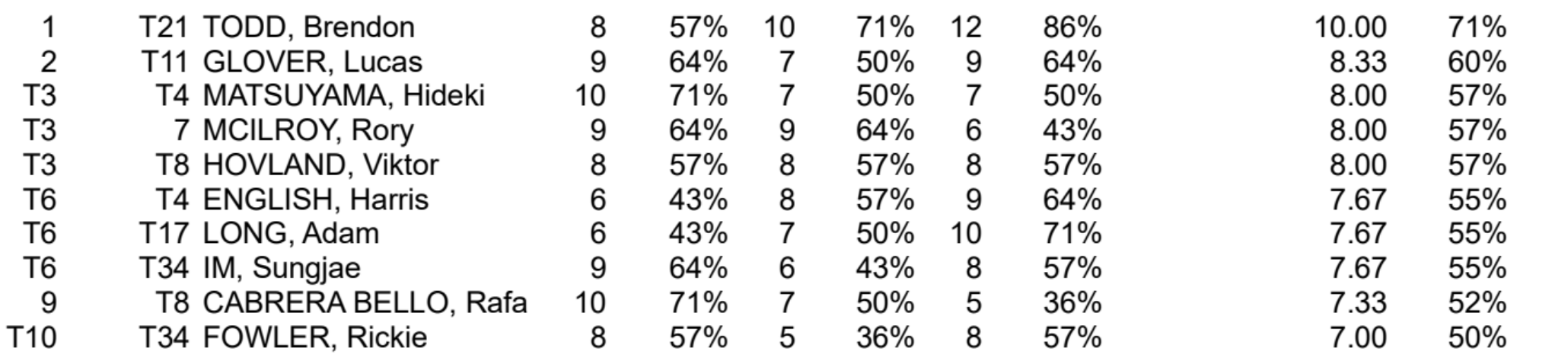
Yes, two players with a legit shot Sunday are hitting fairways and they may still flip the narrative if 57% is a number that affirms your faith in tee ball accuracy:

Screen Shot 2020-09-19 at 7.37.22 PM.png

Digging into the course stats, note how just four holes saw a higher fairway hit percentage than green in regulation. The other ten driving holes saw higher GIR’s than balls in the fairway, with some showing a huge discrepancy indicating that the short grass means only so much.

Screen Shot 2020-09-19 at 7.42.09 PM.png

Also note how small the cost of rough was Saturday, with only four holes having it cost a half stroke or slightly more.

Third round leader Patrick Reed’s ballstriking struggles did finally catch up to him, so there is that for those wanting to insist there is great relevance in hitting fairways.

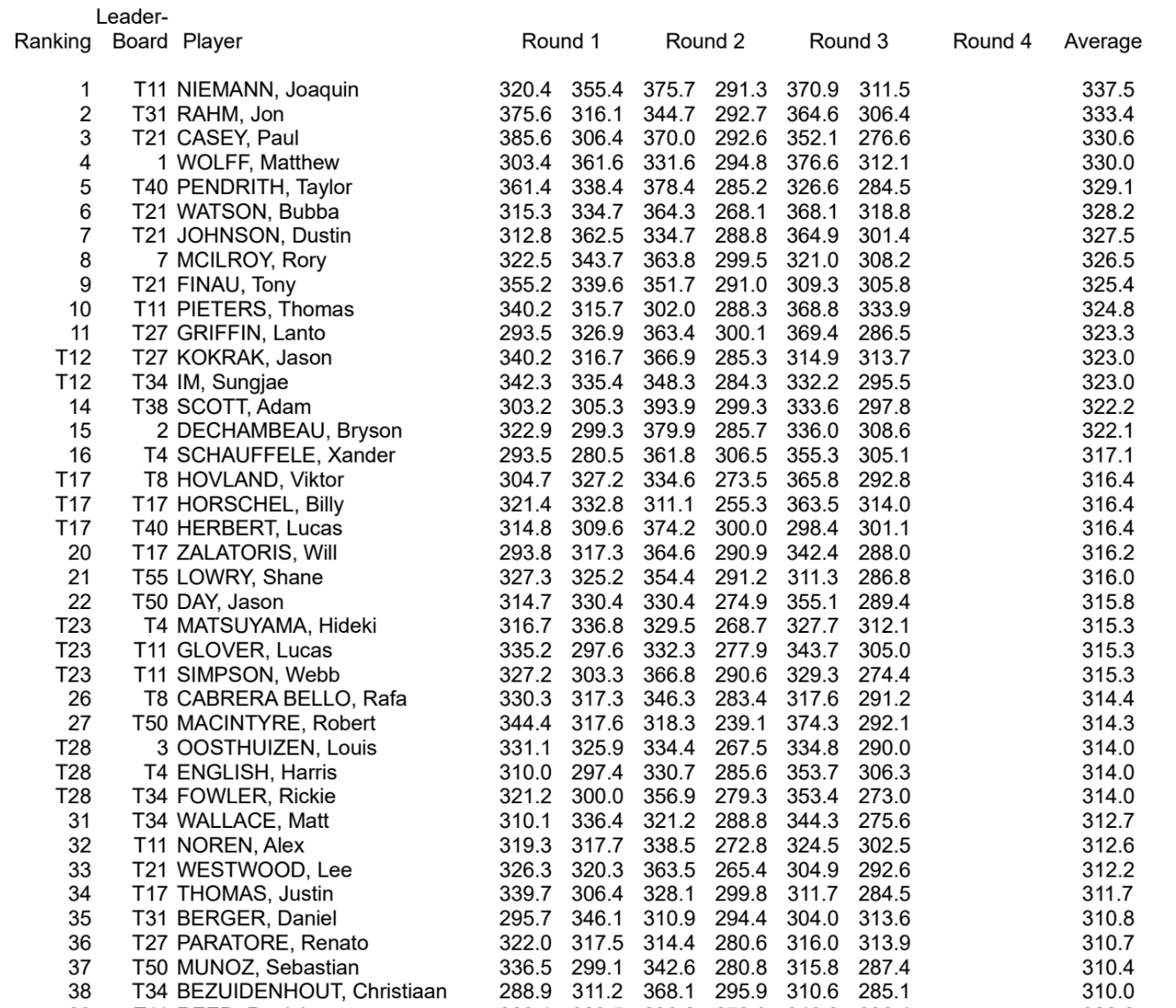
But the distance numbers suggest launch angle golf is working and there is no reason to do anything but bomb away. A staggering 38 players are averaging over 310 yards through three rounds with only 7 players averaging under 300.

The 310-and-up club, led 15 players averaging over 322 yards for the week on the measuring holes.

Screen Shot 2020-09-19 at 7.50.49 PM.png

While it should be a fun final round to watch, this week reminds those who’ve forgotten the previous bomb-and-gouge era that juiced rough still does not discourage the strategy. Still, it is stunning to watch the approach work so well on a course rigged to diffuse such an approach.

The madness of it all was summed up at the NBC telecast’s end when Roger Maltbie was asked by Dan Hicks about Bryson DeChambeau’s attacking style.

“Every part of me wants to not like this, that you just reduce the game to power and the fairway becomes less important, especially at a U.S. Open because historically, that’s just not the way it’s been done,” Maltbie said. “But this is impressive and (DeChambeau is) convincing me that he’s not wrong in the way that he’s assessed how to play the game now.”

Paul Azinger then offered this assessment.

“What are you going to do if you want to neutralize these guys, or if you want to make them accurate? Is power going to trump accuracy in this great game? The answer, it seems, is yes…one single club has made the difference, and it’s the driver.”

Instant Poll: Who will win the 2020 U.S. Open?

Screen Shot 2020-09-19 at 3.44.23 PM.png

Matthew Wolff hit two fairways and twelve greens en route to a sensational third round 65. He leads the U.S. Open at Winged Foot by two over Bryson DeChambeau in what figures to be a wild Sunday race.

Who you got?

Who Will Win The 2020 U.S. Open?
pollcode.com free polls