In golf construction art and utility meet; both are absolutely vital; one is utterly ruined without the other. GEORGE THOMAS
It’s back!
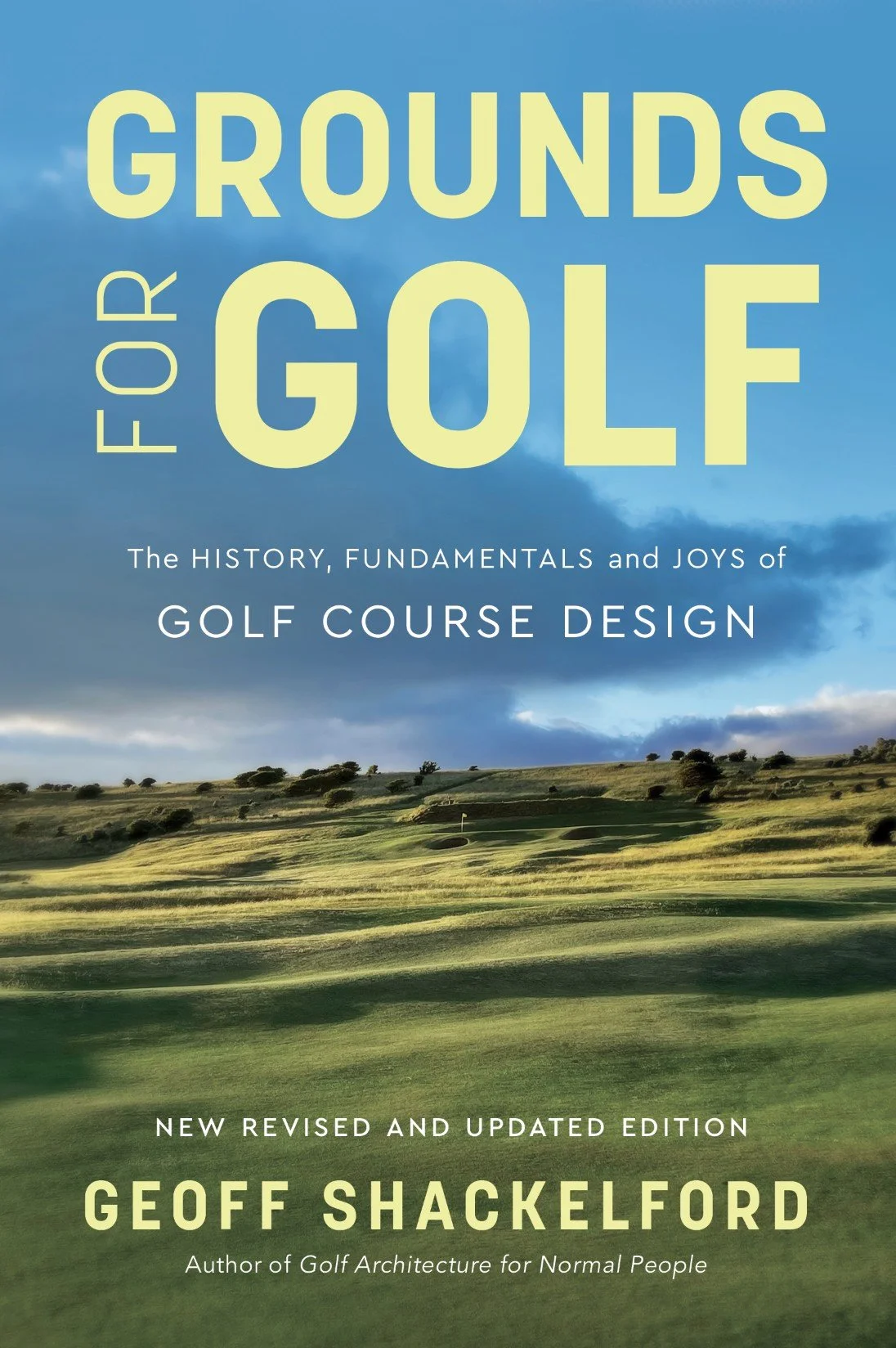
Twenty years later Tatra Press has kindly allowed me to bring back Grounds For Golf now that golf architecture is of more interest to the masses. A new Introduction looks at what’s driven the interest growth and two new chapters I had a blast adding (plus a few edits to keep things up-to-date).
Eddie Southards files a tough-to-read obituary of sorts on the golfers coming to pay their final respects to Baywood Golf Club. Considering how densely stacked the housing is along the fairways, this will certainly be an interesting case study in what happens when a golf course housing project closes down.
Tom Dunne's excellent case for a shorter ball and downsized game was inspired in large part by a visit to Kingarrock, an experience he says "felt straight out of an episode of Downton Abbey." He makes a couple of key points for those who react in horror at the thought of hitting shorter drives on shorter courses...
After playing a few holes, I looked at a 300-yard par-four in exactly the same way I would a 400-yarder using all modern stuff. And on the one occasion that I outdrove my playing partner, I felt exactly the same way I would have otherwise.
And this point interested me because I was absolutely smitten with the noticeably shorter time between teeing off and reaching your drive, an element that dramatically improves the flow of a round.
Since my visit to Scotland, I've kept in touch with David Anderson, Kingarrock's proprietor. He told me a great story a couple of months ago. A South African touring pro (not one of the household names) visited and played hickory over the summer. After his round Anderson asked him if he'd enjoyed himself. The pro said yes, adding that the most refreshing thing was that for a change he could actually see his ball land in the fairway. That's the game they play. And we could play it, too, under Solheim's three-ball solution.
Bill Fields reports on Sunday's closure of former PGA Championship site Pecan Valley, where management company Foresight Golf's talking points for employees included a claim that the "main reason" for the course's lack of profitability is because it's "too difficult for the average golfer." The J. Press Maxwell 1963 design was renovated byBob Cupp in 1998 and hosted the 2001 U.S. Amateur Public Links.
Foresight has posted a message on the Pecan Valley home page minus their talking points, merely offering a plug for its closest nearby course.
Thanks to reader Tylar for the shocking news that San Antonio's Pecan Valley, former PGA Championship host, 2001 site of the U.S. Amateur Public Links and an affordable public course in a populated area, is closing Sunday.
Some of my local courses are getting creative. Not enough, though. More are beginning to embrace Twitter and Facebook. Kudos to them.
One morning, a local course sent an email saying their afternoon was light on tee times. They were offering discounted rates for anyone who wanted to play that afternoon. I thought it was a great idea. Golf, at least for me, has become more of a spontaneous activity. Unpredictable work and personal schedules, as well as the fact that playing golf has been pushed down our list of priorities, mean my friends and I no longer plan tee times 7-10 days in advance. I don’t think we’re alone in that regard.
Any nominations for creative facilities working to get golfers out to play?
Long time readers know I'm a connoisseur of the increasingly bizarre suggestions by the manufacturing industry to protect an imaginary growth market, all under their insistence that golf's well-being relies on the hope of distance boosting equipment.
Geoff Shackelford is a Senior Writer for Golfweek magazine, a weekly contributor to Golf Channel's Morning Drive, is co-host of The Ringer's ShackHouse is the author of eleven books.