Video: 5-Year-Old Tommy Morrissey's Swing Impersonations
/Thanks to Alex Podloger for
Read MoreWhen you come to think of it that is the secret of most of the great holes all over the world. They all have some kind of a twist. C.B. MACDONALD

There were signs this was coming, namely a staff departure and a seemingly strange equipment change by Charl Schwartzel prior to The Open, but still
Mike Stachura's report at GolfDigest.com notes the sale figures which sound great, until they are placed into the context of market share.
Nike, which reported flat to down annual sales in its overall golf business the last two years at just north of $700 million in annual sales (which includes shoes and apparel), has been in the golf business since 1984, but only introduced its first clubs in 2002 with the Pro Combo set of irons. Its sales in 2013 and 2014 were nearly $800 million.
The company has struggled to become a leading player in the equipment business, with market shares in woods and irons that were routinely one-tenth those of leaders Callaway and TaylorMade.
 Stachura also recounts some of the products Nike made over the years and features quotes from Tony Finau, who recently moved to Nike and was surprised by the news. There is also a telling quote from a player who noted he never saw Nike's equipment in the bags of his pro-am partners.
Jason Lusk at Golfweek.com assesses the news and notes this on sales:
In its 10-K report for fiscal year 2015, Nike announced a 2-percent decrease in its golf business revenues from 2014. Revenues had dropped to $771 million in 2015, down from $789 million in 2014 and $792 million in 2013.
Will Gray at GolfChannel.com gets this quote from Mark Steinberg about Tiger's status. They have known about the end of Nike's equipment business for a few days.
"Clearly he and I need to be thinking about a change on the hard goods side," Steinberg told GolfChannel.com via phone. "He and I have discussed at length the plan for that, and feel comfortable with what we're going to do going forward. But clearly, there's likely to be a change."
Jeff Ritter at Golf.com also talked to Steinberg and got this regarding Tiger's clothing:
Steinberg declined to reveal which clubmaker he'd first approach, but added: "He's been a longtime icon of Nike Golf and that's not going to change one ounce. He'll remain a loyal and enthusiastic icon of Nike."
Steve Pike at the A Position says Nike never made equipment up to the levels and notes the timing.
Nike decision to cut bait on the equipment side comes at an interesting time in the golf industry. adidas Group has been trying for the better part of the past year to sell TaylorMade; and the Acushnet Company, parent of the Titleist and FootJoy brands, is in the midst of preparing for an Initial Public Offering. Nike’s exit from the equipment business likely won’t have any impact on either of those deals, but it likely will be seen as another black eye for a struggling industry.
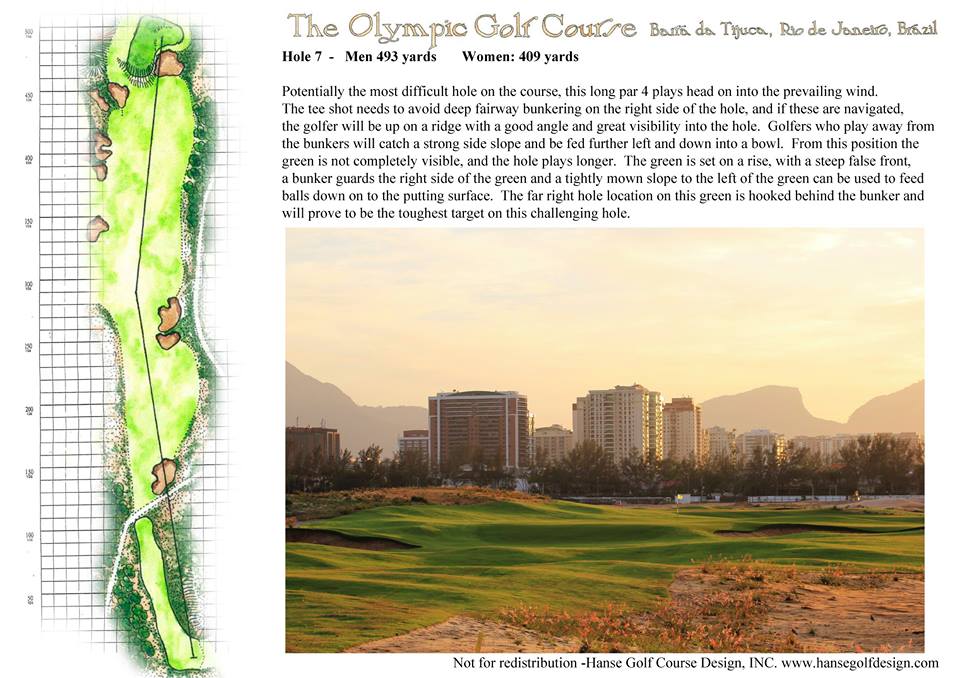
The closing three holes of the front nine return to the upper shelf of the property where the sandy influence is stronger. The long par-4 7th plays493/407 yards into the wind with a strong false front green.
Gil Hanse narrates the flyover for Golf Digest. Here is his final rendering.
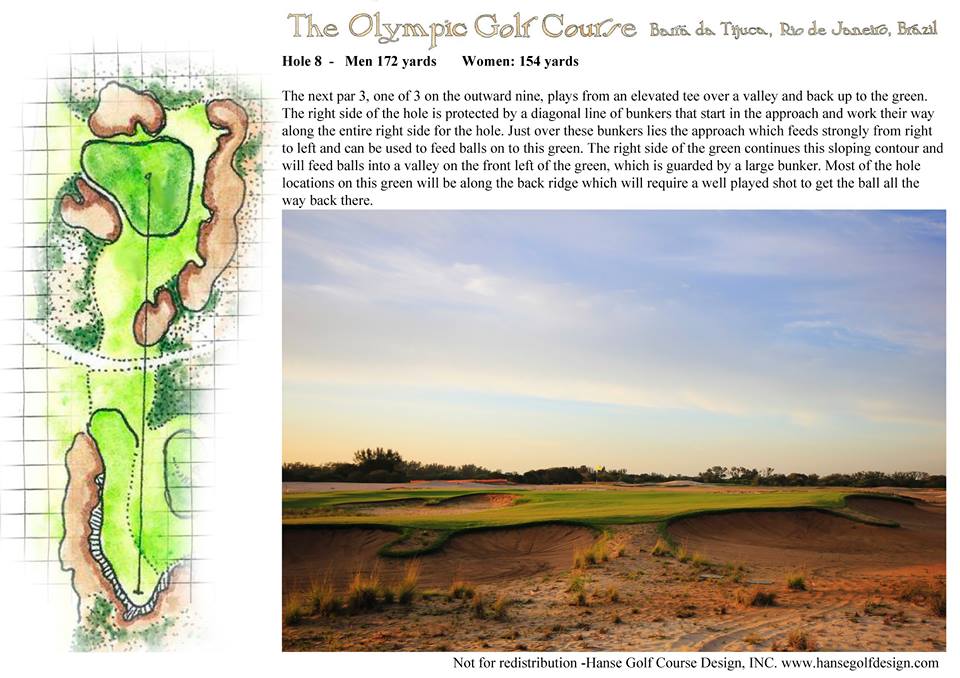
The par-3 eighth (172/154) certainly exudes ties to the Redan and given the terrain it was set on, the fit was not forced. The rendering and the flyover:
‘
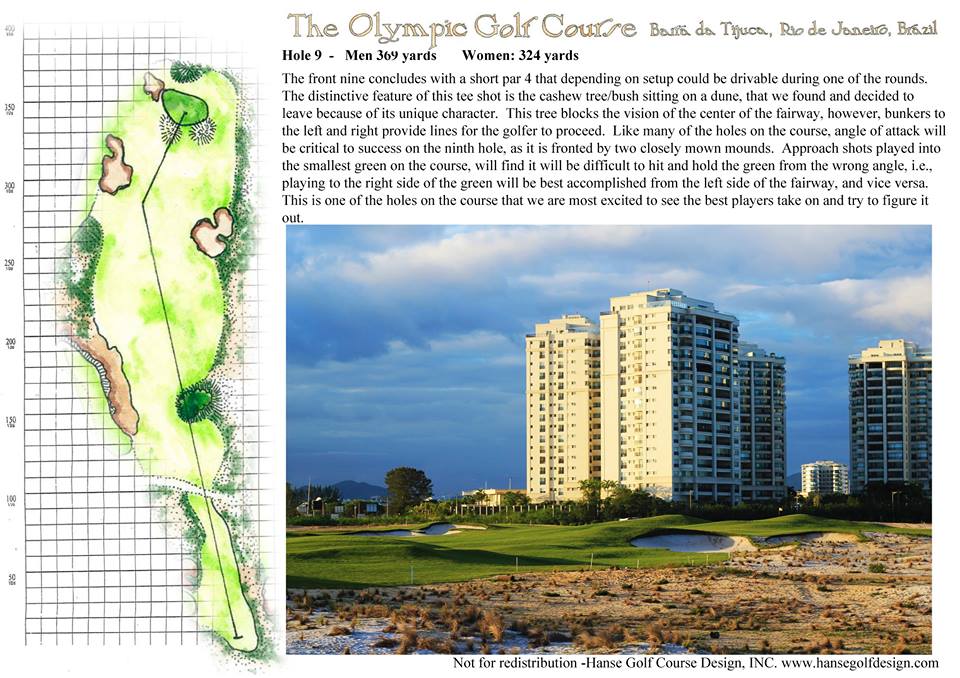
The par-4 ninth hole brings a little blindness and weirdness to close out the front nine, playing 369 yards for the men and 324 yards for the women. The rendering.
In the better late than never files, Matt Kuchar found out during his Travelers Championship media session that there is no team format in the 2016 Olympic golf.  Joel Beall at GolfDigest.com details the awkward exchange just three days out from the opening ceremony.
"There is no combined? No team event whatsoever?" Kuchar continued. "Just an individual. We did the same thing at World Cup: 72 hole stroke play. I played with Kevin Streelman. We never played together but we did represent the United States in a team format.
"That was my initial impression of what was happening with the Olympics, but I'm incorrect on that."
ESPN's Jason Sobel helped clarify the situation for Kuchar, remarking, "If Bubba wins you don't get a medal."
And it's at that point we came to the collective realization: Kuchar legitimately didn't know the Olympic tournament's configuration.
Alan Shipnuck's SI/Golf.com story is a nice recap of Jimmy Walker's rise from solid journeyman to major winner. This was also noteworthy. Someone has made a quick impact...
A month ago he began working with Julie Elion, Mickelson's former sports psychologist. (Jimmy and Phil are frequent practice-round foils.) At Baltusrol part of the plan was for Walker to carry himself with more cowboy swagger. When a reporter noted during the champion's press conference that he had seemed surprisingly calm during the tense finish, Walker said, "That's huge, because that's what I was going for."
Gil Hanse, golf architect of The Olympic Golf Course in Rio and many other projects, joined host Harry Arnett and sidekick Amanda Balionis in Carlsbad for episode 12/season 2 of Callaway Live.
The full episode replay is here:
Nice spot by Justin Abrams to show that men in pastels, anklet socks and driving a buggy around a Colorado colf course can still get into a fight over something very, very important.
Mute the audio for the less-than-savory play by play.
A video posted by Justin Abrams (@jabrams77) on Jul 30, 2016 at 6:30pm PDT
Catching up now post-PGA on the Rio Olympic course, with the fourth, fifth and sixth hole flyovers by Golf Digest and narrated by Gil Hanse.
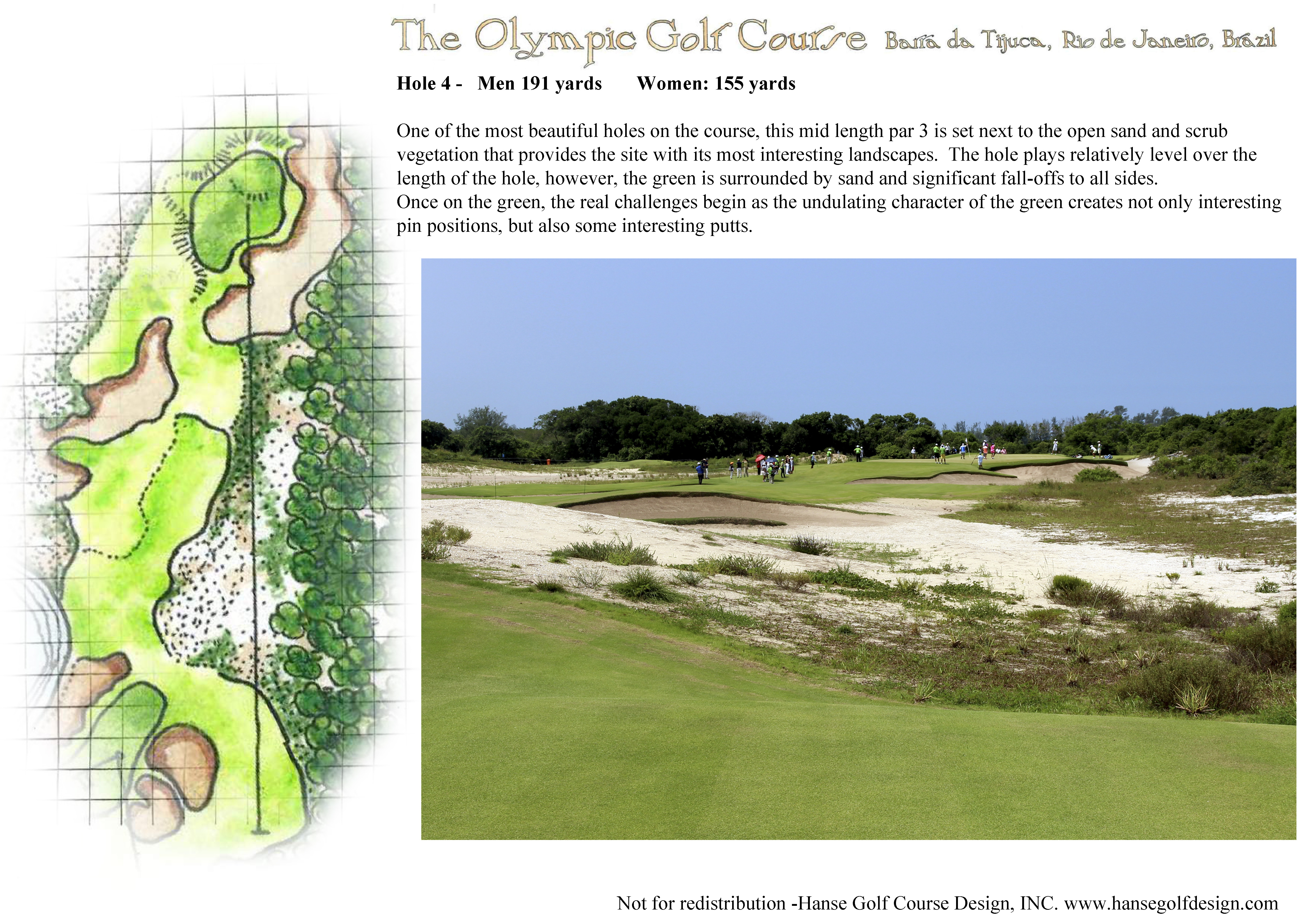
The par-3 4th hole 191 yards for the men and 155 yards for the women and looks like an ideal sandbelt one-shotter, only windier.
Gil's final rendering of the hole.
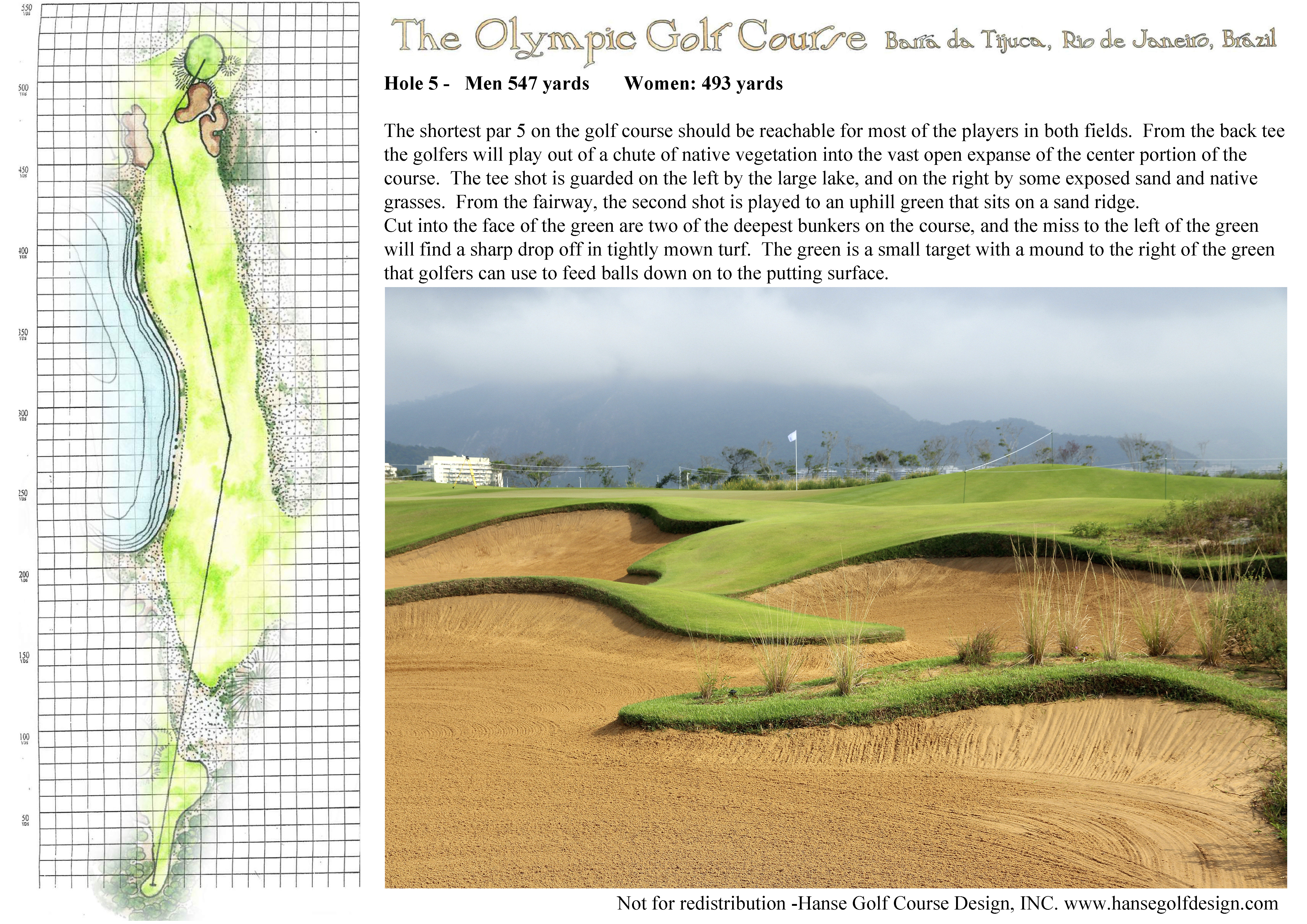
The par-5 fifth hole is 547 yards for the men and 493 for the women and plays gently uphill. It's hard to see, but this is a wonderful greensite that should be a great spectating portion of the course.
Gil's rendering of the fifth.
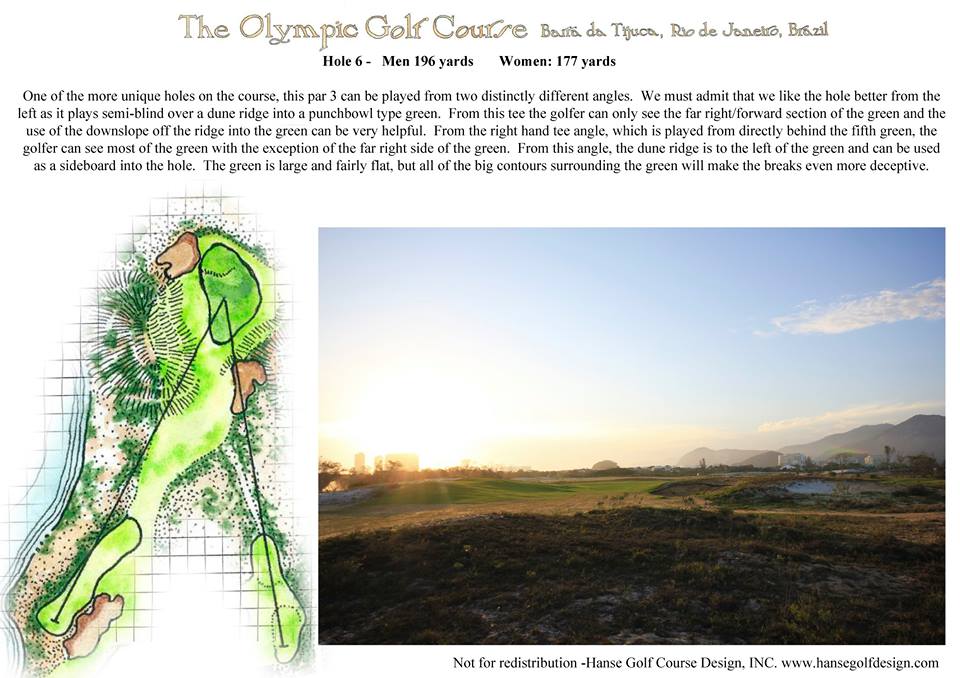
The par-3 sixth plays 196 yards for the men and 177 yards for the women. This hole features two tees, including a blind option over the dune. Strap in, this should be fun!
Gil's final rendering of the 6th includes both tee options.
Golf on TV could be the greatest, it could be the best, it could be King Kong banging on its chest!
Standing in the Hall of Fame, and the world might even know golf is not lame! I'll stop now before you get nightmares since I'm pretty sure Omega's latest ad (key word, ad), will be running a bunch during the Rio games.
Not being present at this year’s PGA Championship afforded an opportunity to be reunited with the early 2000s, a.k.a. a TNT broadcast at a major championship. But this is not to pick on any one network (well, maybe a little), as some of the same issues TNT exemplifies afflict all of the major broadcast presentations, though no major has the annual commercial and promo dump that is the PGA of America's dreadful presentation.
Shoot, even CBS head man Sean McManus talked to Golfweek.com's Martin Kaufmann right after the PGA to address the telecast and suggest the commercial load needs to be dealt with for the next three years of the deal.
No, the affliction I refer to runs deeper than the annual overcommercialization of the fourth of four majors. It's the tendency to stick to what got you here, what has worked over the decades, and to not give up screen space to anything but green grass and golfers. But most of all, to do what will please “partners” who want to play it safe while also preaching how we need to do things differently to save the sport.
Those partners--the PGA of America (this week), the PGA Tour, the USGA, the R&A--all talk relentlessly about growing the game and reaching the all-important millennials, yet refuse to see that their biggest growth tool is in how they present golf on television. Outside of the cost to play, I can’t think of anything more stifling for growth than an aspiring golfer, turning on the suffocatingly safe presentation of golf at the PGA Championship.
TNT’s presentation undermines the event’s place in the major spectrum by appearing to work out of an early 2000’s playbook. (The addition of some fun split screens showed some sign of life and fresh voices in Mike Weir and Amanda Balionis were huge positives.) Yet the ultra-conservative approach to the PGA Championship is even more maddening because of TNT's bold approach to the NBA. That’s where innovation and must-see pre and post game shows have spiked ratings, establishing the cable network as the best at bringing us pro basketball.
In golf, it's vital that television presentation be strong to "grow" participation in the game. More people watch golf on TV than avidly play it. That's an amazing notion suggesting how vital telecast presentation may be in motivating people to play.
With the PGA Championship that TNT airs through 2019, the cable network’s idea of a pre and post game show amounts to reruns of something from their highly-rated catalog. Those cash cows merely require a few an engineer to push a few buttons takes priority for TNT over even now-standard re-broadcast for major rounds (which are appreciated by working folks or those with DVR’s full to the brim).
Adding to the pain is what appears to be a reluctance on CBS’s part to share its gadgets with the TNT broadcast. Can't we all get along here?
Good TNT broadcasts will make more people watch CBS!
As with NBC’s coverage, the beauty of the golf course is a CBS priority and in the early days of high definition, no one disagreed with this approach. But now that nearly all viewers are watching on an HD flat screen and enjoying access to Internet-enabled information, the minimalist approach to screen acreage has begun to give core fans the impression of laziness and casual fans a sense that things could be better. In a day when people can handle more graphics and social media information on screen, golf is still holding back real-time information.
Knowing how hard the people in golf television work, particularly during majors, the impression of laziness is an unfair one. Golf is by far the most difficult sport to cover. Nonetheless, as we get more fun stuff like Protracer, on-screen graphics/Trackman data, split screens that give us a better sense of the golf hole faced, and full-field scores, the broadcasts that eschew such progress only give the impression to viewers that golf is stuck in a different decade. This was TNT last week.
When something controversial happens--like the PGA’s miscue with a hole location and repeat of its 2005 refusal to move up tee times--the lack of broadcast discussion looks lame while social media covers the story. This undermines the credibility of the networks and tournament host. (Especially when it’s the network home to Ernie, Charles, Kenny and Shaq, where nothing is off limits and controversies are embraced). Also, do recall that Fox’s breakthrough at the U.S. Open came at the expense of actually covering its partner’s mistakes. Painful for the USGA, yes, but also a huge boost to their partner overpaying for the product.
The people who want to grow the game need to stop focusing so much on the production values of their public service announcements. They need to look within and start pushing their broadcast partners to rethink how they present the sport, even if means giving back a few bucks to help the networks expand certain production values. These conversations are long overdue and more necessary than another short term feel-good initiative. Because those PSA-driven grow the game concepts pale compared to motivating people by giving them a telecast that inspires them to run to the range.
Geoff Shackelford is a Senior Writer for Golfweek magazine, a weekly contributor to Golf Channel's Morning








Copyright © 2022, Geoff Shackelford. All rights reserved.