Four Captain's Picks: European Tour Unveils Membership Regulation Changes Impacting On Ryder Cup, Rolex Series

Thanks to reader ST who stumbled on this middle-of-the-night, past-deadlines European Tour posting of major membership regulation changes that will impact the Ryder Cup and many players who juggle time on multiple tours.

The key element: four (instead of five) European Tour sanctioned events outside of the majors and WGC's must be played to qualify for Ryder Cup eligibility. There is more.

Firstly, there will be a greater weighting for points earned in tournaments in the latter stages of the process to help ensure the European Team reflects those players in form nearer the time of The Ryder Cup itself.

Race to Dubai points and World Ranking points earned in these tournaments will be multiplied by 1.5 for the two respective qualification lists with the first counting event to benefit from this increased weighting in the 2018 season being the BMW PGA Championship at Wentworth. 

With the 2018 schedule not as yet finalised, the last counting event in the quest to make Thomas Bjørn’s team bound for Le Golf National in Paris in September 2018 is not confirmed, but the starting point will be the D+D Real Czech Masters at the Albatross Golf Resort in Prague from August 31 – September 3, 2017.

This is an obvious reaction to so many players not sniffing the 2016 team while playing so well, or, in the case of Thomas Pieters, requiring a captain's pick.

Secondly, following the introduction of the Rolex Series, no Ryder Cup qualification points will be available from tournaments staged anywhere in the world played in the same week as these events in both 2017 and 2018.

Pelley!

Nice move by the Chief to protect his newly-announced series of events and to offer a little more incentive. Now the bad news...

While this change takes into account the significance of the Rolex Series for the European Tour, it also recognises it will mean fewer qualification points being available globally outside of these tournaments, hence Captain Bjørn will have an extra wild card pick at his disposal for the 2018 team – the third change.

 It means the 12-man European Team for The 2018 Ryder Cup will comprise the first four players from the European Points List, followed by the leading four players from the World Points List and completed by four wild cards. 

This is the most disappointing concession to the increasingly absurd glorification of captains. It's hard to imagine after the first two improvements that many players will be heartened by better qualifying rules while one less qualifying spot is offered.

Darren Clarke reluctantly took Thomas Pieters over Luke Donald. With a fourth pick, is he taking Donald over Russell Knox? If I were betting I'd say yes.

Here's a fun little back room preventive measure for an unforeseen scenario:

Furthermore, the committee also introduced a new regulation stating that players cannot be a European Ryder Cup Captain or a Vice-Captain if they decline membership of the European Tour or fail to fulfil their minimum event obligation in any season, from 2018 onwards.

Costco's Disruptor Ball Appears Dead, What Did We Learn?

Kudos to MyGolfSpy for reporting the likely demise of Costco's Kirkland ball sold for so little and performing so admirably.  I've been trying to track down details on the Kirkland story and my reporting mirrors that of MyGolfSpy in all but one key area. This we agree on: it's unlikely we'll see Costco replicate such a ball at the same price.

To recap, the $15-a-dozen ball is no longer even pictured on Costco's website after supplies became constrained, largely after MyGolfSpy's rave November 7th, 2016 review comparing the pellet favorably to Titleist's Pro-V1.

Tony Covey writes:

Our source inside Costco has not responded to our calls, however, a source familiar with the situation has told us that Costco has suspended production of the Kirkland Signature until further notice. Whether you want to call it a shortage or a total outage, the lack of Kirkland golf balls available to the consumer is being blamed on supply chain issues.

We're told that, internally, Coscto is saying that production will resume at a later date (and that an email will be sent to customers when stock is available), but we have good reason to believe that is an unlikely scenario.

Essentially Costco was the recipient of a one-time bargain-buy on golf ball cores that allowed them to produce the ball inexpensively. Any Trader Joes shopper knows that vineyards with extra stock but not wanting to taint their brand selling their wine at a lower price will sell otherwise nice product to the chain. Trader Joes then slaps their label on what amounts to limited editions, tells us where the grapes were grown and teases us about its heritage without ever outing the vineyard. Some of the wines are better than others, but they are almost always an excellent value.

So which vineyard dumped these cores on Costco at a low, unlikely-to-be-replicated price? Covey writes:

A representative of Nassau Golf (originally listed as the manufacturer of the Kirkland Signature Ball on the USGA conforming list) has told MyGolfSpy that Costco purchased overruns of Nassau's European-market-exclusive Quattro ball. There is some indication the sale was made through a third party, and that Nassau may not have been directly involved in the deal. The same source confirms that while the Costco balls have a different core color, the material composition and layer thickness are absolutely identical to the Quattro.

With the initial supply of overruns exhausted, Costco effectively has nothing left to sell.

Multiple sources I contacted felt that cores were from an overrun of Taylor Mades that needed to be disposed of when Adidas demanded that their subsidiary squeeze cash out of anything they could. The intent was not to disrupt the industry, but instead to cash in however they could on unused inventory. When GolfWRX noted the initial frenzy and MyGolfSpy's review hit, the ball became a disruptor.

Covey does note that the Kirkland ball's manufacturing location is now back to its mission of making Taylor Made golf balls and that a similar situation to the 2016 "K-Sig" is unlikely anytime soon, if at all.

I mention TaylorMade in particular because the company's tour balls are produced at the same factory as the Costco/Nassau balls, and there are some indications that production of new TP5 has pushed smaller companies to the back of the production line. Even if Costco otherwise had the capability to produce balls immediately, which it appears it doesn’t, the K-Sig wouldn’t be given priority over larger brands and long-term customers.

So what have we learned from this brief disruption of the ball market?

--MyGolfSpy's review was incredibly powerful, GolfWRX once again fueled interest in a product and the tide may have turned for golf equipment reviews. As other sluggish traditional publications sat on the sidelines, perhaps for fear of upsetting major manufacturers or simply because Costco is not a potential advertiser, independent internet reviews fueled the frenzy. (GolfWRX first posted about a "frenzy" on October 28th and while Mark Crossfield only posted a review three days ago, internet influencers established even greater power thanks to the Kirkland ball.)

--A lot of people don't like Titleist. There was much behind-the-scenes joy at Titleist facing a scary competitive hit around the time of their IPO. Some of the hostility could be chalked up to their longtime spot atop golf ball sales. Some of the glee was over the incredible brand loyalty Titleist inspires. Some of it related to their hostile position toward distance rollback advocates. But most hostility centered around about the price of a dozen ProV's compared to others and was aired on forums. However... 

--A lot of people don't know what goes into the cost of a golf ball. The anger ignored how much Titleist and other major manufacturers spend on R&D and manufacturing in the USA. That's right, unlike the Costco ball, we are talking about an American made product. I was amazed how many golfers were not aware that ProV's and Callaway Chrome Softs are made in Massachusetts by American workers. If you like to buy "Made in the USA" products, this episode was an eye-opener.

--Costco now looms as a potential market disruptor under the right conditions. Yes, it took some luck and timing, but they do have the ability to inflict temporary damage on major manufacturers. On the other hand, the episode may have legitimized them as a seller of golf equipment of any kind.

--Golfers and their brand loyalties were tested. Many pushed back on Twitter at my intial skepticism over the long term success potential of the ball. I questioned whether golfers could announce they were playing "a Kirkland 3 on the first tee." While I'm all for anything that lowers prices and increases competition, common sense says most golfers are attracted to their favorite brands for reasons both sane and insane.

--The episode did at least include one fun viral video. And look at it this way Wally, there were much worse clips they could have used!

Dr: Minimum Of Six Weeks To Heal For Injury Like McIlroy's

Golf Channel's Matt Adams spoke with an orthopedic surgeon who has served as an independent examiner for the NFL and who says Rory McIlroy's stress fracture is extremely rare for a golfer.

More ominous is his prescription for recovery and healing.

“They are typical in rowing or upper body weight bearing athletes,” Kunkel said. “Stress fractures are caused by an accumulation of micro-trauma. They are tiny fractures or cracks in the bone. Usually the body just heals them. If you do not give it time to heal, it can result in a full fracture. Typically, an injury of this sort will take a minimum of six weeks to heal.”

Kunkel noted that the only way to ensure that an injury of this nature does not reoccur is to stop engaging in the activity that caused the injury and to strengthen the muscles around the core and spine.

“The modern golf swing is hard on the body,” he said. "To have athletes in their 20s experiencing these types of injuries is very concerning for the long-term.”

Dr. Ara Suppiah explains more in this Golf Central phone call with Lisa Cornwell:

Club Corp Headed For Breakup?

Greg Roumeliotis and Lauren Hirsch of Reuters report that investors are pushing for ClubCorp to be broken up and that the company has formed a committee to carry out a review.

They write:

It is a serial acquirer in the golf course industry, buying 12 new clubs in 2015 and 2016. It looks to buy locally-owned golf courses and then refurbish them by adding or improving amenities such as up-scale dining and event rooms.

Shareholder FrontFour Capital Group LLC in September published a letter highlighting ClubCorp's low trading multiple as compared with leisure industry peers such Six Flags Entertainment Corp (SIX.N). It questioned some of its business decisions such as ClubCorp's model to pour money into refurbishing its golf course acquisitions.

"It is obvious to us that ClubCorp's reinvention capital expenditures are transformative in nature and are in no shape or form 'maintenance,'" the letter wrote.

How dare they try to transform their properties for a new generation!

Private equity firm KSL Capital bought ClubCorp for $1.8 billion in October 2006 before taking it public in 2013. The company operates more than 200 properties but it saddled with major debt issues.

More On Justin Thomas' Ascension, Stunning Sony Stats

Now that Justin Thomas has won both Hawaii events and moved into the world top ten, his backstory is probably a lot more interesting to most.

Brian Wacker does a nice job recapping how Thomas got to this point and highlighting the role of his golf instructor dad Mike.

The older Thomas said he often asked Justin if he wanted to go to the swimming pool or to play basketball. He was not interested.

“When he was 7 or 8 years old, he’d call me on his way home from a tournament and say, ‘I’ll be home by 7:30, do you want to play nine holes?’ ” Mike Thomas said. “We’d eat dinner at 9 or 9:30 every night. Selfishly, it allowed me to play more golf.”

The older Thomas taught his son the fundamentals, but he was cautious about pushing him too hard. Most of their lessons would last 10 or 15 minutes, in part because Mike Thomas had a busy schedule teaching and competing, but also because he did not want to be overbearing.

“I’ve seen it done wrong so many times,” Mike Thomas said. “It was more important that we were friends than he was a good player.”

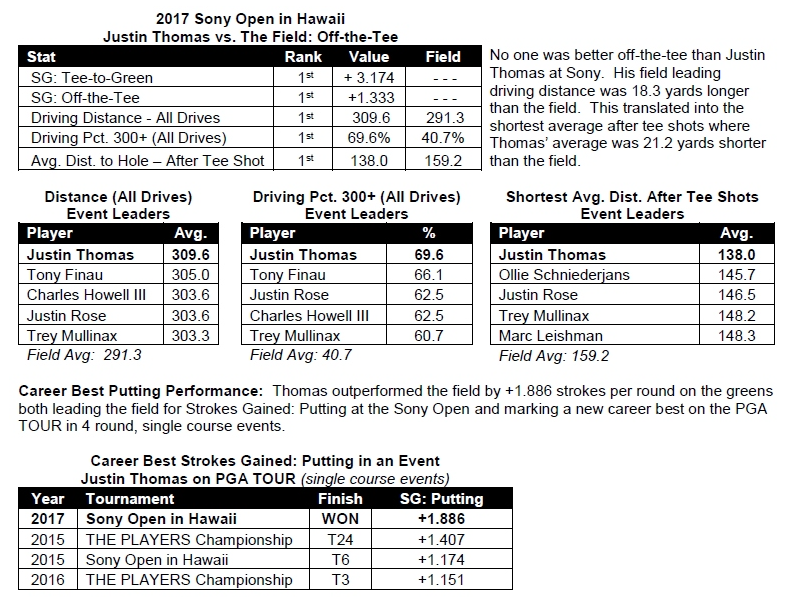
The crack number-crunchers at ShotLink provided these stats from the Sony Open, which show a driving and putting performance that easily explains how the new PGA Tour scoring record occurred.

The divide between Thomas and his next closest competitor in approach distances is a real eye-opener.

Careerbuilder: Mickelson On Creating An Identity

Larry Bohannan talks to Phil Mickelson in advance of his new role as "ambassador" to the Careerbuilder Challenge, formerly known as, well, The Hope.

Mickelson says it's a three-year plan to build the tournament into a more stable and significant event.

"The idea is to create an identity. Our identity is a chance for players to build a foundation for the rest of the year. We want to get a few top players in the field as the year starts.”

As the desert tournament evolved in the 1960s and 1970s, it always had top-name pros from Arnold Palmer to Jack Nicklaus to Gary Player to Johnny Miller to Mickelson himself. Getting at least a few names like that back in the field could help push the CareerBuilder to bigger heights, Mickelson said, and maybe even bring back a little of what the tournament was decades ago.

“If we get a few top players, get some top amateurs and in the future some top celebrities out to the tournament, the tournament will be something fans want to come to,” he said.

It's interesting to see that Mickelson has singled out "top celebrities" given that Commissioner Finchem shifted the event away from celebs just as he did with the Wednesday pro-am here in Los Angeles. Whether Moonbeam was focused on squeezing more revenue out of paying customers over spectator draws, or just a general fan of watching briefcases play golf instead of celebs, I don't know.

Either way, tip of the cap to whoever secured Fitz and The Tantrums for the first Careerbuilder Challenge concert. Can't wait to see the fans free let go of their walkers to dance to The Walker!

Rory's HSBC WD Will Seriously Alter Pre-Masters Plans

Talk about a kickabout to Rory McIlroy's pre-Masters preparation plan.

While his beloved downtime activity of gym time is something Rory McIlroy credits for his ascension, his rib stress fracture was blamed on excessive club testing over the holidays. However, the gym work will be questioned after the almost-World-No.-1-again has WD'd from the HSBC Championship and perhaps other pre-Masters events.

Brian Keogh writes at the Irish Golf Desk:

The Northern Irishman underwent extensive clinical examinations on Monday after picking up the injury in South Africa last week and will now commence rehabilitation and return to golf when he is fully recovered from the stress fracture.

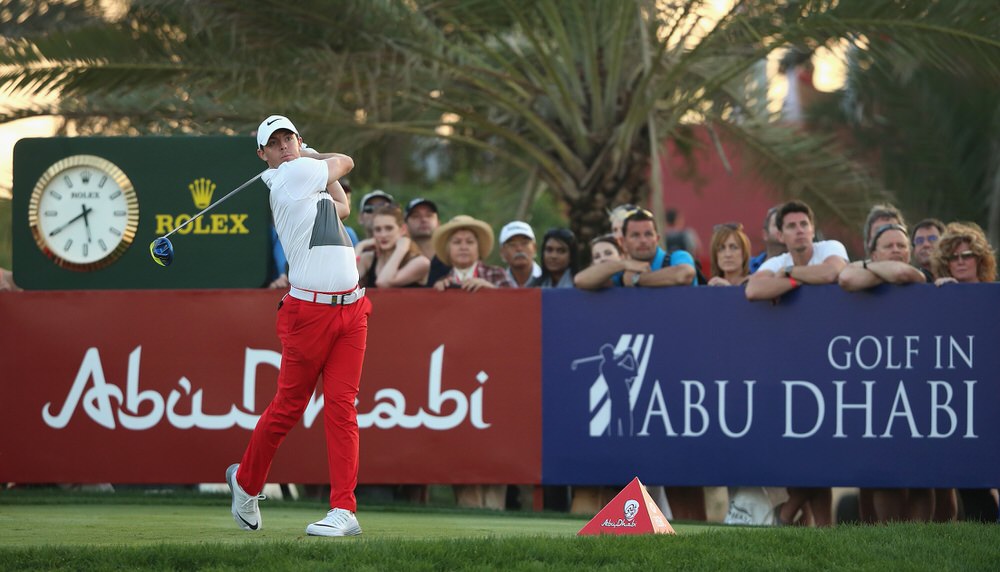
He said: “It’s bitterly disappointing to have to withdraw from the Abu Dhabi HSBC Championship. I think everyone knows how much I love playing this tournament, which is one of the best on the European Tour thanks to the incredible support of HSBC and the Abu Dhabi Sports Council."

Last year, McIlroy discussed the injury-prevention intentions of his workout regimen, which was detailed here by Brian Wacker at PGATour.com, who sat in on the Men's Health cover shoot.

"I think from the start of 2011, the direct correlation between leading a healthier lifestyle and my performance on the course was the same.

"Obviously I'm trying to be strong, but the whole reason I started this is because I was injured."

Obama And Woodmont: Maybe Not The Backlash Suggested

Much was made of the New York Post story on President Barack Obama facing member-backlash should he try to join the mostly-Jewish Woodmont Country Club over his Israel policies, but a few readers who know the club wrote to say they were struggling to see such a widespread membership stance against the president.

Thanks to reader Joe, who sent in this Washington Post story by Bill Turque suggesting hostilities may be the work of just a few members, while others sound more eager to welcome the soon-to-be-former president.

Simon Atlas, a former chair of the club’s admissions committee, said he would be “honored” to have Obama as a member. He added that the club had never applied a political test for acceptance.

“A person’s political affiliation was never a consideration,” said Atlas, former treasurer of the Montgomery County Democratic Central Committee. “We looked at [a person’s] philanthropy, at standing in the community, at reputation. These other things never came up.”

Obama only intends to live in the Washington D.C. area for two years while his youngest daughter finishes high school. His love of the game figures to make his golf preferences in D.C., Chicago and elsewhere (greater Palm Springs?) of great interest.

The White House life and post-presidency talk, and an entire portion of mulligan golf talk, were part of his final 60 Minutes interview with golfer Steve Kroft.

David Owen On Lessons Learned Playing Golf With Trump

Longtime New Yorker staff writer and former Golf Digest contributor David Owen writes about his time playing golf with Donald Trump long before the developer became president-elect.

Given that only one Trump course made the recent Golf Digest top 200 courses (no Bedminster or Doral!), this might explain why panelists do not rate his courses highly:

Golf publications periodically rate golf courses—the hundred best in the world, the hundred best in the country, the dozen best in each state—and Trump’s relationship with such ratings is complex. He complained to me that golf publications never rank his courses high enough, because the people who do the rating hold a grudge against him, but he also said that he never allows raters to play his courses, because they would just get in the way of the members. “I think we’d have a revolt with our membership,” he explained. “Because, unlike other clubs, every one of my membership lists is perfect. And when you start adding hundreds of raters who want to play golf . . .” Nevertheless, when someone from a golf publication does write something positive, after somehow having managed to slip past the perimeter, Trump quotes it endlessly (and, inevitably, magnifies it).

Owen also shares some of the feedback he got from an "upset" Trump after his story appeared.

He called the editor of Golf Digest to complain, and then he called me, on my cell phone. I was in the city on a reporting assignment unrelated to golf, and had the surreal experience of being chewed out by a future President of the United States while standing among the gravestones in the burial ground next to Trinity Church. He wasn’t upset that one of the article’s illustrations had been of a golf ball wearing a turf toupee that looked a lot like his deeply mysterious hair, or that I’d mentioned his asking two little girls at Mar-a-Lago if they wanted to be supermodels when they grew up, or that I’d described nearly tipping him five dollars after momentarily mistaking him for his club’s parking-lot attendant, or that I’d written that he’d introduced one of his club’s members to me not by name but as “the richest guy in Germany.” He was upset that I hadn’t written that he’d shot 71—a very good golf score, one stroke under par.

I hadn’t written that because he hadn’t shot 71. We hadn’t been playing for score, and we had given each other putts and taken other friendly liberties—as golfers inevitably do when they’re just fooling around. I said something to that effect in the politest way I could think of, but he wasn’t mollified. He was also angry that I’d described his wedge game as “poor.” (On several occasions, he’d had trouble with shots inside a hundred yards, both during our round and on the practice range beforehand.) I reminded him that I had mainly written very flattering things about his golf game, and that I’d mentioned his victories in three club championships and had quoted praise from his caddie and his pro (“You have a very nice bicycle, Donald, even if it’s not as nice as your friend’s”). But none of that made any difference. He wanted the number, and the fact that I hadn’t published the number proved that I was just like all the other biased reporters, who, because we’re all part of the anti-Trump media conspiracy, never give him as much credit as he deserves for being awesome. Such is his now familiar habit of acting like a sore loser even when he’s won.

Justin Thomas Breaks PGA Tour 72-Hole Scoring Record

It's one of the biggies not just in golf, but in all of sports and Justin Thomas now holds the PGA Tour's lowest 72-hole scoring record.

Doug Ferguson on Thomas's Sony Open victory that included a 59 and a four day total of, gulp, 253.

Thomas capped off his wonderful week at Waialae that began with a 59 with his second straight victory. He two-putted birdie from 60 feet on the par-5 18th and closed with a 5-under 65 to set the record at 253.
Tommy Armour III shot 254 at the 2003 Texas Open.

"It's been an unbelievable week. Unforgettable," Thomas said before going to sign his historic card.

The final round highlights, in case you were watching something else...