In golf construction art and utility meet; both are absolutely vital; one is utterly ruined without the other. GEORGE THOMAS
It’s back!
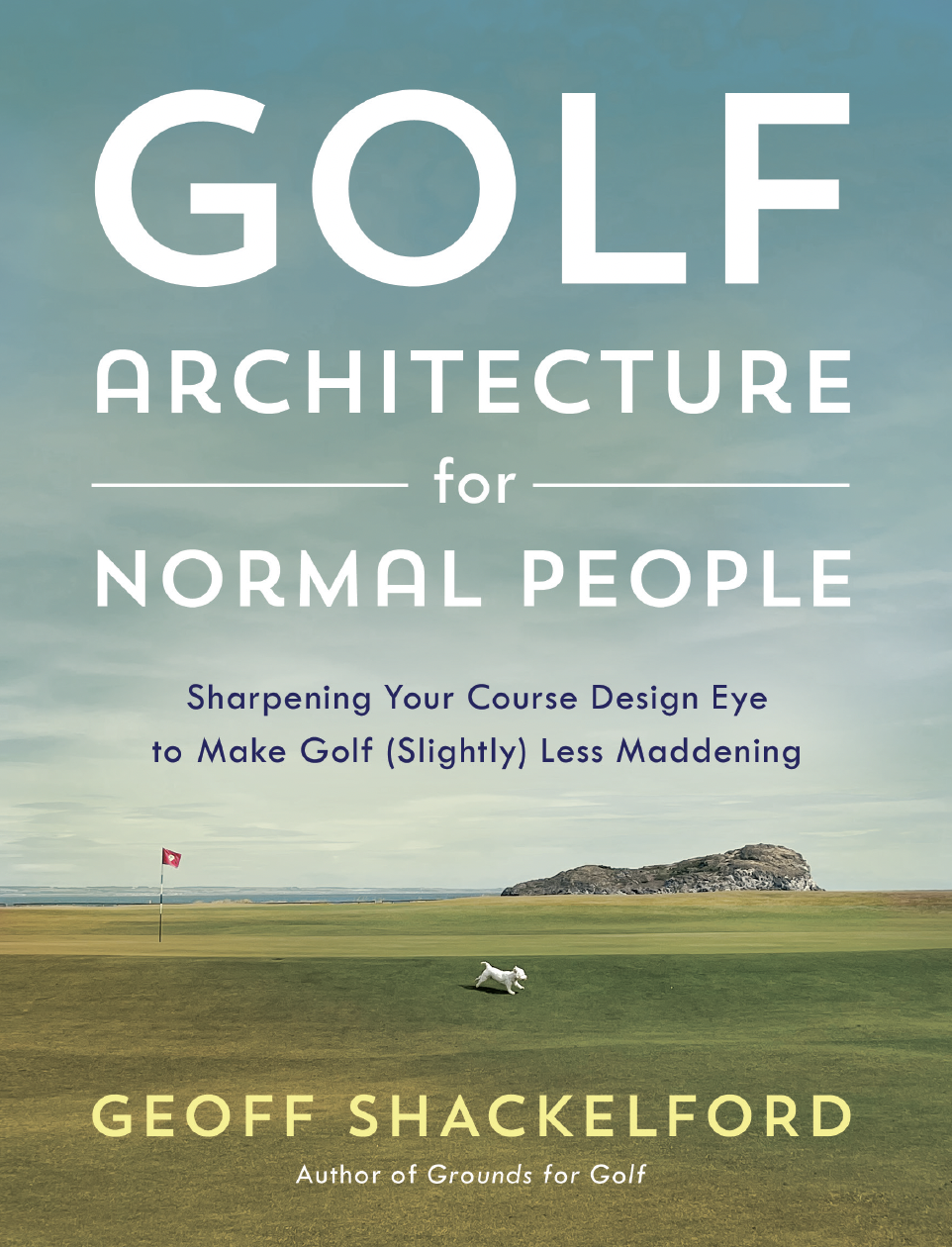
Twenty years later Tatra Press has kindly allowed me to bring back Grounds For Golf now that golf architecture is of more interest to the masses. A new Introduction looks at what’s driven the interest growth and two new chapters I had a blast adding (plus a few edits to keep things up-to-date).
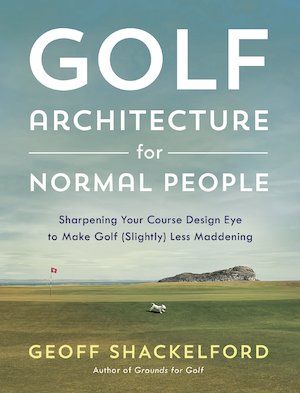
It's been a while since golf, which once received some attention at the New Yorker and no shortage of pages filled by Herbert Warren Wind's writing, has graced a cover.
April, 2011 to be exact and it was a Bruce McCallpiece depictingTiger playing a recovery shot.
“I see that the word ‘duffer’ is defined as ‘a person inexperienced at something, especially at playing golf,’ “ Barry Blitt says, about his cover for the upcoming issue. “That’s the word that comes to mind as I watch President Trump plowing one drive after another through the glass windows of American politics.”
Kirk Bohls reports that Jordan Spieth has entered the design world as a consultant to Roy Bechtol on a par-3 course for UT Golf Club in Austin.
The course will be called The Spieth Lower 40.
“I’m excited about it,” Spieth said. “It’s going to be a cool little par-3 golf course that will be demanding visually but still fair for really solid wedge and short game work. I was definitely very hands on. I looked at the blueprints, the mapping, the scale. It’s cool being part of the design process with Roy because I’m interested in doing that later in life.”
The 4.5 acre course is under construction with a goal to open in September according to coach John Fields.
I've been putting you all to work and really appreciate the feedback. For your efforts, I hope you've been able to enjoy the 20% off offer from Criquet, who surprised us on ShackHouse with a nice offer.
Or from Athlete's Collective, who are giving site readers a great deal (promo code: SHACK) on their Conway 1/4 zips in heather grey and a very Masters-friendly heather green. At $34 a piece they're a bargain, but for $60 in the 2-pack bundle, a true steal.
I believe we have detected a theme in the recent polling: distance in the pro game is very much on your minds.
Michelle Wie's recent resurgence made the first round ANA Inspiration pairing with Lucy Li a lot more fun given a former prodigy was able to enjoy seeing the game's future before her eyes.
Randall Mellat GolfChannel.com with Wie's fun reaction to getting an up-close look at 14-year-old Li.
How does Wie remember reactions to her debut?
“They were just like, `Damn, she's big,” Wie cracked.
Wie is 6 feet tall today, and she was practically that tall when she played her way into the final Sunday pairing with Annika Sorenstam back in 2003.
Li is nearly a foot shorter and petite.
“I was walking behind her on No. 1, and I'm like, `She's really cute,’” Wie said. “No one really called me that when I was 13. `Damn, she tall.’ That's all I got.”
Wie made herself laugh, and that’s what kind of day this pairing was. It was a feel-good match of the veteran and phenom.
Wie posted a 68 and Li a 71 before first round play was suspended.
Thanks to reader LC for this BBC interview with Greg Norman explaining why Rory McIlroy was right to accept President Donald Trump's invitation to play golf. Apparently this was a placeholder discussion as we await Norman's Q3 plans to revolutionize the game.
More mesmerizing is Norman recounting the story he's told many times about not wanting to golf with Bill Clinton, only to have President George Bush set him straight. Norman admits to that round changing his perspective of Clinton and even becoming friends with the former president.
Why that experience didn't stop Norman from suggesting more than once that President Barack Obama was playing a "hefty" amount of golf, is a mystery. Or worse, hinting Obama's supposedly flippant approach to keeping score was the sign of character issues. Or the Shark weighing in on any of this!
Golf has been very fortunate to have players use social media largely for the purposes of highlighting sponsorships, thanking tournaments and sharing little glimpses into the life of a tour pro. The LPGA's players were ahead of the curve and remain so, while PGA Tour players have caught up in some regards.
So while I saw some of the chatter on my feed, it wasn't until G.C. Digitalput together the musings of Grayson Murray, world no. 155, that I realized we have our first Grade A, All-Conference PGA Tour Social Media Point Misser.
Though Murray's vowed to take a leave from Twitter following the hate he received for questioning the world ranking standing of foreign players--even when one made the semi-finals of the WGC Dell Match Play--Murray inexplicably crossed a line I never thought I'd see a player cross: his idea of a jab back at Ben An was to question the path he took to the tour, even though An is exactly 100 places higher on the world ranking list and certainly far more accomplished as the youngest U.S. Amateur winner...ever.
@ByeongHunAn why did you go to Europe when you turned pro? Oh wait you couldn't get through PGA tour school right away....
I'm not a fan of the PGA Tour fining players for merely being ignorant, nor do I support the secrecy of fines. However, Murray's disrespect for his peers and general need for attention certainly warrants a deduction from his PGA Tour account, or however that works. Though given his missed cut streak, there may not be sufficient funds. At least he opened with a nice round in Houston!
In the coming months I'm going to start rolling out "Eye On Design" videos focusing on various design elements in golf that either interest me or need to be reconsidered. While it's not sexy to kick off with the "variable distance" ball topic, we might as well try to wrap our heads around what I anticipate will be a lively debate centered around golf course design.
To set this complicated topic up, here are my thoughts presented in digital video form. I flesh a few more thoughts out to (hopefully) better inform your votes...
For us technophobic, distance RIPer's, things have come a long way over the last decade. Just look at your reaction to the WGC Dell Match Play last week where we saw epic driving distances on fairways playing at a nice, normal firmness.
A consensus of serious golfers see that distance increases for elite players have altered the brilliance and safety of our best-designed courses. This combination of improved technology, blatant outsmarting by manufacturers and a host of other elements like Trackman and instruction, have forced the governing bodies to defend expensive and offensive alterations to works of art.
No other sport pats itself on the back more than golf for upholding its traditions and integrity. Yet no the other sport has sold its soul to protect a relationship between participation and the equipment professionals play. A relationship, which I might add, will continue even after a bifurcation of the rules.
Fast forward 22 years and the amazing synergy of athleticism, fitting, instruction and technology has produced super-human driving distances for decent golfers on up to the best. No other sport on the planet has tolerated such a dramatic change in short time, so should we see 10% taken off the modern driving distance average of an elite golfer--at certain courses and events--the sky will not fall. The players who use such a ball would restore the strategy and intrigue of most golf courses built before 1995. (That was the year, not coincidentally, when things started to change.)
Several solutions that do not fundamentally alter the sport have been offered endlessly. They've also been resisted even as the game has not grown during a technology boom that has seen golfers offered the best made and engineered equipment in the game's history. Solutions such as reducing the size of the driver head for professionals and tournament-specific golf balls have not been welcomed or even tried.
The growing sense that a first step solution is on the way arrived when the USGA’s Mike Davis suggested at the recent Innovation Symposium that a “variable distance” ball could be an alternative for select courses and select social situations.
“We don’t foresee any need to do a mandatory rollback of distance. We just don’t see it. But that’s different than saying if somebody comes to us and says I want an experience that doesn’t take as long or use as much land, can we allow for equipment to do that?”
As we know, the proposed rules of golf re-write emphasizes speeding up the game and everyone knows adding new back tees has never helped on this front. For the first time, elite golfers are suggesting they see the correlation between distance and new tees, but are also tired of walking back to such tees on golf courses where the flow of the round is fundamentally altered.
Beyond the pace and silliness of it all, all indications suggest the USGA and R&A have also developed ways for the handicap system to address a variable distance ball that could be used in select circumstances.
Perhaps it's a club championship and is employed in lieu of extra rough or greens Stimping 13 feet. Or it's an invitational tournament played from tees other than the back. Or maybe there are golf courses experiencing pace of safety issues that will require golfers use such a ball?
On the social side, I expect the case to be made for golfers of different levels playing the same tees thanks to the variable distance ball, Since Davis’s remarks, I have been surprised how many golfers have told me this would make their Saturday foursomes a more cohesive affair, with everyone playing the same tees and the short hitters not frightened by getting fewer shots from a scratch golfer using a shorter flying ball.
Most of all, such a ball on certain courses would return certain skills (hitting a long iron approach?) and end decades of pretending golf does not have an integrity problem.
I point all of this out because Davis’s remarks were no accident. Whether anyone likes it or not, this ball is coming. The variable ball will not be forced, just another way to play the game. The British ball did not break the sport and neither will this option. Because that's all it is, an option. Given that The Masters arrives next week featuring long fairway grain mown toward the tee to prevent roll, I believe the variable distance ball will again be on the minds of all watching.
The Golf Channel's pre-Masters teleconference call included this fromBrandel Chamblee, writes G.C. Digital fresh from a two-week tour of Myrtle Beach's best courses.
G.C. writes:
“If you can believe anything that you read on social media – I know that his coach has been down there, and they’ve been hitting a lot of golf balls down in Palm Beach. The way I understand it, he’s been practicing quite diligently. So it wouldn’t surprise me if Tiger showed up at Augusta National.”
For his part, Montgomerie said that if Woods does show up, he hopes fans don’t see the 14-time major champ bowing out after “77-78 and going home from there.”
In another I'll file under "how far pros have come" in the last five years, it was fun to see Stacy Lewis yearning for firmer, faster conditions and not just declaring today's players superior to their predecessors.
I could do without her love of rough, but two out of three is still amazing.
And it's her reasoning that may be the best part. Randall Mellreports for GolfChannel.com fromMission Hills as the ANA Inspiration is about to begin:
Three of the year’s first tournaments were won with 72-hole record scores. The average winning score this year is 20 under par. The LPGA’s last major, the Evian Championship, was won by In Gee Chun at 21 under, the lowest score by a man or woman in major championship history.
“I definitely think play has gotten better, but I’ve also noticed over the last year and a half that our golf courses have gotten a lot softer,” Lewis said. “Softer golf courses mean you don’t have to think as much. You can be more aggressive and you can go at pins. There’s not as much penalty for a bad shot.
I was hitting some flip wedges today and became pretty impressed with how quickly I got those Mack Daddy's airborne off a mat.
Then I saw the latest from our old trick-shot artiste friend Mathias Schjoelberg and I realized, uh, some people just have gifted (and absurdly strong) hands.
Here's a new variation on a shot he's perfected in other ways from his knees and off a mat. But this one is off grass and he's standing, calling it the "backflop". Mind blown!
But as someone who has followed the issue from the day the USGA mysteriously started advocating for another costly device, I've always been a bit amazed at the lack of statistical backing for these devices as pace enhancers. So again, we must have good players kindly explain how the devices are essentially a backup tool to them in real championship conditions. Or when they blow one into the next fairway.
Will Graysurveyed players at the Shell Houston Open and only Bryson DeChambeau saw a pace of play improvement by introducing rangefinders. The rest, including Jon Rahm, don't see any change coming. There was this from Justin Rose:
“I don’t think it’s going to make any difference to speed of play,” Rose said. “We don’t play ‘one number’ golf. We want to know what it is to the back edge of the green; we want to know the distance over a bunker. We want to know what the distance is to a certain slope.
“So it’s not as basic as, ‘I have 179 to the pin.’ You kind of make decisions out on the golf course based on what’s around the pin.”
Rose’s sentiment was echoed by multiple other players, who added that the utility of rangefinders will hinge on how players choose to use them.
I'm happy to wait out the experiment, but unless the PGA Tour is willing to subsidize the cost for juniors, advocating these devices means they will encourage young and aspiring golfers to believe they need such pricey devices. And just like that, the entry barrier to golf that any sane individual says we must break down, become $300 more expensive.
I mean, that's money they could use to subscribe to PGA Tour Live! For seven years!
Getting the yardage is maybe the 11th most time-consuming thing that slow players do slowly. IMO this once again focuses on wrong things. https://t.co/cKTvNRBUT5
Thanks to reader PG via Golfweek's Marty Kaufman in spotting the Portstewart aerial teaser below.
The Irish Open is played there in July with a $7 million purse as part of the European Tour's new Rolex Series and Rory McIlroy hosts, as this teaser piece by BBC Sport explains (with help from tournament director Michael Moss).
But getting to a brief teaser Portstewart from above is a nice treat, as is the reminder that we have a full links golf season this summer to look forward to:
The good news? The PGA Tour is using the Web.com Tour to experiment with something new. The reluctance to do so has always been a surprise at how little this tour, the other satellite tours or the Champions Tour are not used to test formats or rule changes.
Allowing the use of rangefinders on such a stage will, once and for all, allow us to see if they speed up play on the professional level and how they "look" to a television audience. I suspect, as we've seen with other elite golf where players use rangefinders as a way to double check what they learn via traditional yardage books, that play will not speed up.
There will also be the dreadful optics of watching someone looking through a device, which is about as fun as watching people test virtual reality devices. Perhaps the rule will allow caddies to use them but not players?
But now we'll have data and visuals so that we can remember how rangefinders really only help when a player hits their tee shot into the other fairway.
For Immediate Release:
PONTE VEDRA BEACH, Fla. (March 28, 2017) – The PGA TOUR has announced that it will begin testing the use of distance measuring devices during competition at select tournaments this year on the Web.com Tour, Mackenzie Tour-PGA TOUR Canada and PGA TOUR Latinoamérica.
Each of the three Tours will allow use of the devices by players and caddies at four consecutive tournaments, including Monday qualifiers. For these events, the PGA TOUR will temporarily enact a Local Rule in accordance with Decision 14-3/0.5 of The R&A/USGA Rules of Golf, which stipulates the device can be used to measure distance only (use of functions to measure slope, elevation or wind will not be allowed).
The Web.com Tour tournaments are: the BMW Charity Pro Am presented by SYNNEX Corporation, May 15-21 in Greenville, S.C.; the Rex Hospital Open, May 29-June 4 in Raleigh, N.C.; the Rust-Oleum Championship, June 5-11 in Ivanhoe, Ill.; and the Air Capital Classic, June 12-18 in Wichita, Kan.
PGA TOUR Latinoamérica will do its testing at the last four tournaments of the schedule’s first segment: the Essential Costa Rica Classic, April 20-23; the Quito Open, June 1-4 in Ecuador; the Puerto Plata DR Open, June 8-11 in the Dominican Republic; and the Jamaica Classic, June 15-18.
The Mackenzie Tour-PGA TOUR Canada will test at: the GolfBC Championship, June 15-18 in Kelowna, British Columbia; the Players Cup, July 6 - 9 in Winnipeg, Manitoba; the Staal Foundation Open presented by Tbaytel, July 13 - 16 in Thunder Bay, Ontario; and the Mackenzie Investments Open presented by Jaguar Laval, July 20 - 23 in Mirabel, Quebec.
“For years there has been significant discussion and debate about whether distance measuring devices would have a positive or negative impact on competition at the highest levels of professional golf,” said Andy Pazder, Chief Tournaments and Competitions Officer of the PGA TOUR. “The only way we can accurately assess their impact is to conduct an actual test during official competition on one or more of our Tours. We look forward to seeing how these tests go and carefully evaluating the use of the devices over those weeks. Our evaluation will consider the impact on pace of play, optics and any other effects they might have on the competition."
Once the test and comprehensive evaluation is completed, the PGA TOUR will share the results with its Player Advisory Council on all of its Tours for additional review and discussion.
Geoff Shackelford
Geoff Shackelford is a Senior Writer for Golfweek magazine, a weekly contributor to Golf Channel's Morning Drive, is co-host of The Ringer's ShackHouse is the author of eleven books.


 April, 2011 to be exact and it was a Bruce McCall piece depicting Tiger playing a recovery shot.