
"The last time something this popular was banned it was called prohibition and that didn't go over so well."
/Brandel Chamblee's first of multiple passionate cases for bifurcation in the post anchoring ban announcement.
Read More
It’s back!
Twenty years later Tatra Press has kindly allowed me to bring back Grounds For Golf now that golf architecture is of more interest to the masses. A new Introduction looks at what’s driven the interest growth and two new chapters I had a blast adding (plus a few edits to keep things up-to-date).
The Amazon purchase page for the book arriving June 15, 2026.

 Some poor lad named Nate Schweber got the call from a golf savvy NY Times editor: justify our superfluous A1 story on Charlie Beljan's "panic attack" by finding more golfers suffering from an untold epidemic that has been quietly dooming the game.
So Schweber headed to Van Cortlandt Park where, of course, no one had read the story in spite of its A1 placement.
Mateo’s tale of an anxiety attack on the golf course was one of several that were heard during a random stop at the course in Van Cortlandt Park. None of the golfers interviewed had read about the PGA Tour player Charlie Beljan, who had had a panic attack last week, only to forge ahead to his first career victory.
But the golfers in the Bronx did not need much prompting. Told the details of Beljan’s harrowing experience, they shook their heads in recognition.
What the NY Times actually uncovered were stories of folks needing my drug of choice, Prilosec.
William Larkin, 44, the general manager of the golf course in Van Cortlandt Park, said he had an anxiety attack trying to qualify for a golf tournament in Westchester County about 15 years ago and had to be taken to a hospital.
“I was getting winded going up small hills, my mouth was dry, my left arm got stiff,” he said. “I started thinking I was having a heart attack, which made everything worse.”
He said he spent two days in the hospital having tests. His symptoms had been found to be psychosomatic except for one. His worry had caused his stomach to produce higher-than-normal quantities of acids, which rose up and caused his left arm to stiffen.
“I’ll never forget that day,” he said.
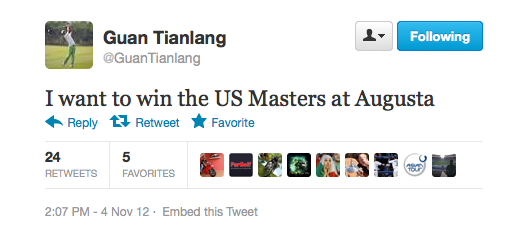
That's the question Steve Elkington posed on Twitter and after reading your many observations on the original post about Tianlang Guan's stunning Asia Pacific Amateur win, I think it's a question worth pondering.
And not to take away from Guan's stellar play or that of the kids (Zhang, Hossler) who contended at this year's U.S. Open, but maybe the broader questions should be: what is allowing people to play the game so much better at a younger age and is that a good thing?
Either way, Guan is setting lofty goals for himself!
 **Steve Elkington adds this cartoon to memoralize the historic moment.
From an unbylined AP story quoting Webb Simpson at the Grand Slam of Golf, and while the language wasn't perfect, he seems to be suggesting that banning anchoring of the putter will be more problematic if it's the USGA doing the banning instead of the PGA Tour. Not that Commissioner No-Controversy would ever do something to protect the game.
"If the USGA bans it, I think it's going to be a whole other ballgame if the PGA Tour bans it," Simpson said.
"It's going to be tough if they do ban it. It's going to be tough for a lot of people. Not players, I think it's going to be tough for the committees to really have their stance on it. If you look at the facts, last year there was no one in the top 20 of strokes gained category that anchored a putter."
"So the argument of, 'It's an advantage', you have to throw that out there," he said. "There's a bunch of arguments going around but I haven't heard a good one yet."
 And he continued to point out a bigger change in the game and he continues to be correct.
"We all know that the R&A and USGA love to keep golf as original as possible," he said. "But I think with the changes in the grooves, the golf balls, the drivers — you've got a little persimmon head 20 years ago the size of a fist, and now a titanium head 460 cc. In 1980, the long drive guy was hitting it 285, and now if you hit it 285, you're one of the shortest guys on the Tour. To me, it's a bigger change to go from that size head to what we play now than the putter."
We knew from previous reports that there were only a handful of golf courses under construction and now Laredo's new public course by Robert Trent Jones Jr. is opening this week. Thanks reader Scott for the reminder. PGA.com's John Holmes has the news of the first noteworthy course opening in a while, which even PGA.com noted is a bit of a stop-the-press moment.
The Max A. Mandel Municipal Golf Course – already nicknamed "the Max" -- is the first city-owned golf facility in Laredo, as well as one of only a handful of new courses to open in the United States this year.
Designed by Robert Trent Jones II Golf Course Architects, the par-72 layout is routed along bluffs overlooking the Rio Grande and winds through 270 acres of sandy terrain. Encompassing almost a mile of riverfront property, the course presents four holes that play adjacent to and high above the water as it traverses deep arroyos and navigates through 30-foot tall mesquite woodlands and open farmland.
With five sets of tees and wide, inviting fairways throughout, the course can be configured as a tournament test of more than 7,200 yards, yet is still a perfect fit for golfers who desire a more manageable challenge of less than 5,000 yards.
Yada, yada, yada... more importantly:
Green fees for Laredo residents range from $33.50 to $46, while non-residents – including the flocks of snowbirds who winter in south Texas – will pay between $46 and $56. There are also discount rates for seniors and juniors.
The International Golf Federation that spearheaded golf's return to the Olympics is broadening its scope by issuing a statement today announcing sustainability as its "core priority." You can read the statement in PDF form here.
"The future will present many challenged but the IGF and its member organizations are working to ensure that many more generations will enjoy golf and the facilities on which it is played."
A couple of screen grabs of the fine print:
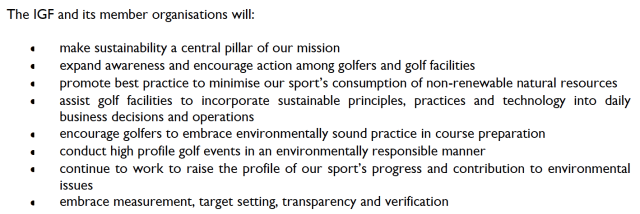
We were doing so well until the last jargon dump of an item. Go on...
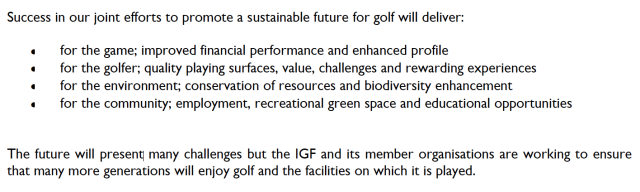
It's pretty exciting to read this kind of focus on the future and desire to shrink the footprint of golf courses. But this is all utter nonsense if the distance the ball travels is not reduced via some form of regulation. Otherwise, the game will continue to spend money on new tees, more rough, faster greens and bigger properties.
**There was also apparently a USGA press release on this but I didn't get it. Cybergolf thankfully posted it.
The pertinent quotes...
"Sustainable management practices are critically important to the future of the game and need to be encouraged throughout the world," said USGA President Glen D. Nager.
"Here in the United States, sustainability principles have been embraced by the golf community for some time, but we can still do even more, especially in promoting solutions-based planning and management strategies. "Environmental and economic sustainability are central to the USGA's mission and are primary components of our long-term commitment to the game," Nager continued. "We have invested significant time and resources over many years to ensure that we are basing decisions and recommendations on sound scientific and economic principles that will foster the future health of the game."
"The future ramifications of a more proactive approach to sustainability will be far-reaching," said USGA Executive Director Mike Davis. "From the golf course operator who can more effectively allocate his maintenance budget, to the player who benefits from firm course conditions, every part of the game can benefit from this global industry-wide commitment."
Geoff Shackelford is a Senior Writer for Golfweek magazine, a weekly contributor to Golf Channel's Morning








Copyright © 2022, Geoff Shackelford. All rights reserved.

