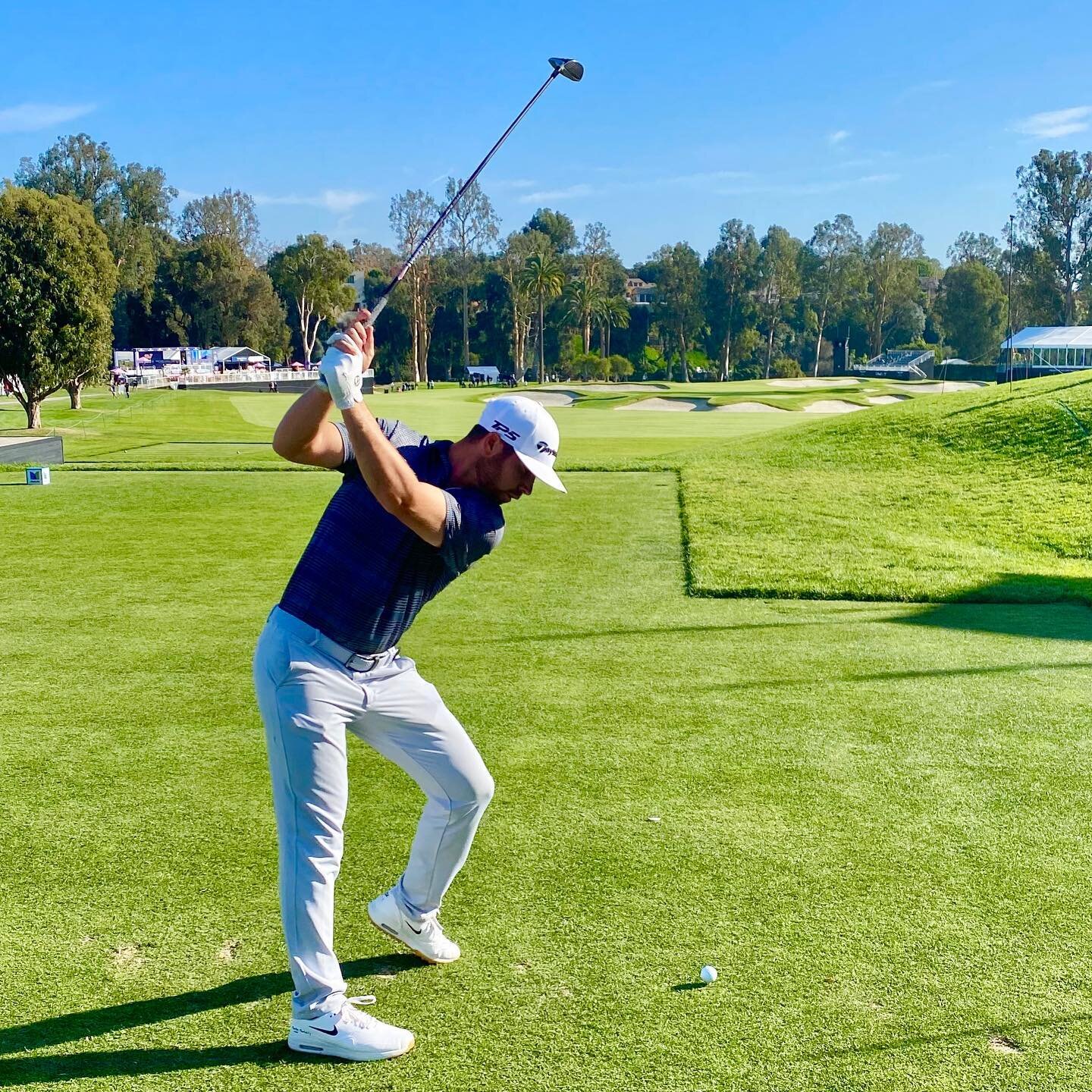

Would a worthy challenger please step up?

Steve Elling pens an entertaining look at the possibility of anyone challenging Tiger, highlighted by this exchange:

Players talked openly about the vexing drought of younger players capable of cracking Woods' dominance because there is no successor in sight. Is anybody going to punch Woods in the beak and give him a run for his money?

"I'd love to," said Aussie Adam Scott, 26, who has frequently struggled at the majors. "That's what I'm out here for. If I could control the anxiety and nerves - somebody has to step up and do it."

Rule out the older guard. It looks as if Ernie Els, Vijay Singh and several other veterans have taken their best shot and mostly missed. Woods, 30, seems poised to rule the sport yet again, having won four of the past eight majors.

"We need guys in their mid-20s and early 30s to step up," said Chris DiMarco, 37, laughing. "I'm too old. I have three kids. I'll keep trying, but somebody else needs to try."

Scott theorized that some young American players are more infatuated with earning paychecks than with becoming the best, a theory that was not universally endorsed.

"How many has he won lately?" DiMarco said tersely.


PGA Numbers

Some of you might interested in this press release from TNT, which shares quite a bit of information about their web traffic during last week's PGA. I'm sparing you the quotes about platforming.

PGA.com, with help from TNT and the PGA of America, and a promotional push from Time Warner family members CNN, SI.com and AOL (America Online), recorded a significant 18 percent boost in total page views during the four days of tournament coverage over the previous year (2006: 49,776,993; 2005: 42,220,173), setting a single-day traffic record of more than 16 million page views (16,207,181) for Friday’s second round coverage. The tournament also brought over two million unique users (2,052,205) to the site from Thursday through Sunday. PGA.com Pipeline registered nearly one million video streams (968,478) from Thursday’s launch until the tournament’s conclusion on Sunday.

TNT also enjoyed success for its broadcast coverage, seeing a four percent increase for its 18 hours of coverage (Thursday and Friday 2 - 8 pm ET; Saturday and Sunday 11 am – 2 pm). The network averaging a 1.5 US rating for its four days of coverage, versus 1.4 in 2005, and also enjoyed a four percent growth in home delivery (2006: 1,676,000; 2005: 1,604,000). TNT also saw an increase in key demos with Persons 25-54 up six percent (2006: 694,000;  2005:657,000) and Men 25-54 up eight percent (2006: 507,000;  2005: 471,000), respectively. 

Tiger Likes Low Number Majors

rankandfile3.gifBrett Avery's PGA Championship stat package is now posted online at GolfDigest.com.

He offers an interesting chart on Tiger's major wins.

The gist?

All but two of Tiger's major wins has come at events where the average scoring could be called "low."

Avery writes:

From the 1999 PGA to last week's 2006 PGA at Medinah No. 3, Tiger Woods has won an incredible 11 of 29 major titles. During that span Woods served as a catalyst for distance increases that prompted the transformation of most host courses. While he won last week on the longest course in majors history, it resulted in yet another victory in a championship with a relatively low scoring average in relation to par. Woods has one the five "easiest" majors since the 1999 PGA, including last week (72.635 average or 0.635 over par). 

Staring at the chart, it's hard not to notice that of the majors at the high scoring majors not won by Tiger, each was marked by course setups ranging from way too narrow (Winged Foot, Oak Hill) to borderline goofy (Royal St. George's, Pinehurst, Southern Hills) to completely over the top (Shinnecock Hills).

When you think of the worst setups of the last 7 years, elements of each of the aforementioned come to mind. 

Reilly: "the single worst squad we've ever taken to a Ryder Cup"

Rick Reilly in this week's Sports Illustrated:

Have you seen the U.S. team? It has all the intimidation power of the Liechtenstein navy. It would have a hard time beating the Winnetka Country Club ladies' B team. It's the single worst squad we've ever taken to a Ryder Cup, and that's saying something, considering the last batch got pummeled 181Ú2-91Ú2.

"We'll definitely be the underdog," Phil Mickelson says. "You lose four of the last five Cups, you're the underdog."

This outfit would be the underdog to a stiff breeze. Or do Brett Wetterich, Zach Johnson, J.J. Henry and Vaughn Taylor make your timbers shiver? It sounds like somebody's Webelos troop. None of those four have ever played in a Ryder Cup before. Three of them missed the cut at last week's PGA, and Henry finished 41st.

Wetterich has missed five cuts in his last eight starts. You look at him and think, Was he my waiter at Olive Garden last night? If he wasn't, he will be soon.

Won't Tiger be psyched to be paired with him?

That's the other thing: Tiger. He's the No. 1 player in the world by a light year, the Golfing Gladiator. Until he goes to Ryder Cups, and then he suddenly becomes Dead Man Walking.

He mopes around like a husband in couples therapy, only he talks to his partner less. It may the only thing he sucks at. His Ryder record is 7-11-2, and no wonder. He wasn't wired for team play. He trusts nobody. Why should he buddy up with people he's been trained to swallow in two bites or less? The hangman doesn't play on the prison softball team. Lions don't room with lambs.

Michael Bamberger says this team resembles a European squad from a few years ago...back when they were huge underdogs. And just in case you don't think you could pick J.J. Henry out of a lineup, SI.com features photos of the team members.

Turning Stone To Host Event

The news that upstate New York's Turning Stone--the last minute fill-in site for B.C. Open host En-Joie--has to raise some concerns about the post-FedEx Cup portion of next year's schedule.

After all, it's August and the schedule is still unsettled.

Also, the PGA Tour is creating another new event at a course that fell into its lap after the successful PGA Club Pro Championship. Meaning that this has come together in a very short amount of time.

So, why is it that several long time events are going and being replaced by new events? (Is this being done because the PGA Tour wants only events structured a certain way)?

And is the unsettled "Fall Finish" situation the reason that the FedEx Cup "playoffs" feature 144 players, instead of a more plausible number like 100 or 70?   

Harmon: "I was appalled by what I saw with Brett Wetterich"

I suppose Wetterich won't be signing up for a series after these remarks from Butch Harmon at the PGA.

Harmon told Sky Sports he was "appalled" by what he saw on day two at the 9th hole at last week's PGA Championship where Wetterich, destined to miss the cut by nine shots after shooting a 2nd-round 77, took four shots to get out of some greenside rough.

Harmon says he was infuriated by Wetterich's attitude.

"I was appalled by what I saw with Brett Wetterich," he told Sky Sports.

"That wasn't even his 36th hole or the last hole of the round, that was his ninth hole of the round and he literally gave up, he just walked along and made a few casual swings.

He just walks up, makes a pass at it, completely whiffs it, then he chunks it, now he just hits it again."

Harmon's comment was made shortly before US captain Tom Lehman finalised the team at the weekend when he named Stewart Cink and Scott Verplank as his two wild card picks.

"This isn't the kind of guy you want on your Ryder Cup team," Harmon said of Wetterich.

Well now we know what break the ice between Wetterich and Tiger: a good Butch Harmon ripfest!  

Nicklaus: "If the USGA is unable to make an effort to move the ball back, then we need to do something on our own"

The Columbus Dispatch's Bob Baptist pens an extensive story on the Ohio Golf Assocation ball that is being used today and tomorrow at Springfield's Windy Knoll. Thanks to reader Tom for the head's up.

Plenty of interesting quotes here, starting with Jim Popa of the OGA:

"The PGA Tour stats will tell you that in the last 25 years, (average) driving distance has increased 30-some yards," Popa said. "The (United States Golf Association) says new equipment has only added 20 yards. They say there’s only 5 yards’ difference between (drives produced by swings speeds of) 110 and 125.

"We know that’s not true. The faster you swing at the new balls, the farther they will fly, and it’s not 5 or 10 yards (farther), it’s 100 yards, 125 yards. That’s what we’re battling. That’s what we think is ruining the game, or going to ruin the game."

Love this line from Baptist, which of course, the USGA will love.

The two most influential governors of tournament golf in the United States, the USGA and PGA Tour, have historically declined to hold the line on technological advances in equipment for fear of being sued by manufacturers. Instead, they have lengthened many of the courses on which their tournaments are played.

And now for Jack's lastest comments:

"I am happy to see that someone is taking the bull by the horns and is saying, ‘Hey, our golf courses cannot handle this golf ball,’ " Nicklaus said in an e-mail interview. "If the USGA is unable to make an effort to move the ball back, then we need to do something on our own."

Alan Fadel, chair of the OGA's ball committee:

If distance is not reined in, Fadel envisions dire consequences for the game: everhigher costs to build bigger courses or expand existing ones, and a lack of incentive to play for youngsters who aren’t as big and don’t hit the ball as far as others their age.

"I feel for the kid who’s 15 playing high school golf who hasn’t had his growth spurt yet," Fadel said. "A couple of them were (Tom) Watson and (Ben) Crenshaw, two of the best players who ever played the game. That guy is not going to have the opportunity in the future."

One of those kids was Mark Brooks, who was one of the top players on the PGA Tour in the late 1980s and early ’90s despite standing only 5 feet 10 and weighing 150 pounds. He won the 1996 PGA Championship and lost a playoff to Retief Goosen in the 2001 U.S. Open.

Brooks says the distance specifications of modern balls could remain the same if only manufacturers were forced to return the balls’ spin rates to what they were 10 or 12 years ago. If that were the case, the harder and higher a ball was mis-hit, the farther off line it would hook or slice, Brooks said, and "I think the guys would self-throttle" to protect against that happening.

"If direction and trajectory aren’t brought back in as highly integral parts of playing this game, then (the game) changes. And for the better? No," Brooks said.

"You end up with a very stereotypical type of golfer who will be big, tall and have a 120 mphplus club-head speed. Or, if he’s little, he’ll be a freak, someone like an Ian Woosnam, who is small but can pound it."

Looks like Mark Brooks will be added to The List.

Popa and Fadel said the OGA’s experiment is being watched with interest by not only other amateur golf associations but the very bodies that have resisted action to this point. Popa said he has discussed it with representatives of the USGA and Augusta National.

"Most changes in golf come from the amateur sector, and most from the grass roots. They don’t come from the PGA Tour; they’ve got a product they have to sell," Popa said.

He recalled the criticism of the OGA in 1994 when the Ohio Amateur was the first tournament in golf to require all participants to wear turf-friendly, non-metal spikes. Ten years later, 99 percent of courses in the United States had banned metal spikes and only 30 percent of tour pros were wearing them, according to a 2004 article in Golf World magazine.

"We stuck by our guns on that and it turned out pretty good," Popa said.

"I have the same feeling for this. I think it’s time a tournament ball be identified. It’s probably going to be best for the game in the long run to have a standard ball.

"What we hope to show is that we’ve given everybody the same ball and they’ve all been able to play the ball successfully and they come off (the course) and say, ‘I can do everything with this ball I can do with my own ball.’ "

Low Scores A Wake Up Call?

Readers of the Future of Golf or this site know that I'm not a fan of gauging a tournament's success based on the winning score when so many elements are in play (weather, conditioning, etc...).

And it's particularly annoying when the course setup is so obviously being used to create a "respectable" final tally, whatever that is.

However, the record scoring at Medinah and the 60 fired Monday at the U.S. Amateur are bound to turn some heads.

Or at least quiet those who have declared that scoring hasn't changed, so all is well in the world of golf.

So will action on the distance issue only come about because of record low scoring?  

I guess it's wishful thinking on my part that people would wake up based on the costly impact on the everyday game or the death of strategic architecture or the emerging drug issues. Maybe low scoring will shame the governing bodies and Tours into action. 


Donegan On The U.S. Team

Lawrence Donegan in Tuesday's Guardian, writing about Tiger and Phil's absence for next week's U.S. practice rounds at K Club:

As an exercise in preparing his squad for what lies ahead, the trip could not be faulted but as a statement of American team unity it had a fatal flaw: his two best players will not be there.

And...

Lehman said he hoped the Irish public would be allowed into the K Club to watch his team's practice sessions - another savvy public relations move on his part - although it did raise the question of how many would take him up on the kind offer, especially as his squad contains four players whom most casual fans would be hard pressed to pick out of a Garda Siochana line-up.

"These guys all deserve to be here. They all played themselves on to the team and I am extremely happy that they did," the US captain said when asked about the presence of the Ryder Cup rookies JJ Henry, Vaughn Taylor, Brett Wetterich and Zach Johnson.

Nor is there likely to be a rush at Dublin airport to get the autographs of Stewart Cink and Scott Verplank, the two players chosen by Lehman as his captain's picks. "Stewart has played steady golf throughout his career. He hits the ball great, is a strong putter and a great chipper of the ball," he said of Cink.


Another Scoring Record Falls

billyhome.jpgFrom ESPN:

Florida sophomore Billy Horschel shot a USGA-championship record 11-under-par 60 Monday to take the first round lead in the U.S. Amateur stroke play qualifying at the Chaska Town Course.

Horschel fired his round at the 6,753 yard, par 71 Arthur Hills 1997 design.

He breaks the USGA championship record by two strokes.

For more on the Am, USAmateur.org has some great coverage.

Woods Win and Low Scoring=Great Ratings

According to AP:
Tiger Woods' victory at the PGA Championship helped the TV ratings increase 22 percent from last year.

CBS' final-round coverage Sunday drew an average overnight household rating of 7.2 with a 16 share. That's up from last year's 5.9 rating with a 13 share for Phil Mickelson's victory. This year's rating was the highest for the final round since 2002, when Rich Beem's one-shot victory over Woods earned an 8.0 with a 17 share.

That's quite a contrast to the U.S. Open, which saw its worst ratings in 12 years. The USGA will blame Tiger, but the buzz at Medinah brought on by birdies had to help too.

2006 PGA Tour Driving Distance Watch, Week 33

pgatour.jpgThe PGA Tour driving distance average jumped from 289.0 yards to 289.1 yards after the PGA Championship.

Tiger Woods jumped from 304.1 to 305.5 after finishing second in driving distance at the PGA. 

Sal Johnson notes, "even though he only hit the driver about 25% of the time on 14 driving holes, he was 2nd in driving distance average at 318 yards."