
In golf construction art and utility meet; both are absolutely vital; one is utterly ruined without the other. GEORGE THOMAS
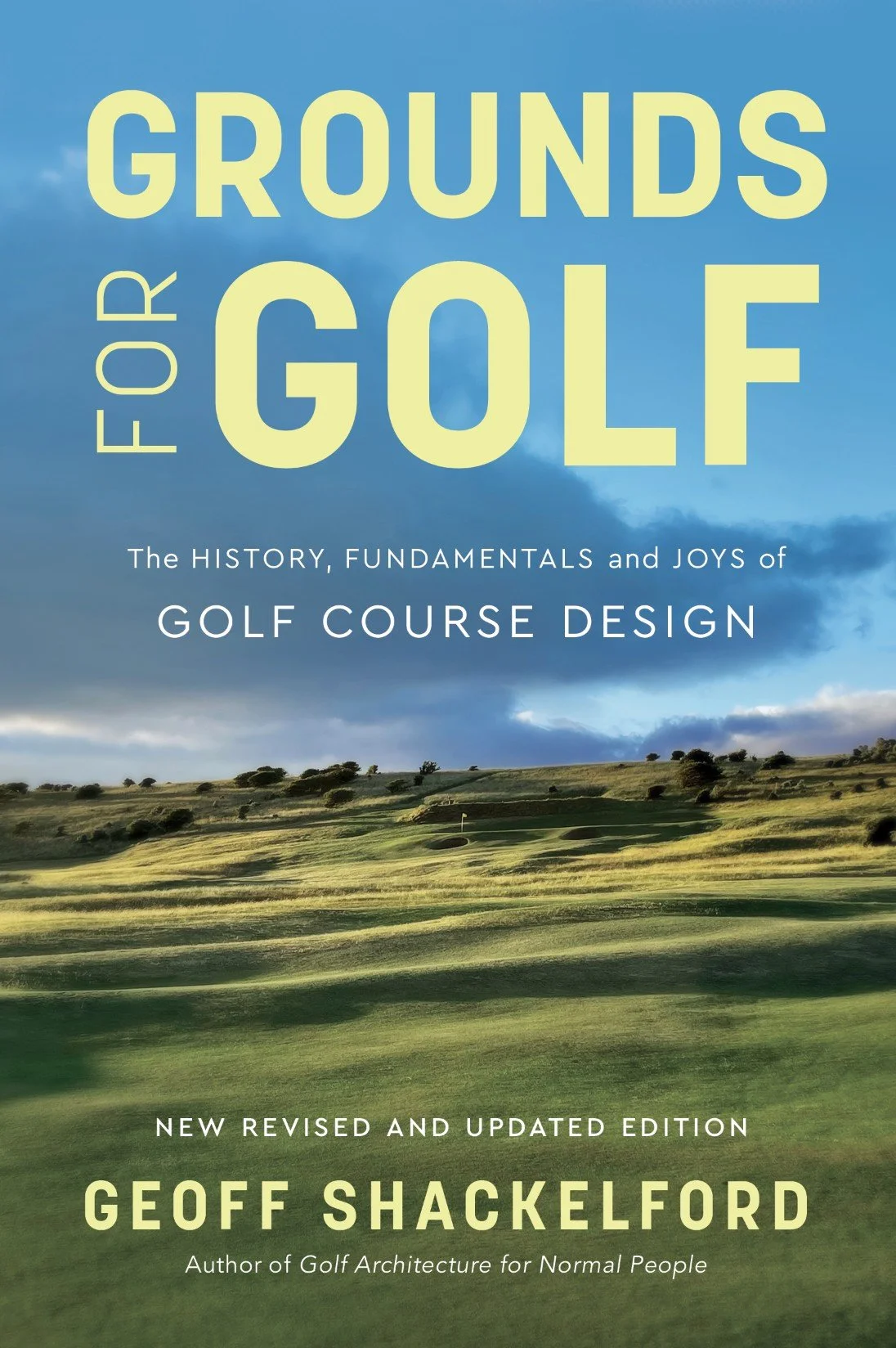
It’s back!
Twenty years later Tatra Press has kindly allowed me to bring back Grounds For Golf now that golf architecture is of more interest to the masses. A new Introduction looks at what’s driven the interest growth and two new chapters I had a blast adding (plus a few edits to keep things up-to-date).
The Amazon purchase page for the book arriving June 15, 2026.


"What was that all about?"
/Thanks to Jay Busbee at Yahoo for noticing a post at The Golf Watch about J.B. Holmes taking a rain check on shaking Jack's hand following his final round 77.
I knew I shouldn't have deleted the telecast before watching it!
IBF Replaces Clampett; TNT Press Releases Will Never Be The Same
/They're surely rejoicing in the TNT PR department at the news that they'll never have to put together press releases compiling the best of Bobby Clampett (for samples, go here, here, here and here).
Former British Open Champion Ian Baker-Finch Joins TNT PGA Championship and British Open Championship Coverage
1991 British Open Champion returns to Birkdale for network’s coverage
Turner Network Television (TNT) announced today a multi-year agreement with former British Open champion Ian Baker-Finch to join the network as an analyst for its coverage of professional golf, including the British Open, PGA Championship, PGA Grand Slam of Golf and President’s Cup. Baker-Finch will join the TNT golf stable of Emmy® award winning host Ernie Johnson, analyst/course reporter Bill Kratzert and course reporter/essayist Jim Huber for the network’s golf events including the two majors, British Open Championship, PGA Championship and PGA Grand Slam of Golf. Baker-Finch will continue to serve as an analyst for CBS Sports' golf coverage."I am excited to be joining the TNT golf team for such high quality events as the PGA and Open Championships, President's Cup and the PGA Grand Slam of Golf," said Baker-Finch. "I look forward to working with Ernie Johnson, Bill Kratzert and Jim Huber as well at some of golf's premier events this year and hope our coverage will help bring the viewers a little closer inside the ropes."
“Ian’s personality, experience and knowledge of the game will be tremendous assets to the TNT golf telecasts and the fans at home,” said Jeff Behnke, executive producer, Turner Sports. “We are pleased to welcome Ian to the Turner Sports family and look forward to televising another year of dramatic golf events.”
Baker-Finch’s crowning achievement was winning the 1991 British Open at Royal Birkdale, site of this year’s British Open Championship. He turned pro in 1979 and won the first of his 16 championships in 1983 at the New Zealand Open in Auckland. His first major victory in Australia came at the 1987 Australian Matchplay Championship at Kingston Heath. Among his credits, he has won on all four major tours, U.S. Tour, European, Japan and Australasian Tours, including the 1988 Australian Masters, the 1989 Colonial Invitational (USA) and the 1993 Australian PGA.
TNT holds the top spot in airing more hours of major championship golf than any other television network airing 63-plus hours of British Open (July 17 – 20), PGA Championship (August 7 – 10) and the PGA Grand Slam of Golf (October 14 – 16) coverage, along with the President’s Cup in non-Ryder Cup years. The network earned an Emmy® in the Outstanding Live Sports Special category for its coverage of the British Open in 2005, which included Jack Nicklaus’ farewell to major championship golf from the Old Course at St. Andrews in Scotland.
"Semel's clamoring for a platform so he can get back into the spotlight"
/Peter Lauria in the New York Post says that former Yahoo CEO Terry Semel is trying to put together a bid for IMG. Thanks to reader John for this.
One of these sources said Semel recently sat down with Forstmann and his bankers at Goldman Sachs, who have been working with IMG on various initiatives since last summer, to gauge their interest.You know when I think of IMG, those are the two names I associate alongside Tiger's.
Earlier this year, Semel and a few Yahoo! defectors launched Windsor Media Capital with what one source described as "significant financial support from large investors."
Sources said Semel thinks he can transform IMG - which has a sports, entertainment, and media division and serves clients Tiger Woods, Gisele Bundchen and "The View" co-host Elisabeth Hasselbeck - into a media and content company and also bolster its digital operation.
For Semel, the pursuit of IMG could help repair a reputation that tarnished during his years as Yahoo! CEO. Indeed, many Yahoo! insiders quietly blame Semel for making the Web giant vulnerable to Microsoft's current takeover attempts.
"Semel's clamoring for a platform so he can get back into the spotlight," said one source, referring to his low profile since he left Yahoo! last year.
Aren't we all clamoring for a platform?
Sources said there are two main obstacles to an IMG deal: price and Forstmann's infatuation with the business.
People close to IMG say Forstmann sees the agency as a "play toy" that allows him to rub elbows with celebrities.
And to have them caddy for him.
They said it would take a rich offer - north of $3 billion - to entice him to sell.Now, if I bought a Gulfstream for $750 million with someone else's money and those people knew they could get $2 billion for it, I'm sure they'll pass!
Sources were unanimous, however, in saying $3 billion is a "very aggressive price," especially considering the low margins on the sports side of the business. They said a more realistic price would be less than $2 billion.
However, despite Forstmann's reluctance to sell, he may face investor pressure to do something with IMG.
Sources said investors in the Forstmann Little fund that acquired IMG four years ago for $750 million are pushing for some kind of a deal. However, other sources denied that was the case, likening the prized agency to the fund's purchase of Gulfstream, which was held for a decade.
Arnold Palmer Center Opening
/ Several stories have coincided with Tuesday's opening of the new USGA museum and research center, starting with Christopher Hann in the New York Times and including John Paul Newport in the Wall Street Journal.
Also worth noting is Adam Schupak's more extensive story in Golfweek and Dave Kindred's Golf Digest story (not posted) in the June issue on James David Chase and his 22,000 word portrait of Arnold Palmer that the USGA purchased.
If anyone goes, feel free to send along a report and/or images.
Update on 2008-06-02 21:35 by Geoff
From the USGA, better late than never:
Grand opening of the USGA Museum and Arnold Palmer Center for Golf History
Tuesday, June 3, at 2 p.m. EDT on www.usgamuseum.com
Highlights of ceremony will re-air at later times throughout the day.
"When you take extraordinary steps to go outside your boundaries and graciously extend an opportunity for success, it would be nice if more than a dozen folks were involved."
/As the U.S. Open Sectional's are played this week (you can get results here), Jim McCabe considers the relevance of international qualifiers and in particular the recently contested 12-spotter in Japan where Craig Parry was one of this year's qualifiers. (Note: McCabe filed this piece before it became known that the European Tour entrants were dropping like flies.)
All in all, more than 800 titanium-toting chaps will be spread across 14 sectional qualifying sites in hopes of securing precious few berths in the upcoming US Open. For most of them, the odds will be long and the patience short, but if they ever ponder the difficulty of their task, let us remind them that there was always the option of Osaka, Japan.
That's right, Osaka. A pricey trip, yes, but the weather's not bad this time of year and the competition wasn't going to be overwhelming. In fact, a mere 12 golfers teed it up and things grew thinner when one of them, Prayad Marksaeng, quit after the morning 18. That left 11 competitors vying for two spots into the US Open. Not bad odds, of course, but the question has to be asked: What kind of tournament has just 11 golfers signing scorecards?
It's the fourth year the US Golf Association has held sectional qualifiers in international ports to make the US Open more accessible to golfers in other lands. But whereas the site in England routinely attracts dozens of established professionals, the tournament in Asia has been thin. Only 17 teed it up in 2005 and similar numbers arrived the next two years (19 and 18). Each of those three years, the USGA generously awarded three spots. This year, when only a dozen golfers showed up, just two spots were granted, but Mike Davis, the USGA's senior director of rules and competition, said it would be wrong to criticize that situation.
In fact, through a USGA spokesman, Davis offered the opinion that the Osaka field was the strongest of the 14 sectional sites, with seven of the 11 finishers ranked within the top 250, and it's a legitimate point. There's also the fact that world golf leaders are committed to "growing the game," and extending opportunities to golf professionals in far reaches of the globe, men such as Artemio Murakami of the Philippines. In Osaka, Murakami, ranked No. 363d in the world, shot 69-69 -138 and tied former PGA Tour winner Craig Parry for medalist honors, and both players have their tickets punched to Torrey Pines in La Jolla, Calif.
The question isn't whether Murakami belongs in the US Open field. He certainly does. No, the problem is perception. When you take extraordinary steps to go outside your boundaries and graciously extend an opportunity for success, it would be nice if more than a dozen folks were involved.
Memorial Photo Caption Fun, Vol. 1
/What's being said in this image courtesy of golf.com's final round image gallery?

"The admission that HGH will be omitted from the testing threatens to undermine the credibility of the new system."
/The Telegraph's Simon Hart says that plans to start drug testing without covering HGH, the most prominent of performance enhancing drugs in sport.
The introduction of random drug-testing was seen as a way of silencing the whispers about drug use in the sport, but now it has emerged that when the system goes live on July 1 the golfing authorities will not even be testing for HGH, despite evidence that it is one of the most widely abused performance-enhancing drugs in sport.
The omission opens the door for potential cheats to avoid steroids but to take the hormone without fear of being caught. Although HGH appears on golf's list of banned substances, both the European and PGA Tours have confirmed that players will only be required to submit urine samples. However, HGH can be detected only by taking blood samples.
"At this time the policy will involve only the collection of urine samples," European Tour spokesman Mitchell Platts said. "Blood sampling may or may not be added at a later date."
HGH could theoretically give players a physical edge because it enables people to train harder and for longer and to recover more quickly. With so much emphasis in the modern game on power and length, it is easy to see how some players might be tempted.
The admission that HGH will be omitted from the testing threatens to undermine the credibility of the new system. When Player made his allegations, he named HGH specifically as a drug he had heard was being used by at least 10 top golfers.
More importantly, God forbid, this could impact the all important quest to get golf in the Olympics. I can't believe Hart could miss such a key point!
The story is accompanied by a Paul Casey commentary in support of testing and Lewine Mair's perspective on the testing process.
Bruins Take First Title Since 1988
/ Ron Balicki reports that the UCLA men made it a SoCal sweep in the NCAA team competition, all topped off by Kevin Chappell's individual title.
 “I thought the pace of play was horrible"
/Alistair Tait isn't too wild about the Curtis Cup pace.
Put Carol Semple Thompson in charge of golf. The game would get a lot quicker if she was chief executive of the royal & ancient game.
The U.S. Curtis Cup captain was as fed up with the turgid pace of play for the afternoon four-balls as most in the crowd of 5,800.
The last match on the course, the contest that pitted Alison Walshe and Stacy Lewis against Liz Bennett and Florentyna Parker, took five hours and 22 minutes to complete.
By the time the match got to the 18th, the only one of the three four-ball contests to go the distance, most of the crowd had gone home. Semple Thompson might have high-tailed it out of the Auld Grey Toon too if not for her responsibilities as U.S. captain.
“I thought the pace of play was horrible,” Thompson said.
Beth Ann Baldry reports on the U.S. taking the lead in the matches, as does John Huggan, who has issues with the pacing and manners displayed.
One other noticeable feature of the first two days – quite apart from the disgracefully slow pace of play – has been an apparent inability to count, with players on both sides equally culpable. On day one, the Scottish duo of Watson and Michelle Thomson lay five to six feet from the cup on the Road Hole. Their opponents, Stacy Lewis and Alison Walshe, were four feet away after three shots. Clearly, a concession was the obvious course of action for the young Scots. Not a bit of it. Only after Watson had missed did they belatedly abandon a cause the equivalent of that faced by the Light Brigade.
A similar thing happened yesterday at the 9th hole. After three-putting from not very far away for a bogey, Watson and Thomson asked Lewis to putt from three feet when the Americans had two for the hole. And, just to show that the arithmetically challenged can be found on both sides of the Atlantic, Booth managed to lag her putt stiff from no more than four feet on the 16th green when she and partner Breanne Loucks had two to win their foursomes match against Kimberly Kim and Jennie Lee.
"Jack (Nicklaus) is the only one who wants this rough, believe me."
/Paul Daugherty talks to Steve Flesch about the setup at the Memorial and says the PGA Tour would not set the course up this way if they were in control.
"I'm not a fan of chipping it out every time you miss a fairway," Flesch said. "Or if you hit it in a fairway bunker, chunking it out."
According to Flesch, it wasn't the PGA Tour's decision to make Muirfield Village's 7,366 yards play like an episode of "Man Vs. Wild."
No player came to town this week saying, "Please groove the bunkers and make the rough tall enough to hide rhinos."
Who, then?
"It's a four-letter word, and he runs this place," Flesch said.
Yeow.
"Jack (Nicklaus) is the only one who wants this rough, believe me. This is like going to Bay Hill. It's Arnie (Palmer's) setup" there, said Flesch. "I don't want to cross a line, but ..." Flesch paused here, then continued. What the heck. "It's their tournament, their golf course. Jack can do whatever the hell he wants."
At the beginning of today's telecast, Jack and Jim Nantz had an exchange about the setup where Jack said he was just setting it up the same as always and that the combination of the weather and tour requirements had it this way.
Meanwhile you'll want to check out Doug Ferguson's piece on D.J. Trahan's wild battles with the wretched 18th.
"I think that's a pretty crappy hole," Trahan said while stalking away from the course after shooting a 6-over 78 in Saturday's third round. "But nobody wants to hear that, right? Everybody wants to hear that it's a great hole. But I don't think it is. I think it's unfair and it's ridiculous."
Perry Skipping U.S. Open Qualifier To Prep For Stanford St. Paul Championship
/...and he's a Ryder Cup hopeful, reports Steve Elling.
Update on 2008-06-01 02:04 by Geoff
Alex Miceli gets Perry to explain his thinking...if you can call it that.
“I don’t do 36 holes ever,” said Perry, citing one reason not to play the U.S. Open qualifier. “I will never do that again. It just wears me out. I’m not physically capable of being – it ruins too many weeks. It ruins my next week and it ruins trying to prepare that week for the tournament. It takes too much out of me.”
Perry made the decision months ago, which is the reason he has played six consecutive weeks and plans to play next week at Memphis, before taking a week off.
“I’ve only played (Torrey Pines) three times in my career so that kind of answers that question. I don’t like it,” Perry said. “Never have.”
Perry missed the cut in 1988 at Torrey Pines and withdrew in 1997. He finished tied for 67th earlier this season.
“I play good at Hartford the week after and at the Buick (Open),” Perry said about his plans after the U.S. Open. “I won Buick and I had chances to win at Hartford. Those are two great courses for me too. So that's kind of how I strategized the whole situation. As much as I would love to play in a U.S. Open, if it would have been anywhere else I would have been after it.”
Euros Again Pulling Mass WD Stunt For U.S. Open Qualifier
/You have to give them marks for consistency, because for the third year in a row many of Europe's finest entered the U.S. Open qualifying at Walton Heath only to pull up lame (but still not costing the rest spots).
Mark Garrod reports:
More than 20 European Tour players have now pulled out of Monday's 36-hole US Open qualifier at Walton Heath.
It is the route used by New Zealander Michael Campbell when he won his first major title three years ago, but since the introduction of the event that season it has always suffered from a large number of withdrawals.
Among those who have decided to skip the chance to compete in the second major of the year are Darren Clarke, former Open champion Paul Lawrie, recent Irish Open and Spanish Open winners Richard Finch and Peter Lawrie and Northern Ireland's Graeme McDowell, currently 10th in the Ryder Cup race.
Clarke made his decision two weeks ago, saying: "My schedule is firmly based around Europe and my goal is to make the Ryder Cup team."
He and others feel that a trip out to California if they made it through the qualifier was not going to benefit them in the coming weeks.
Just over a week ago a total of 76 players were listed for the qualifier, but that is now down to 50 and organisers could well be asking golfers in America who just failed at local qualifying level if they fancy filling the gaps in Surrey.
Four more WD's and they can tie 2006's count. And here was the mild threat issued after last year's antics. You can see it really worked.
"All they have to do is change out the pins, replace the rakes and take away press parking."
/Dave Shedloski reports that the Memorial is like a major. I guess that means wedge out rough, boring golf and long rounds. Oh, and I forgot, rain in the forecast.
Doug Ferguson tells us that Joe Ogilvie is so inspired by the fun setup that he feels everyone should just park their jets in Ohio and stick around.
The U.S. Open starts in two weeks in San Diego, but Joe Ogilvie came up with an environmentally friendly plan. He suggested the second major be contested at Muirfield, so players wouldn't have to travel as far in their private jets.
"You'd save millions of pounds of carbon dioxide in the air, and golf would be a green sport again," Ogilvie said after a 75. "All they have to do is change out the pins, replace the rakes and take away press parking."
I think Joe just wrapped up a future GWAA ASAP/Jim Murray Award with that sympathetic nod to the scribbler's traditional parking arrangement at the Open.
"I know I'm adding it to my own list of the top-five most impressive rounds I've seen in 11 years covering the college game."
/ That's what Ryan Herrington says about UCLA's Kevin Chappell's 68 during third round play at the NCAA's, where he opened up a four shot lead while his Bruins vaulted to first place, just ahead of USC and Clemson.
Sean Martin profiled Chappell earlier this year and it's worth reading if you don't know Chappell's story.









