European 2016 Ryder Cup Captaincy Stakes: Miguel Angel's English, Darren Clarke's Unpredictability

While most of the world focuses on the American response to a Ryder Cup loss, the first signs that Europe has concerns about their lead driver options in 2016 is highlighted in a couple of recent stories.

Sergio Garcia is quoted by Bernie McGuire as suggesting the most interesting man's English is poor enough that communication issues could be an issue when serving as a Ryder Cup captain.

“Becoming captain is different. From the time you get appointed there is more than a year-and-a-half of activities, engagements, interviews and so on that a new captain has to deal with.

“So it is important that everyone he speaks to over that period understands exactly what he is saying because words can be misinterpreted.

"Being a Ryder Cup captain is being the spokesman for the Tour and its sponsors – and then when competition gets under way there’s so many speeches he will have to handle.”

It wasn't an issue for Jose Maria Olazabal, who not only didn't communicate well with his players and exhibited questionable sportsmanship judgement, but lived to tell about it and is considered to have been a fine captain.
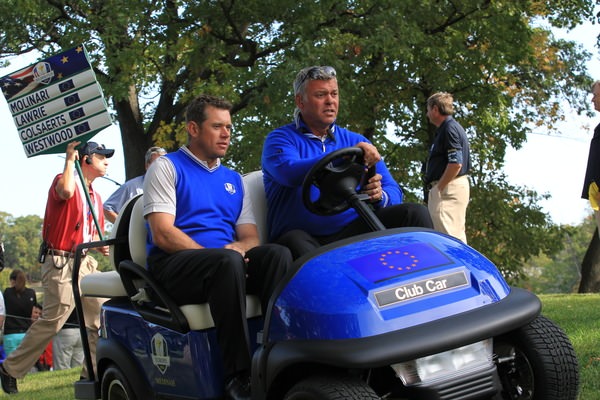
Meanwhile, Fleet Street has been quick to declare Darren Clarke the overwhelming favorite for the 2016 captaincy decision early next year, but Brian Keogh files one of those columns that we'll look to in a few years if a Clarke captaincy turns out to be a mess. Asking the "real Darren Clarke to please stand up," Keogh writes:

Few golfers have shown as many personas to the world as Clarke - genial and fun-loving one moment, laughing and smiling with cigar in hand as the people’s favourite, only to be transformed into a walking volcano for the waiting press, a brooding presence whose mood varied depending on his score.

So who’s he real Darren Clarke? The bleach blonde amateur in the two-tone golf shoes? The cigar-chomping, beer drinking lad with the gut, beloved of the lads down at the pub? The widower, the hard-worker or the hothead? Or the thin, white-haired Duke of our TV screens during the recent Ryder Cup?

Keogh goes on to detail Clarke's revisionist take on former buddy Paul McGinley and what that says about Clarke.
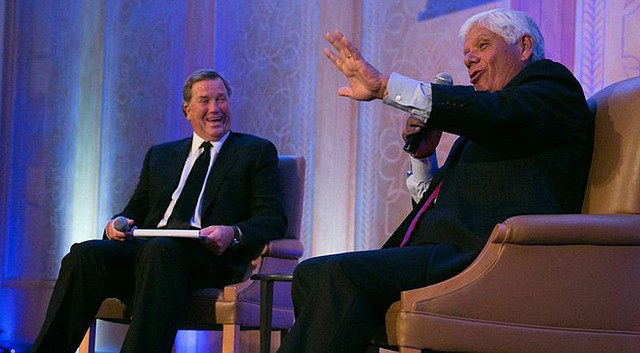
Trevino: "Somehow we've got to get the caddie ranks back"

Golfweek's Adam Schupak attended the Western Golf Association's 4th annual Green Coat Gala and reports that former caddies turned stewards of the game look back at their looping days with increasing fondness.

This year Mike Keiser, Lee Trevino and Peter Jacobsen represented the past-caddie ranks, while Michigan State junior Jacob Mosley talked on behalf of the 870 students currently on Evans Scholarships.

For years, the caddie yard was the academy from which the likes of Trevino, Lee Elder, and 1985 Western Open champ Jim Thorpe graduated as professional golfers. Changing social patterns, and the golf cart, eliminated many of the caddie shacks making Trevino one of the last celebrated alumni of that hard school.

"Somehow we've got to get the caddie ranks back," Trevino said.

While We Were Sleeping Files: 76 World Class Players Took A Really Long Time To Play Golf Saturday

Reduced field sizes are always declared the only cure for PGA Tour slow play, which, according to Daniel Hicks of APF, hit a new low for Saturday's third round of the WGC-HSBC Champions when the 76-player field featuring a sizeable portion of the world top 100 golfers, took 5 1/2 hours to play.

There were complicating factors: high, wet rough, split tee threesomes and reachable fours and fives for everyone because the ball goes too far. Still, just 76 players. 76! And they aren't looking for lost balls.

The leader at the time, Graeme McDowell, called the situation "ridiculous."

"We've got threeballs, a lot of people out there and a couple of driveable par fours and a couple of two-shot par fives. Just a slow golf course. A long day," said McDowell, the 2010 US Open champion.

Ryder Cup star Poulter was less diplomatic in his assessment of the day after a level-par 72 left him four behind McDowell.

"There's no excuses. We need to be pressing and making sure people are keeping up to pace," Poulter told AFP.

"Five and a half hours is too long to play golf. End of story."

Bubba Watson suggested what he always does: penalizing players. Silly him!

"You have to penalise people," he told reporters after the first three rounds at the Phoenix Open earlier this year took well in excess of five hours.

"Give them a stroke (penalty). It could cause you to win or lose. I think strokes is the only way to do it."

Neither McDowell or Poulter took to Twitter to gripe, perhaps knowing they'd be fined for pointing out the obvious.